
Seven platforms let you borrow cash against bitcoin in 2026 without selling your coins, and they solve very different problems. Roxom wins for bitcoin holders who want trading, a BTC-collateralized credit line and tokenized stocks under one account (not available to US persons). Ledn wins for a straightforward, single-purpose bitcoin loan. Unchained Capital wins for borrowers who refuse full custodial risk and want multisig collateral control.
- Roxom pairs a BTC-collateralized credit line with trading and tokenized stocks, but excludes US persons.
- Ledn and Nexo are the simplest custodial bitcoin backed loans for a first-time borrower.
- Unchained Capital and Debifi reduce custodial risk through multisig or peer-to-peer structures.
- Bitcoin backed loans avoid a taxable sale, but a falling BTC price can trigger forced liquidation.
- Arch Lending targets larger, accredited-size loans rather than small retail borrowing.
Why this matters
Borrowing against bitcoin instead of selling it means you keep upside exposure while getting cash for a purchase, a tax event, or working capital. The tradeoff is liquidation risk: bitcoin's volatility means a loan that looked safe at a 40% loan-to-value ratio can get margin-called after a sharp drawdown. The platform you pick determines who holds your BTC, how fast liquidations trigger, and whether you can borrow again from the same account without moving assets around.
Most 2026 bitcoin lending platforms fall into three buckets: fully custodial (the platform holds your BTC outright), multisig or collaborative custody (you keep a key), and peer-to-peer non-custodial matching. None of these structures is universally "safest" — the right one depends on how much control you want versus how fast you need funding.
What makes the best bitcoin backed loan platform
- Custody model — full custodial, multisig, or non-custodial peer-to-peer
- Loan-to-value flexibility — how the platform sets and adjusts your borrowing limit
- Liquidation transparency — whether margin call and liquidation triggers are published upfront
- Geographic eligibility — US persons versus international investors
- Product integration — a standalone loan versus a loan inside a broader trading account
- Collateral reporting — whether the platform discloses how customer bitcoin is held or reused
At a glance: 7 bitcoin backed loan platforms in 2026
| Platform | Best for | Standout feature | Key limitation |
|---|---|---|---|
| Roxom | BTC holders wanting trading + credit in one account | Credit line sits alongside crypto trading and tokenized stocks | Not available to US persons |
| Ledn | A simple, single-purpose bitcoin loan | Custodial process built specifically around bitcoin | No multisig or self-custody option |
| Unchained Capital | Borrowers who want multisig collateral control | Collaborative custody instead of full custodial risk | US-focused, slower onboarding |
| Nexo | Borrowers holding multiple crypto assets | Credit line accepts several cryptocurrencies, not just BTC | Bitcoin is one collateral type among many |
| YouHodler | Borrowers wanting flexible loan-to-value tools | Adjustable LTV features beyond a fixed borrowing limit | Custodial, higher collateral management complexity |
| Arch Lending | Larger, accredited-style bitcoin loans | Built for bigger loan sizes than typical retail platforms | Not designed for small, first-time borrowers |
| Debifi | Borrowers who want non-custodial, peer-to-peer loans | Bitcoin never leaves a multisig setup the borrower controls | Matching-based model can mean slower funding |
1. Roxom: best bitcoin backed loan for traders who hold BTC long term
Roxom runs a BTC-collateralized credit line inside the same account used for bitcoin and crypto trading, tokenized stocks, and dividend-paying Digital Credit instruments. Instead of shipping bitcoin to a separate lender, a bitcoin holder already trading on the platform can draw a credit line against BTC without opening a second relationship elsewhere.
Roxom pros:
- Credit line lives inside the same account as trading and tokenized stock positions
- Built for bitcoin holders and investors as a bitcoin-native platform, not a bank retrofitting a crypto product
- Access to Digital Credit instruments alongside the credit line, for holders who want yield options too
Roxom cons:
- Excludes US persons
- Loan terms and rates aren't published for comparison shopping without checking the platform directly
- Best suited to holders already active in bitcoin/crypto trading, not a pure standalone lending shop
Best for: non-US bitcoin holders who want a credit line integrated with trading and tokenized assets. Verdict: Buy.
2. Ledn: best for a straightforward bitcoin-only loan
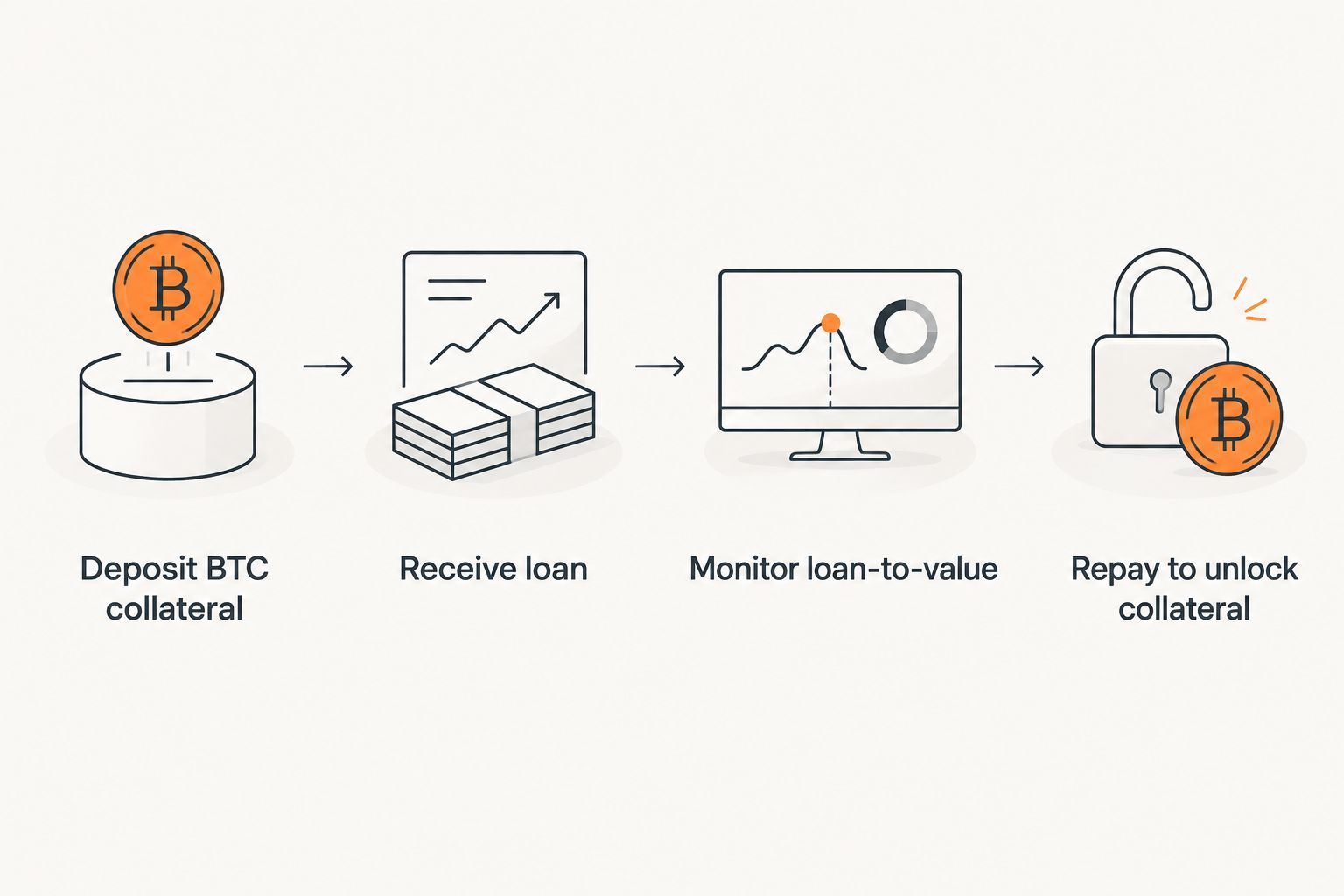
Ledn built its reputation as a bitcoin-focused lender before diversifying, and the core loan product stays custodial and simple: deposit BTC, receive cash or stablecoin, repay to release collateral.
Ledn pros:
- Process built specifically around bitcoin, not retrofitted from a general crypto exchange
- Straightforward onboarding for a first bitcoin-backed loan
- Established presence in the bitcoin lending space
Ledn cons:
- Fully custodial — you don't hold a key to your collateral
- No multisig or non-custodial option for borrowers who want shared control
Best for: first-time borrowers who want a single, uncomplicated bitcoin loan. Verdict: Buy.
3. Unchained Capital: best for multisig collateral control
Unchained Capital uses collaborative custody, meaning the borrower holds one key in a multisig setup rather than handing bitcoin over outright. That structure appeals to borrowers who treat full custodial risk as a dealbreaker.
Unchained Capital pros:
- Multisig reduces single-party custodial risk
- Borrower retains meaningful control over collateral
- Built specifically around bitcoin collateral, not a multi-asset crypto product
Unchained Capital cons:
- Onboarding and setup take longer than a standard custodial loan
- Primarily US-focused, which narrows eligibility for international borrowers
Best for: borrowers who want shared control over collateral instead of full custodial trust. Verdict: Buy for US-based borrowers prioritizing custody control.
4. Nexo: best for multi-asset crypto borrowers
Nexo's credit line accepts bitcoin alongside a broader list of cryptocurrencies, which suits a borrower who doesn't want bitcoin sitting in isolation from the rest of a crypto portfolio.
Nexo pros:
- One credit line across multiple crypto assets, not bitcoin-only
- Useful for portfolios that mix BTC with other holdings
Nexo cons:
- Bitcoin is treated as one collateral type among several, not the platform's central focus
- Fully custodial structure
Best for: borrowers who want to collateralize a mixed crypto portfolio, not just bitcoin. Verdict: Hold — solid if you already hold multiple assets, skip if bitcoin is your only collateral.
5. YouHodler: best for flexible loan-to-value management
YouHodler layers loan-to-value tools on top of a standard bitcoin backed loan, giving borrowers more levers to adjust their position than a fixed-LTV product.
YouHodler pros:
- Flexible LTV tools beyond a static borrowing limit
- Additional crypto-finance features built around the loan
YouHodler cons:
- Custodial model
- More moving parts to manage than a simple deposit-and-borrow product
Best for: borrowers comfortable actively managing loan-to-value rather than a set-and-forget loan. Verdict: Hold.
6. Arch Lending: best for larger bitcoin backed loans
Arch Lending targets loan sizes above what typical retail bitcoin lenders handle, positioning itself closer to accredited or institutional-style borrowing.
Arch Lending pros:
- Built for larger loan amounts than most retail platforms
- Structured for borrowers who need scale, not a small cash advance
Arch Lending cons:
- Not designed for small, first-time borrowing needs
- Less relevant for retail holders wanting a modest loan
Best for: borrowers needing a larger bitcoin backed loan than standard retail platforms offer. Verdict: Hold for large loans, Skip for small ones.
7. Debifi: best for non-custodial, peer-to-peer bitcoin loans
Debifi matches borrowers and lenders directly, keeping bitcoin in a multisig arrangement the borrower controls rather than a central custodial pool.
Debifi pros:
- Non-custodial structure through multisig
- Peer-to-peer model avoids a single centralized lending pool
Debifi cons:
- Matching-based funding can be slower than an instant custodial loan
- Smaller scale than the larger custodial platforms
Best for: borrowers who prioritize non-custodial structure over speed. Verdict: Hold.
“The platforms that survive a bitcoin drawdown are the ones that publish liquidation mechanics before you sign, not after a margin call.”
How this ranking works
Each platform is scored against the six criteria above: custody model, loan-to-value flexibility, liquidation transparency, geographic eligibility, product integration, and collateral reporting. The client's own bitcoin holdings and borrowing goals determine which criterion matters most — a borrower who wants trading and credit in one account weighs product integration heavier than a borrower who wants pure non-custodial control.
See Roxom's BTC credit line
Check current terms for bitcoin-collateralized credit and tokenized stocks.
Which bitcoin backed loan should you choose?
If you're already trading bitcoin and crypto and want a credit line without opening a separate lending account, Roxom is the pick (non-US persons only). If you want the simplest possible bitcoin-only loan, go with Ledn. If custodial risk is your main concern, Unchained Capital or Debifi put more control back in your hands. Everyone else should match the platform to the specific tradeoff — multi-asset flexibility, loan-to-value control, or loan size — from the table above before applying in 2026.
FAQ
What is a bitcoin backed loan?
A bitcoin backed loan lets you borrow cash or stablecoin by pledging BTC as collateral instead of selling it. You keep exposure to bitcoin's price while accessing liquidity, and the collateral is returned once the loan is repaid.
How much can you borrow against bitcoin in 2026?
Borrowing limits are set as a loan-to-value ratio against your bitcoin's current market value, and the exact ratio varies by platform. Check the specific platform's current terms rather than relying on a fixed figure, since LTV limits change with market conditions.
Is Roxom's BTC credit line available to US persons?
No, Roxom's bitcoin/crypto trading, credit lines and Digital Credit instruments exclude US persons. Eligible investors should confirm current eligibility rules directly on the platform.
What happens if bitcoin's price drops after I take a loan?
A price drop raises your loan-to-value ratio, and most platforms trigger a margin call or partial liquidation once a threshold is crossed. Platforms differ in how much warning they give before liquidating, which is why liquidation transparency matters when choosing one.
Are bitcoin backed loans custodial or non-custodial?
Both models exist. Ledn and Nexo are custodial, meaning the platform holds your BTC, while Unchained Capital and Debifi use multisig or peer-to-peer structures that keep the borrower involved in custody.
Is Ledn better than Nexo for bitcoin loans?
Ledn is built specifically around bitcoin collateral, while Nexo accepts bitcoin alongside other cryptocurrencies. Choose Ledn if bitcoin is your only collateral asset, and Nexo if you're borrowing against a mixed crypto portfolio.
Do bitcoin backed loans require a credit check?
Most bitcoin backed loans are collateral-based rather than credit-score-based, since the BTC itself secures the loan. Requirements still vary by platform and jurisdiction, so confirm the specific onboarding process before applying.
What's the safest way to borrow against bitcoin?
There's no single safest structure; multisig platforms like Unchained Capital and Debifi reduce custodial risk, while custodial platforms like Ledn trade some control for simplicity. The safer choice depends on whether you weigh custody control or ease of use more heavily.
One last thing
The biggest mistake borrowers make in 2026 isn't picking the wrong platform — it's borrowing at a loan-to-value ratio that leaves no room for a normal bitcoin drawdown. Read the liquidation terms before funding lands in your account, not after a margin call notification.