
Best overall: WhaleWisdom for comparing reported hedge fund stock holdings. Best for verifying a filing: SEC EDGAR. Best for browsing a curated set of investors: Dataroma. Roxom is a trading platform for eligible non-U.S. investors, not a hedge fund stock holdings tracker.
- WhaleWisdom is the best hedge fund stock holdings tracker for comparing managers and reported positions.
- SEC EDGAR is the source to verify a holding against the manager’s original 13F filing.
- Dataroma is best for browsing a curated set of investors, not for checking every filer.
- Roxom offers tokenized-stock trading to eligible non-U.S. investors; it does not replace a 13F tracker.
Why this matters
A tracker shows what an investment manager reported holding, not what the manager owns right now. Form 13F is generally due within 45 days after each calendar quarter ends. A position dated March 31, 2026, can therefore appear in a filing weeks after the quarter closes. By the time you see it, the manager can have changed the position.
That delay determines how to use these tools in 2026. Start with a tracker to find a manager or security, then open the original filing before treating a position as evidence. If you want to trade a related idea, make that a separate decision. None of these steps turns a historical disclosure into a live trading signal.
What makes the best hedge fund stock holdings tracker
- Filing coverage: Decide whether you need access to the full set of public 13F filings or a selected group of investors.
- Source verification: You should be able to check a reported position against the original filing, including amendments.
- Manager search: Finding the right filing entity matters more than recognizing a fund’s public-facing name.
- Position context: A holding is more useful when you can identify its reporting date and compare it with earlier disclosures.
- Decision fit: Researching a manager, verifying a filing and placing a trade are different jobs. Pick the tool for the job in front of you.
At a glance: which option fits your task?
| Option | Best for | Standout feature | Key limitation |
|---|---|---|---|
| WhaleWisdom | Comparing reported managers and positions | Aggregated 13F research | Aggregated data still needs filing-level verification |
| SEC EDGAR | Checking an original disclosure | Direct access to public filings | You must interpret filings yourself |
| Dataroma | Browsing a curated investor set | Investor-focused portfolio views | Its selected investors are not every 13F filer |
| Roxom | Acting on a separate tokenized-stock idea | Trading access for eligible non-U.S. investors | Not a 13F tracker; U.S. persons are excluded |
The first 3 options answer questions about disclosed holdings. Roxom addresses a different question: whether an eligible investor wants to trade a tokenized stock after doing that research. Keep that distinction intact when comparing them.
1. WhaleWisdom: best hedge fund stock holdings tracker for comparisons
WhaleWisdom organizes public 13F information around investment managers and their reported holdings. It is the most direct starting point here when your question is which managers reported a stock or how a manager’s disclosed portfolio changed between reporting periods. Its value is comparison, not confirmation that a position remains open today.
In 2026, use WhaleWisdom to narrow a research question before reading the underlying disclosure. Check the filing date, the reporting period and the filing entity. A familiar fund name alone does not tell you which legal entity submitted the report.
WhaleWisdom pros:
- Puts manager and holdings research in one place.
- Makes comparisons easier than opening filings one by one.
- Helps you move from a stock idea to the managers that reported it.
WhaleWisdom cons:
- Its displayed holdings inherit the delay of the underlying 13F filings.
- An aggregated view is not a substitute for checking an amendment or the original filing.
- Reported positions do not reveal a manager’s complete portfolio or current exposure.
Best for: Investors who need a practical first pass across reported 13F holdings.
Verdict: Buy WhaleWisdom as your starting research tool if comparing managers is your main task. Verify any position you intend to rely on in SEC EDGAR.
2. SEC EDGAR: best for verifying a hedge fund filing
SEC EDGAR is the public filing system behind this research. Look for the manager’s Form 13F-HR and check for a 13F-HR/A amendment before relying on a position. The information table identifies securities and reported share or principal amounts; it does not tell you the manager’s present-day trade plan.
EDGAR wins when accuracy of attribution matters. A tracker can help you discover a holding, but the filing lets you inspect what the reporting manager submitted. In 2026, that is the right final check before you cite a manager’s disclosed position in a report or use it to frame further research.
SEC EDGAR pros:
- Provides the original public filing rather than a third-party summary.
- Lets you inspect filing dates, reporting periods and amendments.
- Shows the reporting entity named on the disclosure.
SEC EDGAR cons:
- Research across many managers takes more manual work.
- A filing still describes a past reporting date, not a live portfolio.
- You must read the information table and any amendment carefully.
Best for: Anyone who needs to verify a specific claim about a manager’s reported holdings.
Verdict: Buy SEC EDGAR as your verification step, even if you start your search elsewhere. The original disclosure is the check on every tracker in this list.
3. Dataroma: best for browsing selected investors
Dataroma presents portfolio information for a curated set of investors. It suits a reader who wants to explore recognizable investment managers and move between their reported holdings without beginning with a filing search. The trade-off is scope: a selected investor set cannot answer whether every reporting manager held a security.
Treat a Dataroma portfolio as a research lead in 2026. Note the reporting period, identify the filing manager and confirm a consequential holding in EDGAR. If your question starts with a particular investor, Dataroma is a cleaner fit than a broad search. If your question starts with all filers of a particular stock, choose broader 13F research instead.
Dataroma pros:
- Keeps the browsing task focused on selected investors.
- Makes it straightforward to explore a manager’s reported portfolio.
- Gives you a useful starting point for investor-led research.
Dataroma cons:
- Does not represent the complete universe of 13F filers.
- Its holdings remain subject to the underlying filing delay.
- A curated portfolio view does not verify what the manager holds today.
Best for: Readers following investors already included in Dataroma’s selection.
Verdict: Buy Dataroma for investor-led browsing. Skip it as your sole source when the question requires coverage of all reporting managers.
4. Roxom: best for a separate tokenized-stock trading decision
Roxom is a bitcoin-native platform offering bitcoin and crypto trading, BTC-collateralized credit lines, tokenized stocks and dividend-paying Digital Credit instruments. It serves eligible non-U.S. investors; U.S. persons are excluded. Roxom is not the best hedge fund stock holdings tracker because tracking 13F filings is not its stated job.
It belongs in this comparison only at the point where research becomes a distinct trading decision. Finding a stock in a manager’s filing does not establish that a corresponding tokenized stock is offered, that its terms match the listed share, or that following the manager makes sense. Check the instrument and its current terms before acting. Do not treat a tokenized stock and a reported U.S. equity holding as interchangeable without that check.
Roxom pros:
- Gives eligible non-U.S. investors a platform for tokenized-stock trading.
- Also covers bitcoin and crypto trading for readers whose research spans those markets.
- Separates the execution choice from the filing-research tools above.
Roxom cons:
- Does not replace a 13F search or the original SEC filing.
- Excludes U.S. persons.
- Its stated offering alone does not establish that any stock found in a filing has a matching tokenized instrument.
Best for: Eligible non-U.S. investors making an independent tokenized-stock trading decision after researching an idea.
Verdict: Hold Roxom as a separate trading option. Use WhaleWisdom or EDGAR for the holdings question first; consider Roxom only if its available instruments and terms fit your own decision.
How to read a 13F without mistaking it for a live portfolio
A 13F can support a narrow, useful statement: a reporting manager disclosed a reportable position for a particular quarter-end. It cannot, by itself, establish when the manager bought the position, whether the manager still holds it, or how the position fits alongside exposures the form does not show.
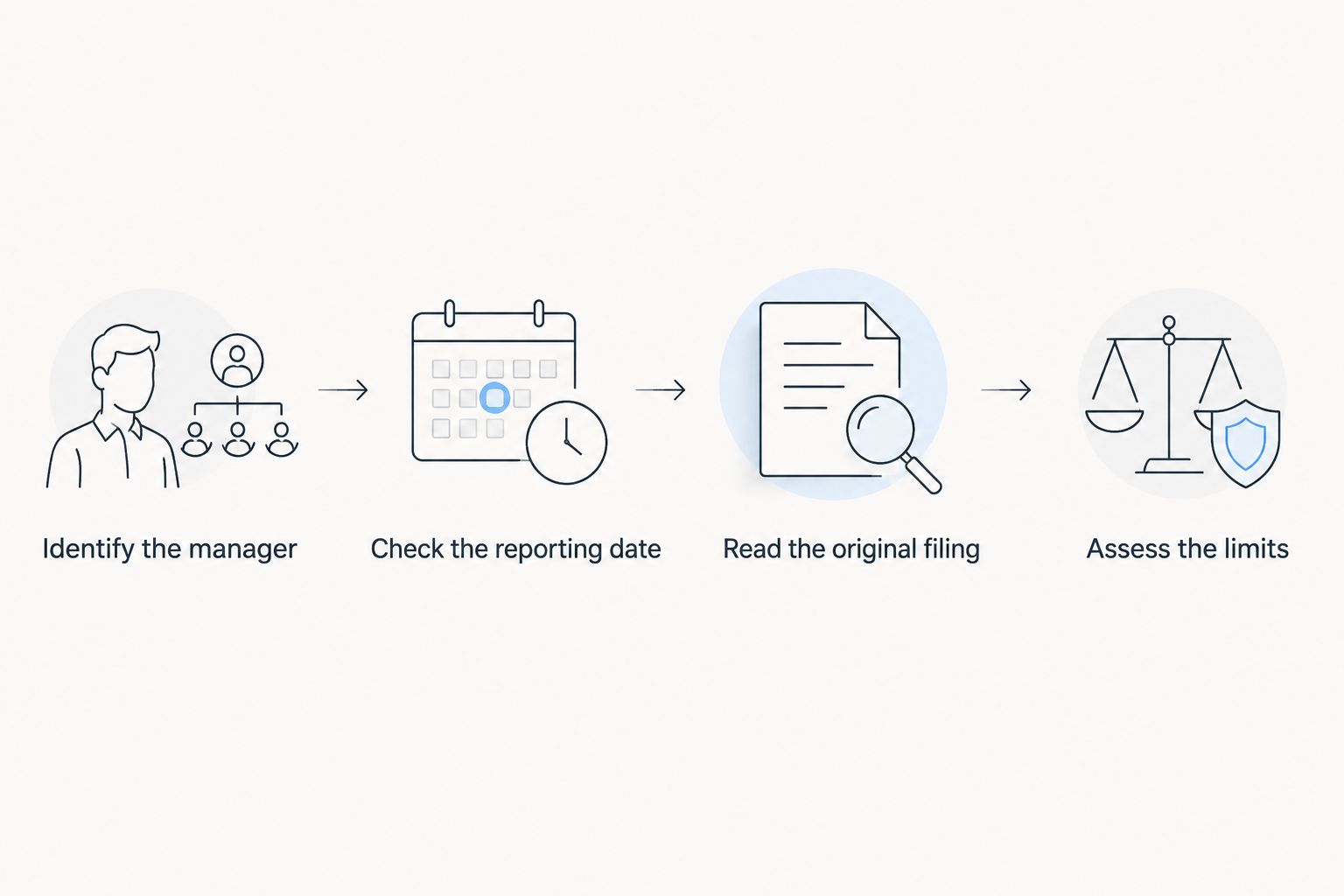
Follow this sequence when a 2026 tracker result catches your attention:
- Identify the manager. Match the tracker’s name to the entity on the filing. Do not assume similarly named entities submitted the same portfolio.
- Check the reporting date. Separate the quarter-end date from the later date when the filing became public.
- Read the original filing. Find the security in its information table and check for amendments before repeating the holding claim.
- Assess the limits. Form 13F covers specified reportable securities. It is not a complete account of every investment, short position or hedge.
The reporting threshold matters too. Form 13F applies to institutional investment managers that meet its reporting requirements, including the threshold tied to $100 million in qualifying securities. A missing manager is not proof that the manager owns no stocks. Likewise, a missing security is not proof that a manager has no economic exposure to it. Keep your claim as narrow as the disclosure.
Options shown on a 13F need their own care. A reported put or call is not equivalent to owning the underlying shares, and the form does not give you the full context for a manager’s hedges. If your thesis depends on the direction or size of a manager’s total bet, a holdings table alone cannot settle it.
How we ranked these options
The order follows the research task in the criteria above. WhaleWisdom wins for comparing disclosed holdings across managers. SEC EDGAR follows because it verifies the underlying filing, while Dataroma serves a narrower, investor-led browsing task. Roxom ranks last for the tracker query because it is a trading platform, not a stated source of 13F tracking.
No option earns credit here for making old disclosures look current. A useful tracker makes the reporting period clear and gives you a path to verify a claim. A useful trading platform answers a different question. Keeping those standards separate is more valuable than putting every finance product on the same feature checklist.
Which hedge fund stock holdings tracker should you choose?
Choose WhaleWisdom if you have not yet settled on a manager or stock. It is the default for comparing reported holdings. Choose SEC EDGAR when you already have a specific holding claim to verify, and choose Dataroma when you want to browse its selected investors. These are complementary research paths, not competing sources of live positions.
If a disclosed stock leads you toward a trade, pause at the boundary between research and execution. The 13F tells you what a manager reported for a past date; it does not recommend your next order. For eligible non-U.S. investors, Roxom is a separate place to assess a tokenized-stock trading idea, subject to the instruments and terms available on the platform.
FAQ
What is the best hedge fund stock holdings tracker in 2026?
WhaleWisdom is the best starting point for comparing managers and their reported 13F holdings. Verify a specific position against the original filing in SEC EDGAR.
Can I see a hedge fund’s stock holdings in real time?
No, Form 13F does not show holdings in real time. It reports positions for a past quarter-end and is generally due within 45 days after that quarter ends.
Is SEC EDGAR better than WhaleWisdom?
SEC EDGAR is better for checking what a manager actually filed; WhaleWisdom is better for starting a comparison across reported holdings. Use both when a holding matters to your decision.
Does a 13F show every investment a hedge fund owns?
No, a 13F covers specified reportable securities rather than every investment or hedge. Do not treat its information table as a complete portfolio.
Is Dataroma a complete list of hedge fund filings?
No, Dataroma focuses on a selected set of investors. Use broader 13F research or SEC EDGAR if you need to look beyond that selection.
Is Roxom a hedge fund stock holdings tracker?
No, Roxom is a bitcoin-native trading platform that offers tokenized stocks to eligible non-U.S. investors. Use a 13F research tool to investigate reported manager holdings before making a separate trading decision.
Why is a stock missing from a manager’s 13F?
A missing stock does not, by itself, prove the manager had no exposure to it. The form covers specified reportable securities and does not describe every position or hedge.
One last thing
The most useful detail in a 2026 holdings result is often the quarter-end date, not the size of the position. Read that date before you read a manager’s supposed conviction: the filing establishes a historical disclosure, and the next trade is yours to assess.