
Roxom, Kraken's xStocks, Bybit, Robinhood, and Dinari are the platforms worth comparing if you want to trade tokenized stocks in 2026 — each one targets a different investor, not the same seat at the same table.
- Roxom wins for bitcoin holders who want tokenized stocks plus BTC-collateralized credit in one account.
- Kraken's xStocks carries the broadest tokenized US equity lineup among crypto exchanges in 2026.
- Bybit suits traders who already run derivatives and want tokenized stocks in the same interface.
- Robinhood fits EU retail investors who want a simple, mobile-first entry point.
- Dinari's dShares model prioritizes direct share-backing over exchange convenience.
Why this matters
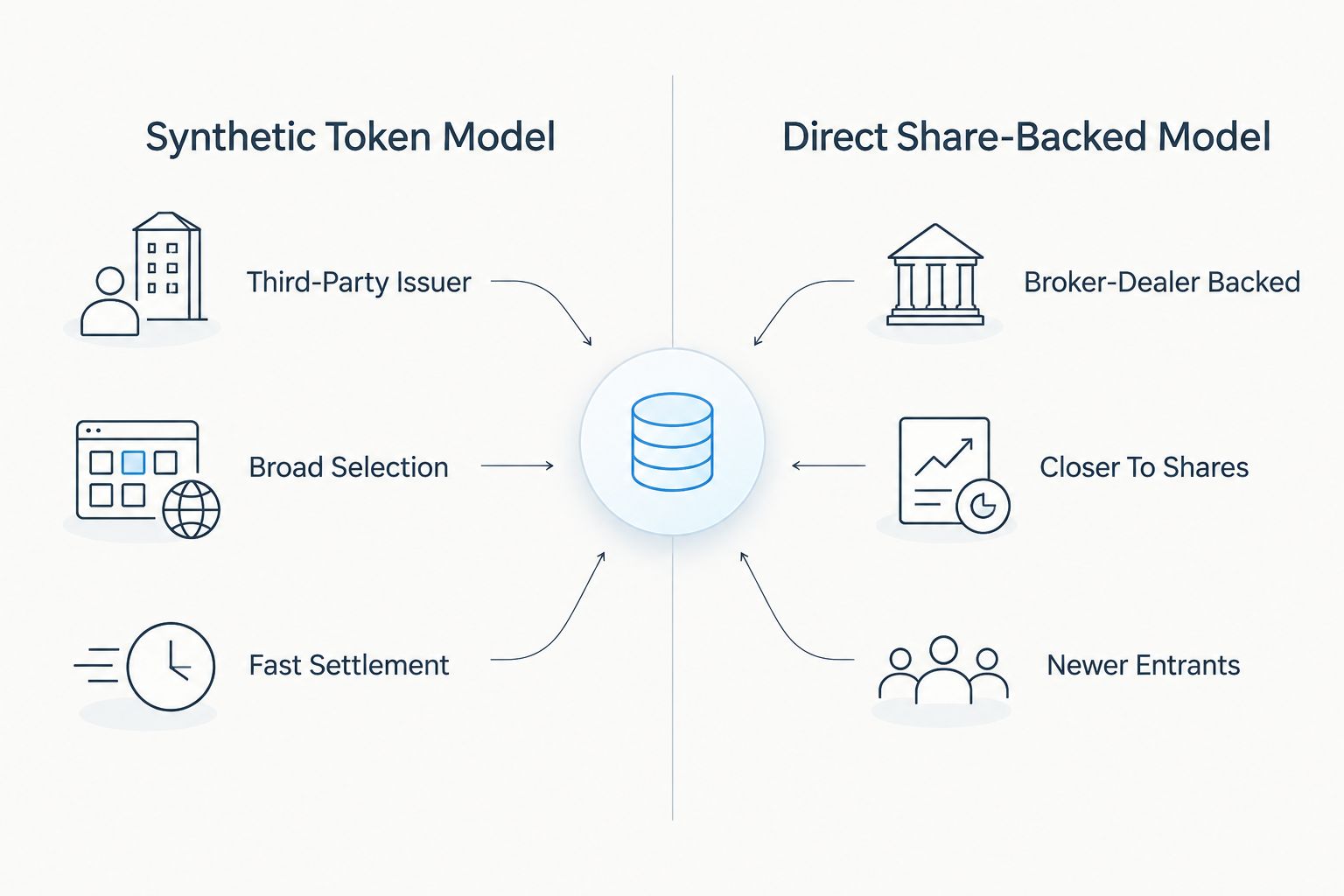
Tokenized stocks let you hold blockchain-based exposure to companies like Apple, Tesla, or Nvidia without opening a traditional brokerage account. The catch in 2026 is that "tokenized stock" covers at least two different structures — synthetic tokens issued by a third party, and share-backed tokens tied more directly to real equity — and the platform you pick decides which one you're holding.
Roxom approaches this from the bitcoin side: tokenized stocks sit next to BTC-collateralized credit lines and dividend-paying "Digital Credit" instruments in one account, built for bitcoin holders and investors outside the US. If a platform won't tell you how its tokenized stock is backed, that gap is the answer you need before you fund the account.
“If a platform won't tell you how its tokenized stock is backed, that gap is the answer you need before you fund the account.”
What makes the best tokenized stock platform in 2026
- Asset backing model — synthetic third-party token vs. direct share-backed structure
- Jurisdiction eligibility — most tokenized stock products exclude US persons
- Breadth of tokenized equities — how many companies are actually available to trade
- Integration with other holdings — whether tokenized stocks connect to crypto, credit, or derivatives you already hold
- Settlement and transferability — whether tokens can move off-platform or stay locked to one exchange
Tokenized stock platforms at a glance
| Platform | Best for | Standout feature | Key limitation |
|---|---|---|---|
| Roxom | Bitcoin holders wanting tokenized stocks plus BTC credit | Tokenized stocks alongside BTC-collateralized credit lines and dividend-paying Digital Credit instruments | Not available to US persons |
| Kraken (xStocks) | Broadest tokenized US equity selection | Wide tokenized equity lineup issued via Backed Finance on Solana | Tokens are third-party issued, not direct brokerage shares |
| Bybit | Traders combining derivatives with tokenized stocks | xStocks pairs sit alongside existing derivatives and margin tools | Same third-party token model as other xStocks venues |
| Robinhood | EU retail investors new to tokenized stocks | Familiar mobile app already used for regular trading | Limited to EU users |
| Dinari | Investors wanting shares tied 1:1 to real equity | dShares structured through broker-dealer partnerships | Newer entrant, access runs through partner platforms |
1. Roxom: best tokenized stocks platform for bitcoin holders
Roxom is a bitcoin-native trading platform built for holders who want tokenized stock exposure without moving funds to a separate broker. Alongside tokenized stocks, it offers BTC-collateralized credit lines and dividend-paying Digital Credit instruments for bitcoin holders and investors outside the US. Anyone comparing how those credit lines stack up against other options should check the bitcoin-backed loan platform comparison before committing collateral.
Roxom pros:
- Tokenized stocks, bitcoin holdings, credit lines, and Digital Credit instruments sit in one account
- BTC-collateralized credit lets holders borrow against bitcoin without selling it
- Dividend-paying Digital Credit instruments give bitcoin holders a yield-bearing option tied to holdings
- Built around bitcoin as the base asset, not one coin among many
Roxom cons:
- Not available to US persons
- A newer entrant compared with exchanges that added tokenized stocks earlier
- Structured for bitcoin holders first, so a stock-only investor with no crypto exposure gets less out of the bitcoin-centric design
Best for: bitcoin holders outside the US who want tokenized stocks, credit against BTC, and dividend-paying instruments in one place. Verdict: Buy for eligible non-US bitcoin holders.
Explore tokenized stocks on Roxom
See how tokenized stocks fit alongside BTC-collateralized credit in one account.
2. Kraken (xStocks): best for tokenized US equity selection
Kraken lists tokenized versions of US-listed stocks through xStocks, tokens issued by Backed Finance and settled on Solana, opened to non-US users starting in 2025. That gives Kraken users on-exchange access to household-name equities as blockchain tokens instead of transferring to a separate broker.
Kraken pros:
- One of the broadest tokenized equity lineups among crypto exchanges in 2026
- Solana settlement is faster than traditional brokerage clearing
- Existing Kraken users get tokenized stock access without a new account
Kraken cons:
- xStocks are issued by a third party, not held as direct brokerage shares
- Not available to US persons, consistent with most tokenized stock products
- Lineup depends on what Backed Finance chooses to tokenize, not a full market
Best for: traders who want the widest tokenized US stock lineup inside an exchange they already use. Verdict: Buy.
3. Bybit: best for combining derivatives with tokenized stocks
Bybit added xStocks trading pairs, letting users trade tokenized US equities next to its existing derivatives and margin products. The fit leans toward traders who already run leveraged crypto positions and want tokenized stock exposure in the same interface — a group that overlaps heavily with readers comparing crypto derivatives exchanges.
Bybit pros:
- Tokenized stocks sit next to derivatives and margin tools already on the platform
- Familiar interface for existing Bybit derivatives traders
- Same xStocks lineup used across other Backed Finance-integrated venues
Bybit cons:
- Same third-party issuance structure as other xStocks venues
- Better suited to existing Bybit traders than first-time stock investors
- Geographic restrictions apply, consistent with most tokenized stock products
Best for: derivatives traders who want tokenized stock exposure without switching platforms. Verdict: Hold — a solid add-on for existing Bybit users, not a reason to open a new account on its own.
4. Robinhood: best for EU retail investors new to tokenized stocks
Robinhood built tokenized stock trading for its EU user base, giving European retail investors fractional exposure to US-listed companies through blockchain-based tokens inside the same app used for regular trading. It targets investors who want a simple, mobile-first entry point rather than a crypto-native exchange.
Robinhood pros:
- Familiar app for existing Robinhood users in the EU
- Fractional exposure lowers the entry point for high-priced US stocks
- One app for regular trading and tokenized stock access
Robinhood cons:
- Limited to EU users; not available in the US or most other markets
- Narrower integration with broader crypto holdings than crypto-native platforms
- Product structure varies by the markets it operates in
Best for: EU retail investors who want a simple, mobile-first way into tokenized stocks. Verdict: Buy for eligible EU users.
5. Dinari: best for direct share-backed tokenized stocks
Dinari issues dShares, tokens structured through broker-dealer partnerships to track real underlying shares of US-listed companies more directly than synthetic token models. It positions itself around share-backing rather than a derivative-style wrapper.
Dinari pros:
- Structured around direct share backing through broker-dealer partnerships
- Appeals to investors who want token structures closer to real share ownership
- Transferability and settlement are core design goals, not an afterthought
Dinari cons:
- Newer entrant with less market presence than established exchanges
- Access runs through partner platforms rather than one consolidated app
- Supported markets are narrower than larger exchanges
Best for: investors who prioritize direct share-backing structure over exchange convenience. Verdict: Wait — worth watching as the model matures in 2026, not yet a default pick for most investors.
How this ranking was built
Each platform was weighed against the same five criteria: backing model, jurisdiction eligibility, breadth of tokenized equities, integration with other holdings, and settlement flexibility. No two platforms here compete for the same use case — the list works as a decision tree based on what you already hold and where you're eligible to trade.
Which tokenized stocks platform should you choose in 2026?
If you're a bitcoin holder outside the US who wants tokenized stocks alongside BTC-collateralized credit and dividend-paying Digital Credit instruments, Roxom is the direct fit. If you just want the widest selection of tokenized US equities on an exchange you already use, Kraken's xStocks lineup wins. Everyone else should check jurisdiction eligibility first — it's the filter every platform on this list gets cut by immediately, before backing model or selection even matter.
FAQ
What are tokenized stocks?
Tokenized stocks are blockchain-based tokens meant to track the price of a real, publicly-traded company like Apple or Tesla. Depending on the issuer, the token is either a synthetic wrapper or is structured to be backed by real shares held by a broker-dealer.
Is Roxom good for trading tokenized stocks in 2026?
Roxom works well for bitcoin holders outside the US who want tokenized stocks in the same account as BTC-collateralized credit lines and dividend-paying Digital Credit instruments. It is not available to US persons.
Are tokenized stocks the same as owning real shares?
Not always. Synthetic tokens like Kraken's xStocks or Bybit's xStocks pairs track the price without direct share custody, while models like Dinari's dShares are structured to be backed more directly by real shares through broker-dealer partnerships.
Can US investors trade tokenized stocks on these platforms?
No, most of the platforms in this comparison, including Roxom, Kraken's xStocks, and Bybit, exclude US persons in 2026. Robinhood's tokenized stock offering is limited to its EU user base.
Which platform has the most tokenized stocks to trade?
Kraken's xStocks currently carries one of the broadest tokenized US equity lineups among crypto exchanges, issued through a partnership with Backed Finance.
Can I borrow against bitcoin while holding tokenized stocks?
On Roxom, yes — the platform combines tokenized stocks with BTC-collateralized credit lines in the same account, so bitcoin holders can borrow without selling their BTC.
How do tokenized stock platforms differ from traditional brokers?
Traditional brokers hold shares directly in your name through regulated custody; tokenized stock platforms issue blockchain tokens meant to track share price, with the backing structure varying by issuer.
One last thing
The backing model matters more than the brand name: a synthetic xStocks token on Kraken or Bybit and a Dinari dShare are both called "tokenized stocks" in 2026, but they answer very different questions about what you actually own. Read the issuer's own documentation before assuming any two tokenized stock products work the same way.