
Roxom, Deribit, Binance, Bybit, OKX and dYdX cover six different ways to trade crypto derivatives in 2026, and none of them is the right answer for every trader. Best for bitcoin holders who want leverage without selling BTC: Roxom. Best for options depth: Deribit. Best for raw liquidity across altcoin perpetuals: Binance. Best for copy trading: Bybit. Best for unified multi-asset margin: OKX. Best for non-custodial perpetuals: dYdX.
- The best crypto derivatives exchange in 2026 depends on custody preference, not just fees or leverage caps.
- Roxom fits bitcoin holders who want BTC-backed credit lines and tokenized stocks instead of a straight perpetual futures book.
- Deribit still concentrates the deepest bitcoin and ether options order books; Binance and Bybit carry the widest perpetual futures menus.
- dYdX is the pick if custody risk on a centralized exchange is the dealbreaker, not the fee schedule.
- Every platform on this list carries real limitations — none of them is a fit for every trader or every jurisdiction.
Why this matters
Crypto derivatives volume moves faster than spot volume, and picking the wrong venue costs you in slippage, forced liquidations, or a frozen withdrawal when you least expect it. Roxom approaches the category differently than a pure futures exchange: it's a bitcoin-native trading platform built around BTC-collateralized credit lines, tokenized stocks and dividend-paying Digital Credit instruments for bitcoin holders and investors outside the U.S.
That matters because "best crypto derivatives exchange" means something different depending on whether you're hedging a spot position, trading options premium, or borrowing against bitcoin instead of selling it. 2026 has more regulatory divergence between jurisdictions than any prior year in the category, and custody model now matters as much as leverage caps.
What makes the best crypto derivatives exchange
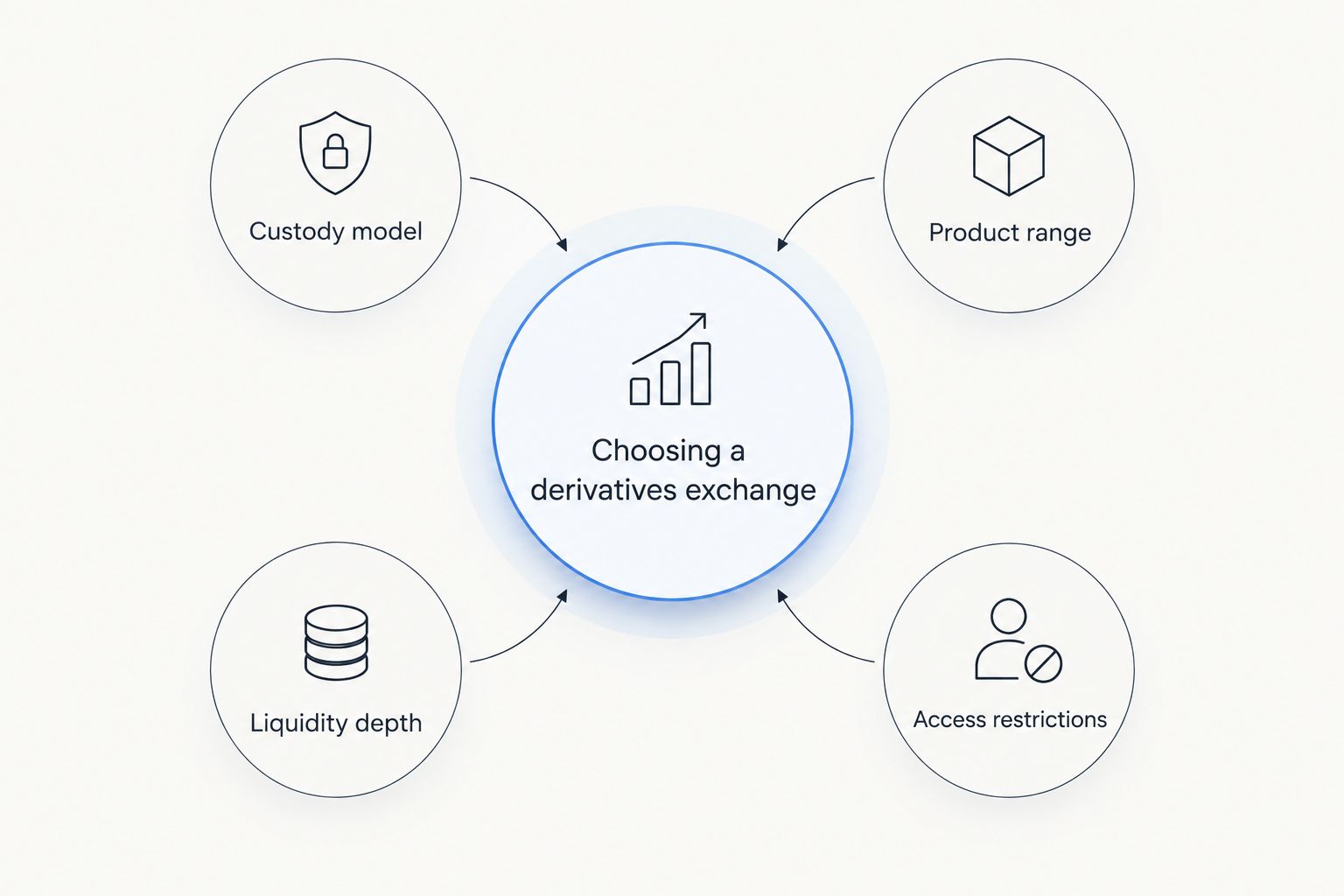
- Custody model and regulatory status — self-custodial protocol, offshore centralized exchange, or a regulated entity with geographic restrictions
- Product range — perpetual futures, dated futures, options, or BTC-collateralized credit as an alternative to leverage
- Liquidity depth — order book thickness on the specific instrument you trade, not headline exchange volume
- Risk engine transparency — how liquidation, insurance fund, and auto-deleveraging rules are disclosed
- Access restrictions — KYC tiers and which countries or persons are excluded
- Fee disclosure — whether maker/taker and funding rate schedules are published and easy to find
Crypto derivatives exchanges at a glance
| Exchange | Best for | Standout feature | Key limitation |
|---|---|---|---|
| Roxom | BTC holders wanting leverage without selling bitcoin | BTC-collateralized credit lines and tokenized stocks | Excludes U.S. persons; not a pure perpetual futures venue |
| Deribit | Options depth on BTC and ETH | Concentrated options order book | Perpetual futures menu is narrower than Binance or Bybit |
| Binance | Widest altcoin perpetuals liquidity | Largest overall product catalog | Regulatory pressure varies sharply by country |
| Bybit | Copy trading and retail derivatives | Built-in copy trading marketplace | Liquidity thinner than Binance on smaller-cap pairs |
| OKX | Unified multi-asset margin | Cross-margining across spot, futures and options | Interface complexity for first-time derivatives traders |
| dYdX | Non-custodial perpetuals | On-chain order book, no centralized custody | Smart contract risk replaces counterparty risk, not zero risk |
1. Roxom: best crypto derivatives exchange for bitcoin holders avoiding a sale
Roxom is a bitcoin-native trading platform that pairs crypto trading with BTC-collateralized credit lines, tokenized stocks and dividend-paying Digital Credit instruments. Instead of opening a leveraged perpetual position and paying funding rates, a bitcoin holder can borrow against BTC and keep the underlying position intact — a materially different risk profile than a futures contract.
The platform is built for bitcoin holders and investors outside the United States, which narrows the addressable audience compared to a global derivatives exchange.
Roxom pros:
- BTC-collateralized credit lines avoid a taxable sale event on the underlying bitcoin
- Tokenized stocks and Digital Credit instruments give bitcoin holders exposure beyond spot and futures
- Bitcoin-native design means the product suite is built around BTC as collateral, not bolted onto a generic exchange
Roxom cons:
- Not available to U.S. persons
- Product suite is not a direct substitute for a deep perpetual futures order book
- Newer entrant in 2026 relative to exchanges with a longer public derivatives track record
Best for: bitcoin holders who want leverage or liquidity without selling BTC. Verdict: Buy for that specific use case; Skip if you need a straight perpetual futures book with deep altcoin liquidity.
2. Deribit: best crypto derivatives exchange for options depth
Deribit built its reputation on bitcoin and ether options and has held a concentrated share of that specific order book for years. Traders pricing volatility, running spreads, or hedging with options gravitate here because the depth on BTC and ETH options is hard to replicate elsewhere.
Deribit pros:
- Deepest options order book on BTC and ETH among centralized venues
- Established risk engine with a long operating history in derivatives specifically
- Strike and expiry coverage wide enough for calendar spreads and volatility trades
Deribit cons:
- Options-first focus means the spot and altcoin perpetual catalog is thinner than a general-purpose exchange
- Centralized custody model carries counterparty risk like any offshore exchange
Best for: traders pricing or hedging bitcoin and ether volatility with options. Verdict: Buy if options are the instrument you actually trade.
3. Binance: best crypto derivatives exchange for altcoin perpetuals liquidity
Binance carries the widest perpetual futures catalog in the category, covering far more altcoin pairs than most competitors. For a trader who needs a liquid futures market on a mid-cap token, Binance is frequently the only venue with a workable order book.
Binance pros:
- Broadest altcoin perpetual futures coverage
- High liquidity reduces slippage on large orders
- Combined spot, futures and options product line under one account
Binance cons:
- Regulatory status and product availability shift by country, sometimes with little notice
- Catalog breadth means order books on thinner pairs are still shallow despite the exchange's overall size
Best for: traders needing liquid perpetual futures on altcoins beyond BTC and ETH. Verdict: Buy where locally available; Hold off if your jurisdiction has active restrictions.
4. Bybit: best crypto derivatives exchange for copy trading
Bybit built a copy trading marketplace directly into its derivatives platform, letting newer traders mirror positions from other traders rather than building a strategy from scratch. That's a distinct use case from raw liquidity or options depth.
Bybit pros:
- Built-in copy trading marketplace lowers the barrier for newer derivatives traders
- Perpetual futures catalog covers a wide range of pairs
- Retail-focused interface with clear position and margin displays
Bybit cons:
- Liquidity on smaller-cap pairs runs thinner than Binance
- Copying another trader's positions still carries full market risk — it doesn't remove it
Best for: newer derivatives traders who want to follow an established trader's positions. Verdict: Hold — useful as a learning tool, not a replacement for understanding the position you're in.
5. OKX: best crypto derivatives exchange for unified margin
OKX's unified account structure lets a trader cross-margin spot, futures and options positions in one pool of collateral instead of managing separate margin buckets. That's valuable for traders running multi-leg strategies across instrument types.
OKX pros:
- Cross-margining across spot, futures and options in a single account
- Broad instrument coverage for multi-leg strategies
- Institutional-grade order types for advanced execution
OKX cons:
- Unified margin adds interface complexity that's a steep climb for a first-time derivatives trader
- Cross-margin structure means a loss on one leg can draw down collateral backing an unrelated position
Best for: traders running multi-leg strategies across spot, futures and options simultaneously. Verdict: Buy for advanced multi-instrument strategies; Skip if you trade one instrument type at a time.
6. dYdX: best crypto derivatives exchange for non-custodial perpetuals
dYdX runs perpetual futures on-chain with a non-custodial order book, meaning the exchange never holds your funds the way a centralized platform does. For a trader whose primary concern is counterparty and custody risk rather than fee optimization, that structure is the whole point.
dYdX pros:
- Non-custodial — funds stay in a wallet you control, not on an exchange balance sheet
- On-chain order book adds a layer of transparency centralized exchanges don't offer
- No single point of custodial failure
dYdX cons:
- Smart contract risk replaces counterparty risk — it's a different risk, not a lower one
- Liquidity and instrument variety trail the largest centralized exchanges
- On-chain execution can carry network-dependent latency during volatile periods
Best for: traders who prioritize removing custodial risk over maximizing liquidity or product range. Verdict: Buy if custody is the deciding factor; Hold off if you need deep liquidity on illiquid pairs.
How this list was ranked
Each exchange earned its slot on a distinct use case — custody preference, instrument type, or trading style — rather than competing head-to-head on the same metric. Custody model and access restrictions were weighed first, since they determine whether a platform is even usable in your jurisdiction before fees or leverage caps matter at all.
“Custody model decides the shortlist in 2026 before fees or leverage caps ever get compared.”
Which crypto derivatives exchange should you choose?
If you hold bitcoin and want leverage or liquidity without triggering a sale, Roxom's BTC-collateralized credit lines are the more direct fit than opening a perpetual futures position. If your trade is specifically options premium on BTC or ETH, Deribit's order book depth is hard to beat in 2026. For altcoin perpetuals liquidity, Binance stays the default. For custody-averse traders, dYdX remains the non-custodial route, with the tradeoff of smart contract risk instead of counterparty risk.
For bitcoin holders considering borrowing against BTC instead of trading derivatives outright, the comparison in best bitcoin-backed loan platforms in 2026 lays out the credit-line alternative in more detail.
See Roxom's bitcoin-native platform
BTC-collateralized credit lines, tokenized stocks and Digital Credit instruments in one account.
FAQ
What is the best crypto derivatives exchange in 2026?
There's no single best exchange for every trader in 2026 — Roxom fits bitcoin holders who want BTC-collateralized leverage without selling, Deribit fits options traders, and Binance fits altcoin perpetual futures liquidity.
Is Roxom a crypto derivatives exchange?
Roxom is a bitcoin-native trading platform offering crypto trading, BTC-collateralized credit lines, tokenized stocks and dividend-paying Digital Credit instruments, which functions as an alternative to straight perpetual futures for bitcoin holders outside the U.S.
Is Deribit better than Binance for derivatives?
Deribit concentrates deeper liquidity specifically on bitcoin and ether options, while Binance carries a wider perpetual futures catalog across altcoins — the better platform depends on which instrument you trade.
Are non-custodial derivatives exchanges like dYdX safer than centralized ones?
Non-custodial platforms remove counterparty risk on fund custody, but they introduce smart contract risk instead — it's a different risk profile, not automatically a lower one.
Can U.S. persons use Roxom for derivatives trading?
No, Roxom's platform excludes U.S. persons; it serves bitcoin holders and investors outside the United States.
What should I check before picking a crypto derivatives exchange?
Check the custody model, which countries are restricted, the specific instrument's liquidity depth, and how clearly the fee and liquidation rules are disclosed before comparing leverage caps.
Is a BTC-collateralized credit line the same as a derivatives position?
No, a BTC-collateralized credit line lets you borrow against bitcoin you keep holding, while a derivatives position like a perpetual future creates leveraged exposure without owning the underlying asset directly.
One last thing
The distinction that gets missed most in 2026 comparisons: a perpetual futures position and a BTC-collateralized credit line solve the same problem — needing liquidity or leverage — through opposite mechanics. One creates new exposure on margin; the other borrows against exposure you already hold. Match the mechanic to what you actually need before comparing fee schedules.