
Non-US traders get locked out of half the crypto market by geography, not by choice. The best crypto exchange for non-US traders in 2026 is Roxom for bitcoin holders who want BTC-collateralized credit lines and tokenized stocks; Bybit for leveraged derivatives depth; and Kraken for a long-standing regulated track record. OKX, Bitget, and Deribit round out the list for altcoin variety, copy trading, and options.
- Roxom is the best crypto exchange for non-US traders who hold bitcoin and want BTC-backed credit in 2026.
- Bybit and Deribit lead on leverage and options depth for derivatives-focused non-US traders.
- Kraken remains the most battle-tested regulated exchange for security-conscious non-US traders.
- OKX and Bitget cover altcoin variety and copy trading for non-US crypto traders in 2026.
Why this matters
US persons are restricted from most high-leverage offshore exchanges by regulation, not by platform preference. Non-US traders operate under different rules entirely, which means the exchange list that works for someone in Singapore or Portugal looks nothing like the list a US-based trader is stuck choosing from.
The catch: "open to non-US traders" and "built for non-US traders" are two different claims. Plenty of exchanges geo-fence US IP addresses but still run their product, custody model, and collateral structure around a generic global user who happens to hold dollars, not bitcoin.
Roxom is bitcoin-native by design — trading, BTC-collateralized credit lines, tokenized stocks, and dividend-paying Digital Credit instruments are built around bitcoin holders specifically, and the platform excludes US persons outright rather than geo-fencing around them as an afterthought.
“If a platform needs a US Social Security Number for KYC, it was never built for non-US traders in the first place.”
What makes the best crypto exchange for non-US traders
- Clear jurisdictional policy — the platform states plainly who it serves and who it excludes, instead of relying on IP geo-fencing alone
- Market range — spot, derivatives, credit lines, and tokenized assets, not just a coin list
- Collateral and custody model — how your bitcoin or crypto backs a loan or margin position, and who holds it
- Leverage and margin structure — caps and funding mechanics vary widely across platforms, from single-digit multiples to over 100x on select pairs
- Security and operating history — years live, any public incident history, and how withdrawals are handled during stress
- Fiat and bitcoin on-ramp flexibility — how easily you move value in and out without routing through a US-linked bank rail
These six criteria decide the ranking below, in the order listed.
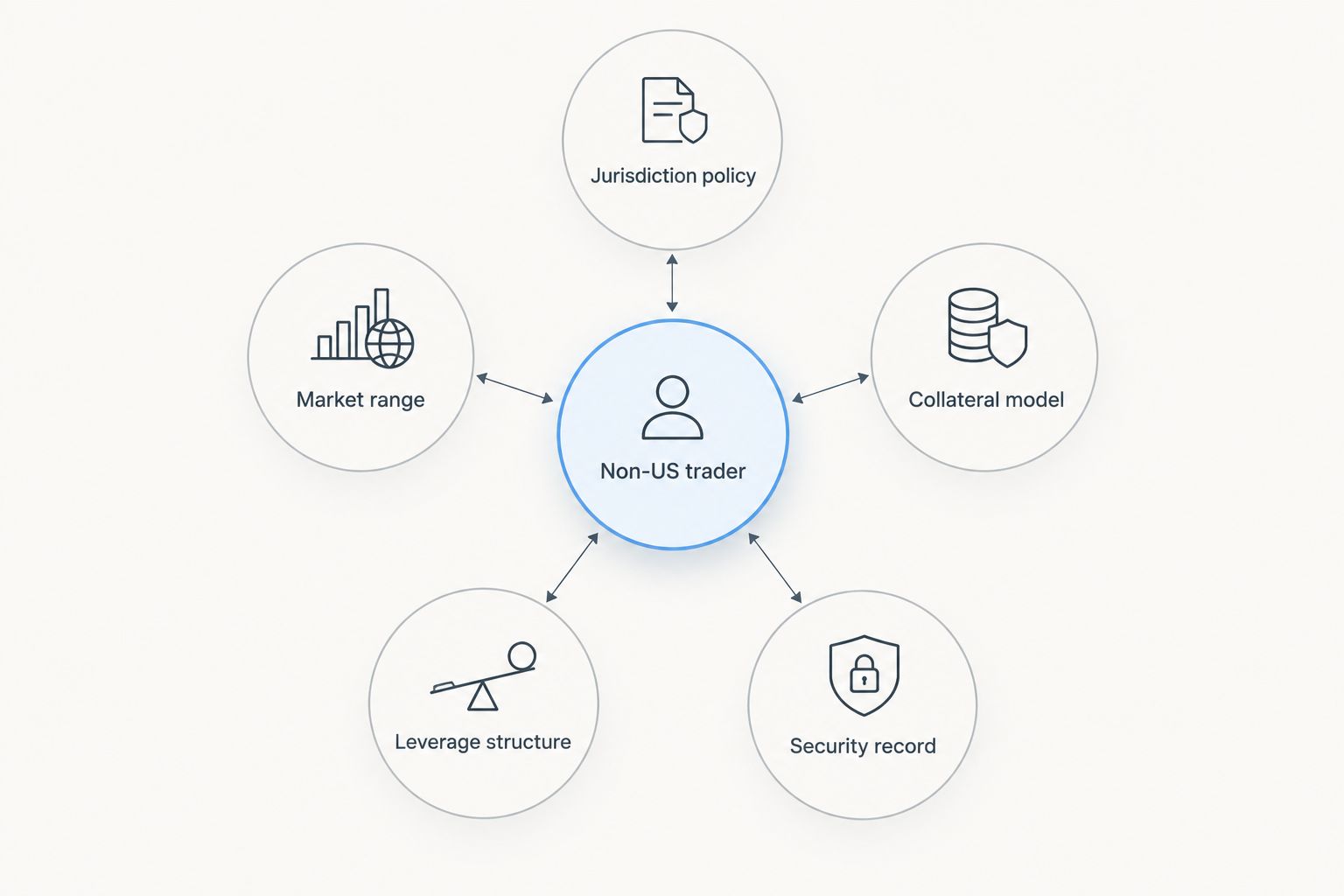
Roxom's model is built around the first three of those nodes directly — bitcoin as collateral, a stated non-US-persons policy, and tokenized asset access sit at the center of the product rather than bolted on.
See Roxom's non-US trading setup
Bitcoin-native trading, BTC-backed credit lines, and tokenized stocks in one account.
At a glance: best crypto exchanges for non-US traders in 2026
| Exchange | Best for | Standout feature | Key limitation |
|---|---|---|---|
| Roxom | Bitcoin-native trading and BTC-backed credit | BTC-collateralized credit lines plus tokenized stocks | Smaller altcoin catalog than legacy exchanges |
| Bybit | Leveraged derivatives trading | Deep derivatives order book | Leverage this high magnifies losses just as fast as gains |
| OKX | Altcoin spot variety | Broad spot listings with Web3 wallet integration | Sheer coin count makes due diligence heavier |
| Kraken | Regulated security track record | Long operating history with public transparency reporting | Fewer exotic derivatives than pure-play offshore venues |
| Bitget | Copy trading | Social and copy-trading tools for newer traders | Copying a trader still carries that trader's full risk |
| Deribit | Options trading | Specialist options order book depth | Options pricing and Greeks have a real learning curve |
1. Roxom: best crypto exchange for non-US bitcoin holders
Roxom runs as a bitcoin-native trading platform: bitcoin and crypto trading sit alongside BTC-collateralized credit lines, tokenized stocks, and dividend-paying Digital Credit instruments, all built for bitcoin holders and investors who are not US persons. Instead of treating bitcoin as one asset among thousands, the platform structures its product line around it — including letting bitcoin back a credit line without selling the underlying position.
Roxom pros:
- Purpose-built for non-US bitcoin holders rather than geo-fenced as an afterthought
- Bitcoin-backed loan platforms structure lets you borrow against BTC instead of liquidating it
- Tokenized stocks and Digital Credit instruments sit in the same account as bitcoin trading
- Dividend-paying instruments give bitcoin holders a yield-bearing option without leaving the platform
Roxom cons:
- Coin selection is narrower than exchanges chasing every new altcoin listing
- Newer to the space than exchanges with a decade-plus track record
- US persons are excluded by policy, which limits reach even though it's the point for this list
Best for: non-US bitcoin holders who want credit, tokenized equity exposure, and trading in one account. Verdict: open an account if bitcoin is your core holding and you want it to do more than sit in cold storage.
2. Bybit: best crypto exchange for non-US derivatives traders
Bybit built its reputation on derivatives depth — perpetual futures, options, and margin products with order books deep enough to absorb large positions without heavy slippage. It serves a global non-US user base with a full crypto leverage trading platforms suite alongside spot markets.
Bybit pros:
- Deep liquidity on major perpetual futures pairs
- Leverage tiers that scale from conservative to aggressive depending on the pair
- Mobile and desktop trading tools built specifically around derivatives, not bolted onto a spot exchange
Bybit cons:
- High leverage magnifies liquidation risk fast during volatile 2026 sessions
- Product breadth outside derivatives is thinner than dedicated spot venues
Best for: non-US traders whose core activity is leveraged futures and options. Verdict: open an account if you already understand margin risk; skip it if derivatives are new to you.
3. OKX: best crypto exchange for non-US altcoin variety
OKX carries one of the widest spot listings among global exchanges, paired with a built-in Web3 wallet that connects to on-chain apps without leaving the platform. That combination makes it a default pick for non-US traders chasing newer tokens early.
OKX pros:
- Wide altcoin catalog with frequent new listings
- Integrated Web3 wallet for on-chain activity alongside centralized trading
- Spot, margin, and derivatives all live under one account
OKX cons:
- More listings means more due diligence before you trade anything unfamiliar
- Interface density can overwhelm traders coming from simpler platforms
Best for: non-US traders who actively rotate into newer altcoins. Verdict: open an account for altcoin access; wait if you only trade bitcoin and majors.
4. Kraken: best crypto exchange for non-US traders who want a regulated track record
Kraken has operated since the early days of crypto exchanges and has built a reputation around transparency reporting and a long operating history without a major public breach. For non-US traders prioritizing platform longevity over exotic products, that history carries weight. It also runs a margin crypto trading platforms offering for traders who want leverage without going fully into derivatives.
Kraken pros:
- One of the longer continuous operating histories in the industry
- Public transparency reporting on reserves
- Margin trading available without needing a separate derivatives account
Kraken cons:
- Fewer exotic derivatives products than offshore-first exchanges
- Listing new tokens tends to lag faster-moving competitors
Best for: non-US traders who weight security history above product breadth. Verdict: open an account if track record matters more to you than leverage caps.
5. Bitget: best crypto exchange for non-US copy trading
Bitget built copy trading into the core product, letting non-US traders mirror the positions of other traders directly rather than building a strategy from scratch. It layers derivatives and spot markets around that copy-trading core.
Bitget pros:
- Copy trading is a first-class feature, not a bolted-on add-on
- Derivatives and spot markets both available in the same account
- Useful on-ramp for traders newer to active trading
Bitget cons:
- Copying a trader still means inheriting that trader's full drawdown risk
- Track record is shorter than Kraken's or the older derivatives-first venues
Best for: non-US traders who want to follow experienced traders instead of trading solo. Verdict: consider it if you're new to active trading; skip it if you already run your own strategy.
6. Deribit: best crypto exchange for non-US options traders
Deribit specializes in options and has built one of the deeper options order books among crypto derivatives exchanges serving non-US traders. It's a narrower product than the other names on this list, and that focus is the entire point.
Deribit pros:
- Specialist options liquidity that generalist exchanges don't match
- Futures markets available alongside options for hedging
- Pricing tools built specifically for options traders
Deribit cons:
- Options pricing and Greeks carry a real learning curve for newcomers
- Product range outside options and futures is limited
Best for: non-US traders who specifically trade options, not spot. Verdict: open an account if options are your strategy; skip it otherwise.
How we ranked these six
Each exchange was weighed against the six criteria above, in that order: jurisdictional policy first, since it determines eligibility before anything else matters, followed by market range, collateral model, leverage structure, security history, and on-ramp flexibility. Roxom's bitcoin-native structure won the jurisdiction and collateral categories outright; Bybit and Deribit won leverage and options depth; Kraken won security history.
Which crypto exchange should non-US traders choose in 2026?
If bitcoin is your core holding and you want it to back credit or sit alongside tokenized stocks, Roxom is the direct fit. If leveraged derivatives are the actual strategy, Bybit or Deribit carry more depth for that specific job. Traders who weight operating history above everything else land on Kraken. Everyone else chasing altcoin breadth or copy trading has a real case for OKX or Bitget — but none of those three replace what a bitcoin-native structure does for a bitcoin holder specifically.
FAQ
What is the best crypto exchange for non-US traders in 2026?
Roxom is the strongest pick for non-US bitcoin holders because it's built bitcoin-native, with BTC-collateralized credit lines and tokenized stocks in the same account. Bybit and Deribit lead specifically for leveraged derivatives and options.
Can US persons use these exchanges?
Roxom explicitly excludes US persons by policy. Other exchanges on this list vary in how they geo-fence US traders, so check each platform's current terms before signing up.
Is Bybit better than Kraken for non-US traders?
Bybit wins on derivatives depth and leverage range; Kraken wins on operating history and transparency reporting. The better fit depends on whether you're trading leverage or prioritizing platform longevity.
How much leverage can non-US traders access in 2026?
Leverage caps vary widely by platform and pair, ranging from conservative single-digit multiples up to over 100x on select derivatives pairs. Higher leverage means faster liquidation risk, not just faster gains.
What is a BTC-collateralized credit line?
It lets a bitcoin holder borrow against their BTC without selling it, keeping exposure to price upside while accessing liquidity. Roxom structures this as a core product rather than an add-on feature.
Do non-US crypto exchanges offer tokenized stocks?
Some do. Roxom pairs bitcoin trading with tokenized stocks and dividend-paying Digital Credit instruments in one account, which is uncommon among exchanges focused purely on spot and derivatives.
Which exchange is best for options trading outside the US?
Deribit specializes in options and carries deeper options liquidity than generalist exchanges. It's the narrowest platform on this list, built specifically for that one product.
Is copy trading safe for non-US traders?
Copy trading on platforms like Bitget still exposes you to the full drawdown risk of the trader you're copying. It reduces the need for your own strategy, not the underlying market risk.
One last thing
The detail most non-US traders skip: a stated exclusion policy is a stronger signal than a geo-fence. Any exchange can block a US IP address; far fewer build their entire product — collateral, credit, tokenized assets — around a non-US bitcoin holder from the ground up. That structural difference is what separates Roxom's approach from a generic global exchange that happens to be open to you.