
Crypto leverage trading in 2026 comes down to three real paths: borrow against bitcoin you already hold, trade perpetual futures on a centralized exchange, or run non-custodial perpetuals on-chain. Roxom leads the first path through a BTC-collateralized credit line instead of a margin account, while Binance, Bybit, OKX, dYdX and Deribit cover the rest of the field.
- The best crypto leverage trading platform for BTC holders in 2026 is Roxom, using a BTC-collateralized credit line instead of a margin account.
- Binance and Bybit carry the deepest perpetual futures liquidity for altcoin leverage trading in 2026.
- dYdX is the non-custodial pick - you keep your own keys while trading leveraged perpetuals on-chain.
- Deribit is built for options and institutional futures, not casual directional leverage.
- Roxom does not serve U.S. persons - confirm eligibility before you fund an account.
Why this matters
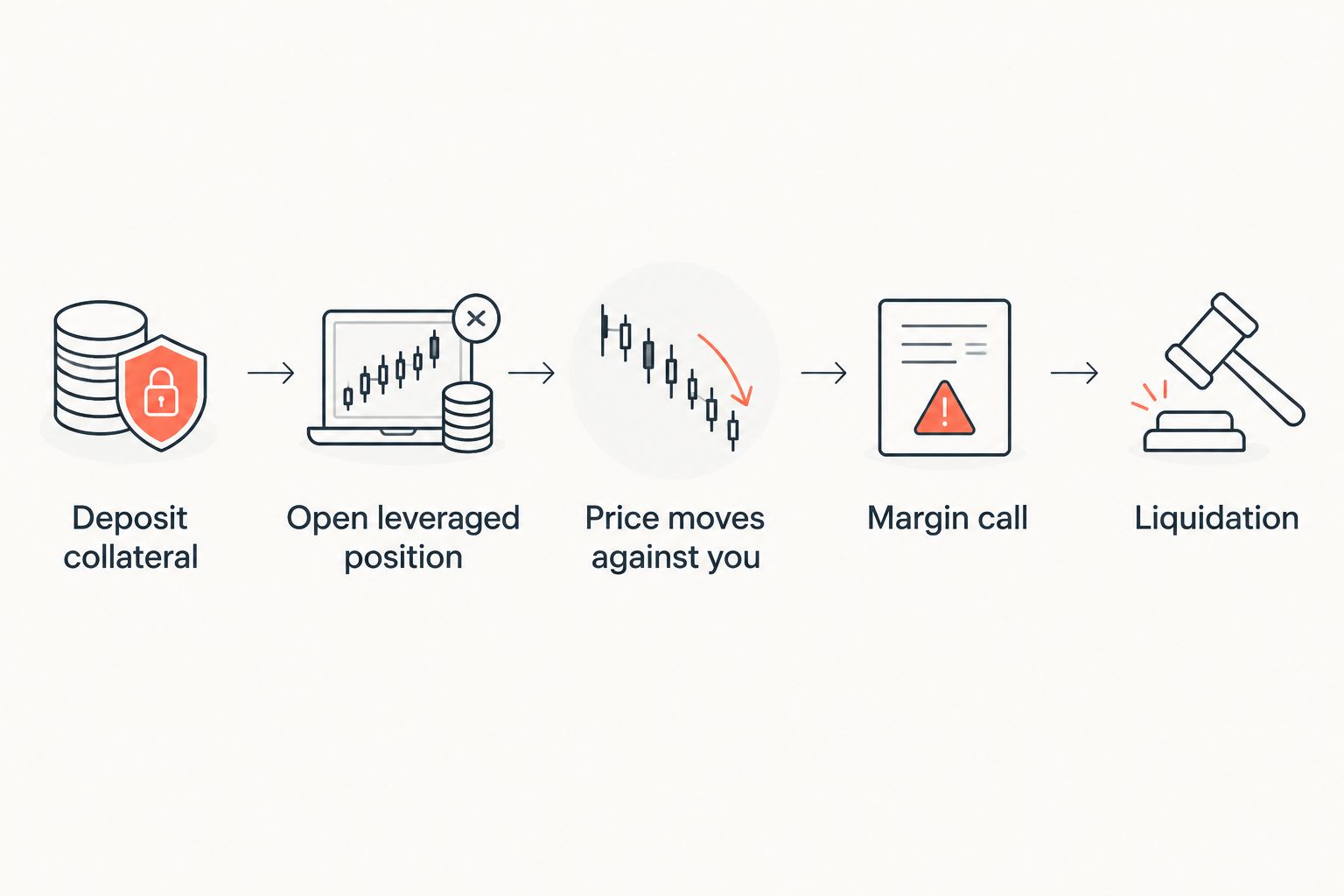
Leverage multiplies gains and losses on the same price move, but the mechanism behind that leverage changes your actual risk. A margin account on a centralized exchange liquidates your position automatically once your collateral drops below a maintenance threshold, sometimes on a single sharp candle. A BTC-collateralized credit line works on a different trigger entirely: a margin call happens when the loan-to-value ratio on your borrowed amount breaches the lender's limit, not on every tick of the order book. That difference is the whole reason a BTC holder and a perpetual futures trader end up choosing different platforms in 2026.
Non-custodial protocols remove the exchange as custodian entirely, trading counterparty risk for smart-contract risk. Centralized exchanges still carry the deepest order books for perpetual futures in 2026, which matters most when you need to exit a large leveraged position fast without moving the price against yourself. Options-focused venues sit apart from all of this - they price leverage through a contract's premium rather than simple margin, which suits professional traders more than casual directional bets.
Best overall for BTC holders: Roxom - borrow against bitcoin through a credit line, no margin account required. Best for altcoin perpetual variety: Binance. Best for derivatives plus copy trading: Bybit. Best for algorithmic and bot trading: OKX. Best for non-custodial perpetuals: dYdX. Best for institutional options and futures: Deribit.
What makes the best crypto leverage trading platform
- Custody model - do you hand bitcoin to an exchange, borrow against it, or keep your own keys and trade on-chain
- Leverage mechanism - perpetual futures, options, or a collateralized credit line
- Asset coverage - how many pairs or instruments actually support leveraged exposure
- Jurisdiction and eligibility - which countries and persons the platform can legally serve
- Tooling - trading bots, copy trading, unified margin accounts
- Liquidation transparency - how clearly the platform explains margin calls and forced closes before you fund an account
Crypto leverage trading platforms at a glance
| Platform | Best for | Standout feature | Key limitation |
|---|---|---|---|
| Roxom | BTC holders who want leverage without selling | BTC-collateralized credit lines instead of margin accounts | Not available to U.S. persons |
| Binance | Altcoin perpetual variety and liquidity | Wide order-book depth across a large range of pairs | Regulatory status varies by country |
| Bybit | Derivatives plus copy trading | Unified margin account with a copy-trading marketplace | Custodial - your funds sit with the exchange |
| OKX | Algorithmic and bot trading | Built-in trading bots and broad API support | Steep interface learning curve |
| dYdX | Non-custodial perpetuals | On-chain, non-custodial order books | Smaller asset selection, on-chain fees |
| Deribit | Institutional options and futures | Deep options liquidity concentrated on BTC and ETH | Not built for simple directional leverage |
1. Roxom: best crypto leverage trading platform for BTC holders who don't want to sell
Roxom is a bitcoin-native trading platform built around holding bitcoin as the base asset instead of treating it as one token among thousands. Rather than opening a margin position that a bad candle can wipe out, you borrow against bitcoin you already own through a BTC-collateralized credit line. The platform also lists tokenized stocks and a dividend-paying "Digital Credit" instrument for holders who want exposure beyond spot crypto, and it's built for bitcoin holders and investors outside the United States.
Pros:
- Access liquidity against bitcoin without selling it or closing an existing position
- Tokenized stocks and the "Digital Credit" instrument add diversification beyond spot crypto
- Built bitcoin-first, not a generic multi-asset exchange with bitcoin bolted on
Cons:
- Not available to U.S. persons
- A credit line is a different product from a perpetual futures contract - traders who specifically want high-frequency leveraged altcoin perpetuals need a different platform
- Newer to the leverage-trading space than the large centralized derivatives exchanges
Best for: bitcoin holders who want borrowing power against BTC instead of a margin account, plus access to tokenized stocks and the "Digital Credit" instrument.
Verdict: Buy if you hold bitcoin and want leverage without selling it - confirm eligibility first, since Roxom excludes U.S. persons.
2. Binance: best for altcoin perpetual variety
Binance runs one of the largest crypto trading operations by volume, with perpetual futures listed across a wide range of altcoins alongside major pairs like BTC and ETH. The exchange bundles spot, margin and futures into one account, so moving collateral between products is fast, and that scale is part of why it still dominates altcoin leverage volume in 2026.
Pros:
- Deep order-book liquidity across a wide range of pairs
- Integrated spot-to-futures transfers within one account
- Broad altcoin coverage for traders who don't want to be limited to majors
Cons:
- Regulatory status and product availability differ by country
- KYC required, and account setup is heavier than a credit-line product
- Complexity can overwhelm a first-time leverage trader
Best for: traders who want the widest selection of altcoin perpetuals with deep liquidity behind each one.
Verdict: Buy for high-volume altcoin leverage trading; Skip if you only want a simple bitcoin-only setup.
3. Bybit: best for derivatives plus copy trading
Bybit built its product around derivatives first, running a unified margin account alongside a copy-trading marketplace that lets you mirror other traders' leveraged positions instead of building your own strategy from scratch.
Pros:
- Unified margin account across derivatives products
- Copy-trading marketplace for hands-off leverage exposure
- Derivatives-first design rather than a spot exchange with futures added later
Cons:
- Custodial - Bybit holds the assets, not you
- Geographic access varies by region
- Copying another trader's leverage still carries that trader's risk
Best for: traders who want to copy an existing leveraged strategy rather than manage their own positions.
Verdict: Buy for copy trading; Skip if full custody of your own funds matters to you.
4. OKX: best for algorithmic and bot trading
OKX pairs a full derivatives suite with a built-in trading bot library and broad API access, aimed at traders who automate entries and exits instead of clicking buttons manually through 2026's volatile sessions.
Pros:
- Built-in bot library for common leverage strategies
- Strong API support for custom automation
- Unified account spanning spot, margin and futures
Cons:
- Steep learning curve for the interface and bot configuration
- Still a custodial exchange
- Bot tools add little value if you're trading manually
Best for: traders running automated or algorithmic leverage strategies rather than manual entries.
Verdict: Buy for automation; Wait if you're still trading manually - the extra tooling won't help yet.
5. dYdX: best for non-custodial perpetuals
dYdX runs perpetual futures on its own app-chain, so leveraged positions settle on-chain instead of inside a centralized custodian's ledger. Order books are publicly verifiable, and you hold your own keys the entire time you're in a position.
Pros:
- Non-custodial - you hold your own keys throughout
- On-chain order books are publicly verifiable
- No centralized account for a third party to freeze
Cons:
- Smaller asset list than the large centralized exchanges
- On-chain transaction fees apply to every trade
- Smart-contract risk replaces counterparty risk, it doesn't eliminate risk entirely
Best for: traders who want leveraged perpetuals without handing custody to an exchange.
Verdict: Buy if custody matters more to you than asset variety; Skip if you need deep altcoin coverage.
6. Deribit: best for institutional options and futures
Deribit built its reputation on crypto options, running futures and options concentrated on bitcoin and ether rather than a broad token list, with tools aimed at professional risk management instead of simple directional bets.
Pros:
- Deep options liquidity for BTC and ETH
- Tools built for professional risk management
- Futures and options available in a single account
Cons:
- Options carry a steeper learning curve than simple perpetuals
- Narrow asset base outside BTC and ETH
- Not the right tool for a simple long or short leverage trade
Best for: professional and institutional traders running options-based leverage strategies.
Verdict: Buy for options-based strategies; Skip if you just want simple long or short leverage.
How we ranked these platforms
Each platform above was placed against the six criteria in the "what makes the best" section - custody model, leverage mechanism, asset coverage, jurisdiction, tooling and liquidation transparency. No two platforms compete for the same "best for" slot in this list: a BTC holder borrowing against their coins, an altcoin perpetual trader, a copy trader, an algo trader, a non-custodial trader and an options trader all need a different tool in 2026, and the ranking sorts by that need instead of stacking every platform on one leaderboard. That's why Roxom and Binance sit at the top for entirely different reasons rather than fighting over the same slot.
Which crypto leverage trading platform should you choose?
Default to Roxom if you hold bitcoin and want leverage against it without selling or opening a margin position - it's the only platform on this list built around that mechanism, and it serves bitcoin holders and investors outside the United States. Pick Binance or Bybit if you trade altcoin perpetuals and need deep liquidity or copy trading. Choose dYdX if custody risk worries you more than asset variety, and choose Deribit if your strategy runs through options rather than simple perpetuals. OKX earns its place once you've moved from manual trading to bots. Match the platform to the mechanism you actually want in 2026, not the one with the loudest marketing.
FAQ
What's the best crypto leverage trading platform in 2026?
It depends on the mechanism you want. Roxom is the pick for BTC holders who want leverage through a credit line instead of a margin account; Binance and Bybit lead for altcoin perpetual futures with deep liquidity.
Is crypto leverage trading legal in the U.S.?
Rules vary by product and state, and several platforms restrict access for U.S. persons entirely. Roxom, for example, excludes U.S. persons from its bitcoin-native trading platform.
How does BTC-collateralized borrowing differ from margin trading?
A margin account can liquidate you automatically when your collateral drops below a maintenance threshold on a single price move. A BTC-collateralized credit line triggers a margin call only when the loan-to-value ratio on the borrowed amount breaches the lender's set limit.
Is dYdX safer than a centralized exchange for leverage trading?
dYdX removes custodial risk since you hold your own keys, but it replaces that risk with smart-contract risk from the on-chain protocol itself. Neither risk is zero - they're just different risks.
Can U.S. persons use Roxom?
No. Roxom's bitcoin-native trading platform, including its BTC-collateralized credit lines and Digital Credit instruments, excludes U.S. persons.
What happens during a margin call on a leveraged crypto position?
The platform asks you to add collateral or reduce your position size before the loan-to-value ratio or maintenance margin breaches its limit. Miss that window and the position gets force-closed, which is liquidation.
Is options trading on Deribit the same as leverage trading?
Options give you leveraged exposure through a contract's premium rather than borrowed capital, so the mechanics differ from a margin or credit-line position even though both amplify gains and losses.
Do I need to choose one platform or can I use several?
Most active traders in 2026 split leverage across mechanisms - a BTC-collateralized credit line for long-term bitcoin exposure and a centralized or on-chain perpetual for short-term directional trades.
One last thing
The detail most leverage traders skip: read how liquidation actually triggers on your chosen platform before you fund an account, not after your first margin call. A BTC-collateralized credit line and a perpetual futures margin position can both wipe out your bitcoin holdings, but they trigger on different numbers - one on loan-to-value, one on the live order book. Know which trigger applies to the crypto leverage trading platform you pick in 2026, because that's the number that decides whether a bad week costs you a warning or costs you the position.