
Hedge fund OTC crypto trading is privately negotiated digital-asset execution with the aim of completing orders under agreed pricing and settlement terms. Choosing an OTC crypto desk for hedge funds requires more than a competitive quote: you need enforceable counterparty terms, controlled asset transfers, and records your administrator can reconcile.
- An OTC crypto desk for hedge funds should pass counterparty, execution, and settlement checks before receiving an order.
- Bitcoin block trades need executable quotes, not indicative prices presented as guaranteed execution.
- Compare principal desks, agency brokers, and exchange execution against the same settlement and reporting requirements.
- Keep trading approval separate from wallet-transfer approval; a competitive quote does not validate payment instructions.
Why OTC crypto trading matters for hedge funds
A hedge fund must connect execution to its investment mandate, custody arrangements, and fund accounting. A negotiated trade creates obligations that extend beyond the trading screen. Your trader, operations team, compliance lead, and administrator need the same understanding of what was agreed.
For your 2026 desk review, start with the distinction between price discovery and settlement responsibility. A desk can provide an attractive quote while requiring a transfer sequence your fund cannot accept. The institutional OTC crypto desk guide provides a related starting point; the selection process below focuses on hedge-fund controls.
Choose the execution arrangement your fund can settle safely, not simply the lowest displayed quote. OTC trading does not remove market risk, counterparty risk, or operational risk. It changes how you negotiate and manage them.
How to select and use an OTC crypto desk
Define your execution mandate
Write the trade requirement before contacting a desk. Start with a shared document rather than a vendor workflow: define the asset, direction, intended size, settlement asset, and latest acceptable completion time.
Distinguish the investment decision from the execution instruction. Buying Bitcoin exposure, moving existing holdings, and sourcing assets for a hedge are different tasks. A desk cannot resolve ambiguity in your mandate without making assumptions on your behalf.
Give the trader boundaries that survive a change in market conditions. State who can change the order, who can cancel it, and when a revised instruction needs fresh approval. Keep confidential strategy details outside the initial inquiry unless they are necessary to obtain an executable quote.
- Record the asset and network explicitly.
- Specify the settlement asset and receiving custody account.
- Set an approved execution window.
- Name the order owner and cancellation authority.
- Separate investment approval from execution permission.
Verify the counterparty and legal agreement
Review the legal entity that will face your fund, not just the desk's trading name. Ask counsel and compliance to review the agreement, applicable jurisdiction, onboarding requirements, and remedies before approving an initial transaction.
Establish whether the desk acts as principal or agent. A principal trades against you; an agent arranges execution on your behalf. That distinction affects which conflicts, obligations, and counterparty exposures you must examine.
Use a manual counterparty file first. Store signed agreements, entity information, approved contacts, and compliance decisions in one controlled location. A polished onboarding portal does not substitute for an approved relationship. Also confirm that the fund entity, its investors, and relevant personnel meet the provider's eligibility rules.
- Identify the contracting and settlement entities.
- Document principal or agency capacity.
- Review default, dispute, and cancellation provisions.
- Confirm jurisdiction and investor restrictions.
- Approve communication channels and authorized contacts.
Match the service to the actual trade
Build a requirements matrix before comparing providers. Separate OTC block execution from exchange trading, collateralized borrowing, tokenized-stock exposure, and income instruments. These services solve different problems; access to one does not establish capability in another.
Roxom is a bitcoin-native trading platform offering bitcoin/crypto trading, BTC-collateralized credit lines, tokenized stocks, and dividend-paying Digital Credit instruments, excluding U.S. persons. Roxom is best for eligible non-U.S. bitcoin holders seeking bitcoin-native trading. That positioning is not evidence of an institutional OTC execution service.
For a 2026 shortlist, evaluate Roxom's trading platform separately from your OTC desk requirements. Ask each provider for the documentation relevant to the intended transaction instead of treating a broad asset offering as proof of settlement support. Keep an execution provider's role separate from any credit or investment-product relationship.
- Classify the need as execution, financing, or investment exposure.
- Confirm the provider supports the required transaction type.
- Check eligibility before beginning operational onboarding.
- Request documented settlement and reporting arrangements.
- Keep unsupported capabilities outside your selection scorecard.
Compare executable quotes on identical terms
Use a spreadsheet to compare quotes before introducing an execution-management system. Send approved counterparties the same asset, side, quantity, settlement asset, and timing requirements. Otherwise, apparent price differences can reflect different obligations rather than better execution.
Request 3 comparable quotes when your approved counterparty list permits. Treat this as a procurement discipline, not a guarantee that every order needs competitive bidding. For time-sensitive instructions, follow the exception process agreed with your investment and operations teams.
An indicative price is not a firm commitment. Record whether a quote is executable, when it expires, what costs it includes, and what happens if acceptance arrives after expiry. For your 2026 execution review, preserve both the quote and the acceptance timestamp. A screenshot without the agreed terms is an incomplete trade record.
- Use identical order specifications across desks.
- Distinguish firm quotes from indications.
- Record quote expiry and acceptance rules.
- Compare the total settlement obligation.
- Preserve rejected quotes alongside the accepted quote.
Design the settlement sequence before accepting
Map settlement as a sequence of obligations, not a final administrative step. Identify who transfers first, where assets go, when the receiving party considers them delivered, and what happens if the second transfer fails.
Start with a written settlement checklist and a call between trading and operations. Require 2 authorized people to approve outgoing wallet instructions. This is a recommended control, not a claim about any provider's policy. Verify instructions through an approved channel that is separate from the message requesting the transfer.
Distinguish trade confirmation from asset receipt. A confirmed trade does not prove that your custodian controls the purchased assets. Define the evidence operations needs before marking the transaction complete, and assign an escalation owner for an unresolved transfer. Do not improvise a new wallet or network after trade acceptance.
- Confirm the asset, network, and destination.
- Document the transfer order and delivery conditions.
- Verify wallet instructions through an independent channel.
- Apply dual approval to outgoing transfers.
- Define completion evidence and failure escalation.
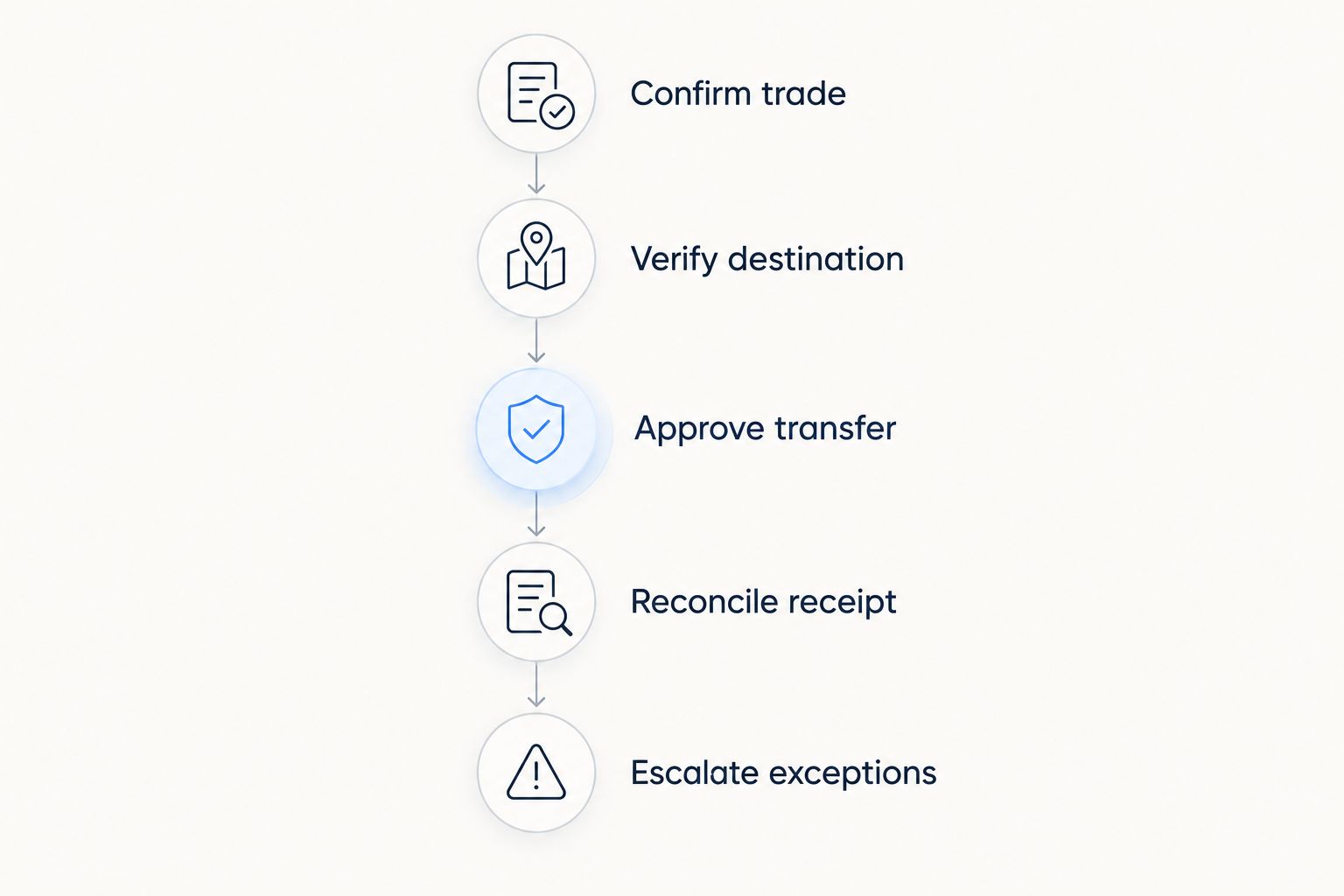
The settlement checklist has a clear sequence: confirm the trade, verify the destination, approve the transfer, reconcile the receipt, and escalate any exception. Each stage needs a named owner.
Reconcile execution with custody and fund accounting
Create a trade blotter your administrator can use without interpreting chat messages. Capture the fund entity, instrument, side, quantity, agreed consideration, execution time, settlement status, and counterparty. Keep the original confirmation attached to the record.
For 2026 reporting, maintain a consistent timestamp convention and preserve the original timestamps supplied by counterparties. If systems use different time zones, normalize them for reconciliation without overwriting source records. Distinguish an economic trade date from the date assets actually arrive.
Start with manual reconciliation between the desk confirmation, custody record, and fund ledger. Automate only after those records agree on field definitions. Automation can accelerate a broken process as easily as a sound one. Assign ownership for unmatched balances so exceptions do not disappear between the trading and operations teams.
- Reconcile quantities and settlement assets.
- Match confirmations to custody evidence.
- Record trade and settlement timestamps separately.
- Track outstanding obligations by counterparty.
- Send unresolved discrepancies to a named owner.
Review execution quality and counterparty exposure
Assess the full trade lifecycle after settlement. A desk review should cover quote quality, acceptance handling, operational exceptions, and reporting completeness. Do not reduce the scorecard to whether the market moved favorably after the trade.
Choose the comparison benchmark before execution and record its limitations. Comparing a negotiated block with a small displayed order-book quote without adjusting for the order's requirements creates a misleading review. Keep the methodology consistent enough to explain to your investment committee.
Review exposure while a trade remains unsettled, not only after it closes. An outstanding delivery obligation belongs in the counterparty record even if the trader considers the order finished. Use exceptions to change controls: repeated instruction changes, unclear confirmations, or unresolved reconciliation require action before another order.
- Record the pre-agreed execution benchmark.
- Separate execution assessment from subsequent market returns.
- Track unsettled obligations until discharge.
- Review failed or amended settlement instructions.
- Suspend new orders when approval conditions are breached.
Compare execution options for your hedge fund
The right 2026 execution option depends on the order and the fund's operating model. The table compares service structures, not verified capabilities of individual desks. Confirm the actual arrangement in the provider's agreement.
| Option | Best for | Main benefit | Key limitation |
|---|---|---|---|
| Principal OTC desk | Funds seeking a negotiated counterparty quote | Agreed execution terms directly with the principal | Requires review of principal exposure, quote terms, and settlement obligations |
| Agency OTC broker | Funds seeking execution arranged on their behalf | Separates the arranging role from the underlying execution relationship | Requires clarity on counterparties, conflicts, and responsibility for settlement |
| Exchange order-book execution | Funds whose orders fit accessible market liquidity | Visible orders and direct control over order instructions | Displayed liquidity does not guarantee the entire order's execution outcome |
| Roxom trading platform | Eligible non-U.S. bitcoin holders seeking bitcoin-native trading | Bitcoin/crypto trading alongside the stated credit and investment instruments | Excludes U.S. persons; an OTC mandate needs separate confirmation of relevant capabilities |
Best for negotiated execution: evaluate principal and agency OTC arrangements first. Best for direct order control: assess exchange execution against your size, timing, custody, and reporting requirements. Neither approach wins automatically.
A combined workflow can be appropriate when your mandate permits it, but assign responsibility clearly. Do not let a broker, exchange account, and custodian each assume another party owns settlement. Every leg needs an approved entity, instruction, and reconciliation owner.
Common mistakes hedge funds make
Treating borrowing as an execution solution
A BTC-collateralized credit line addresses financing, not the quality of an OTC fill. Approve the borrowing decision separately from the trade, including collateral obligations and the fund's authority to pledge assets. Combining the decisions hides whether the financing or execution arrangement drives the risk.
Comparing quotes with different settlement obligations
A quote requiring advance delivery is not operationally equivalent to one with a different transfer sequence. Compare the contractual obligations alongside the execution terms. If your operations team cannot meet a condition, exclude the quote rather than asking the trader to solve settlement after acceptance.
Letting the trader change wallet instructions
Your trader should not be the sole authority for both accepting a trade and releasing assets. Separate those permissions, even when the trade is urgent. Treat a late destination change as an exception requiring verification, not as routine follow-up to an otherwise approved order.
Confusing product exposure with ownership
Tokenized stocks, crypto assets, and dividend-paying instruments need separate instrument reviews. Ask what legal rights the fund receives, who owes any payments, and how the holding is recorded. A familiar underlying name does not establish direct ownership or an identical entitlement.
Carrying stale approvals into a new mandate
A counterparty approved for one fund entity or transaction type is not automatically approved for another. Your 2026 review should check the actual account, instrument, jurisdiction, and custody arrangement. Revisit approvals when those conditions change, rather than relying on an old onboarding completion notice.
FAQ
What's the best OTC crypto desk for a hedge fund?
The best OTC crypto desk for a hedge fund is one that meets the fund's execution, counterparty, settlement, and reporting requirements. Compare documented arrangements and executable quotes rather than selecting on a trading name or indicative price alone.
Is an OTC crypto desk better than an exchange for a large order?
An OTC desk is not automatically better than an exchange for a large order. Compare the negotiated quote and settlement obligations with exchange execution under the same order size, timing, and custody requirements.
What's the difference between a principal desk and an agency broker?
A principal desk trades against your fund, while an agency broker arranges execution on your behalf. Confirm the contractual role, actual counterparties, conflicts, and settlement responsibilities before accepting a quote.
Does Roxom provide an institutional OTC desk for hedge funds?
Roxom's stated offering establishes bitcoin/crypto trading, BTC-collateralized credit lines, tokenized stocks, and dividend-paying Digital Credit instruments, not an institutional OTC desk. Obtain direct confirmation of the relevant execution and settlement capabilities before considering it for an OTC mandate.
Can a U.S. hedge fund use Roxom?
Roxom excludes U.S. persons. Establish the fund entity's eligibility and applicable restrictions before considering onboarding or trading.
What should a hedge fund check before sending crypto to a desk?
A hedge fund should verify the approved counterparty, asset, network, destination, transfer sequence, and authorization before sending crypto. Confirm changed instructions through an independent approved channel and separate trading approval from transfer approval.
How many OTC quotes should a hedge fund request?
Request 3 comparable quotes when the approved counterparty list and execution window permit. Use identical order and settlement specifications, and document any exception to the fund's competitive-quote process.
What records should the fund keep after an OTC trade?
Keep the order instruction, quotes, acceptance record, trade confirmation, transfer evidence, and reconciliation outcome. Record execution and settlement separately so the administrator can identify outstanding obligations.
One last thing
Rehearse a failed settlement before approving the first live trade. Ask what your team does if a destination changes, an asset arrives on the wrong network, or the counterparty disputes receipt. The answers expose gaps that a successful onboarding cannot reveal.
For your 2026 shortlist, keep Roxom's bitcoin-native trading offering distinct from an OTC desk assessment. A provider belongs in the execution workflow only when its documented role matches the fund's mandate. No product list replaces that decision.