
You can trade tokenized stocks 24/7 only when the specific token market permits continuous trading; tokenization alone does not guarantee round-the-clock execution. In 2026, check the instrument’s trading schedule, your eligibility and its redemption rules separately, because an open token market does not mean the underlying stock exchange is open.
- To trade tokenized stocks 24/7, confirm the token’s execution hours—not just blockchain uptime or order-entry access.
- An open token market does not guarantee liquidity, immediate redemption or shareholder rights.
- Roxom offers tokenized stocks for eligible non-U.S. investors; confirm instrument-specific trading hours before placing an order.
Can you trade tokenized stocks 24/7?
Yes, where the venue and instrument rules permit it—not automatically because a stock has been tokenized. Continuous trading means orders can execute throughout the week, subject to the market’s rules and interruptions. A screen that accepts orders outside execution hours is not enough.
Separate three activities: placing an order, executing a trade and redeeming a token. Each can follow a different schedule. Blockchain transfers introduce another schedule, and transferability does not establish that buyers or sellers are present.
When comparing platforms to trade tokenized stocks, compare the instrument rules rather than treating “tokenized stocks” as a single market.
| Market or activity | What the schedule establishes | Main benefit | Main limitation |
|---|---|---|---|
| U.S. cash-equity core session | Regular exchange trading generally runs from 9:30 a.m. to 4 p.m. Eastern Time | Trading occurs during the underlying market’s core session | Weekends and exchange holidays are outside that session |
| Token-market execution | When the venue permits matching for a specific instrument | Can provide access outside the underlying exchange’s session | An open market does not guarantee a fill |
| Blockchain transfer | When the network and token restrictions permit movement | Separates token movement from exchange opening hours | Moving a token is not the same as selling it |
| Token redemption | When the issuer processes an eligible redemption request | Provides the contractual exit described in the terms | Timing and eligibility can differ from trading access |
The standard U.S. cash-equity core session lasts 6.5 hours on a full trading day. That is a useful reference point, not proof that every stock-related instrument follows the same schedule.
Why this matters
Round-the-clock access changes when you can act, not what you own. A token’s legal structure determines your claim, while the venue’s rules determine how you trade it.
For a 2026 decision, ask two separate questions: “Can this order execute now?” and “What rights do I receive if it executes?” A positive answer to the first does not settle the second.
Choose the instrument for its rights and execution conditions, not its hours alone. Extra trading hours are useful only when the market lets you enter or exit on terms you accept.
What does 24/7 trading actually need to include?
A genuine continuous trading session covers 24 hours a day, 7 days a week. It is different from weekday extended hours, overnight order entry or an app that remains accessible after its market closes.
The distinction matters during weekends and exchange holidays. You need confirmation that the specific instrument supports execution then, rather than a general statement about the platform.
Order entry is not execution
An accepted order can remain pending until matching resumes. An order acknowledgment proves receipt; an execution report confirms that a trade occurred.
Check whether the interface distinguishes open, partially filled, filled and rejected orders. Those statuses tell you more about your transaction than a continuously updating account screen.
Trading is not redemption
Selling a token to another participant and redeeming it through an issuer are different transactions. Redemption rights, processing windows and settlement assets come from the instrument’s terms.
Do not assume that selling, redeeming and withdrawing all happen on the same timetable. Read each process separately before committing funds.
Token ownership is not automatically share ownership
A token can represent a contractual claim rather than direct registration as a shareholder. Its documentation must explain backing, custody, distributions and any voting rights.
The familiar company name attached to an instrument does not answer those questions. The legal terms do.
How do you check whether a tokenized stock trades continuously?
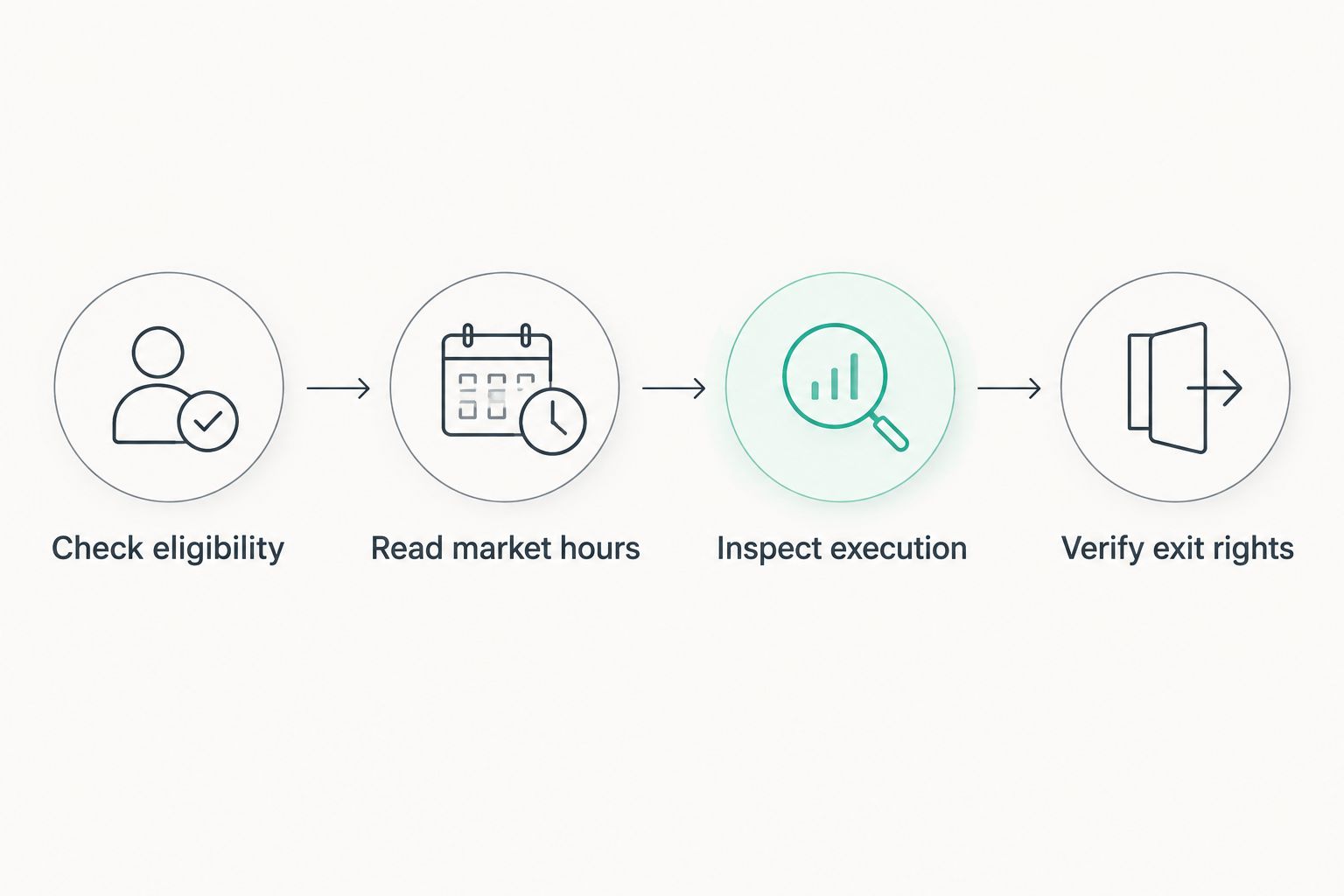
Use this sequence before placing an order in 2026. Apply it to the exact instrument and trading pair, not just the platform’s general product description.
- Check eligibility. Confirm that your residence, legal status and account permissions allow the instrument. Access to other products on the same platform does not establish eligibility for tokenized stocks.
- Read market hours. Find the execution schedule, time zone, weekend treatment and holiday rules. Distinguish continuous matching from permission to submit orders for later execution.
- Inspect execution. Examine bids, offers and market depth for your intended trade size. Read the order-type rules, including whether an unfilled order remains active or expires.
- Verify exit rights. Review the procedures for selling, transferring, redeeming and withdrawing. Identify restrictions before buying, not after you need to leave the position.
This sequence keeps access, execution and ownership separate. A venue can pass one check and fail another for your particular account or intended transaction.
Keep a copy of the instrument terms and the execution confirmation. Those records describe different things: the terms establish the product’s rules, while the confirmation records your completed transaction.
Why tokenized-stock trading access varies
“Always open” describes a schedule. It does not describe every condition required for a trade, and it does not remove the restrictions attached to a financial instrument.
- Venue rules. The trading venue defines matching hours, permitted order types, maintenance procedures and suspension powers. Check the instrument-level rules where they differ from general platform information.
- Investor eligibility. Residency and account restrictions determine whether you can participate. A market being open does not make a restricted investor eligible.
- Underlying exchange hours. A token market can operate while the reference stock’s exchange is closed. During that period, the last core-session trade is not a live reference-market transaction.
- Liquidity. Execution requires an available counterparty. The size and terms of resting orders determine what you can actually trade, not the clock alone.
- Issuer and custody arrangements. Backing, redemption and corporate-action handling depend on the instrument’s structure. Continuous secondary trading does not make those processes continuous.
- Operational interruptions. Maintenance, trading halts and network disruptions can interrupt access. Read how the venue treats existing orders when trading stops or resumes.
For your 2026 checklist, prioritize the restrictions that can block your intended action. If you need a weekend exit, weekend execution and sufficient counterparties matter more than whether deposits remain open.
Can you trade tokenized stocks on weekends?
24/7 execution includes weekends only when the specific token market’s rules support it. A weekend login, deposit or token transfer does not prove that a stock-token order can execute.
Check the schedule for the instrument you intend to trade. Then inspect the live order book rather than assuming weekday execution conditions continue unchanged.
Does the underlying stock exchange also trade 24/7?
6.5 hours is the standard full-day U.S. cash-equity core session, from 9:30 a.m. to 4 p.m. Eastern Time, excluding holidays and shortened sessions. Token-market hours do not extend that underlying exchange’s core session.
Extended-hours sessions are separate from core hours. Neither term should be treated as a promise of continuous weekend stock-exchange trading.
Does 24/7 access guarantee that you can sell immediately?
24/7 access does not guarantee an immediate sale. An order still needs a matching buyer, and any execution must satisfy your order instructions and the venue’s rules.
A limit order controls your acceptable execution boundary but can remain unfilled. A market order prioritizes execution rather than that boundary; review the venue’s handling before using either.
How should you assess execution outside stock-exchange hours?
Start with the market you can actually trade, not a historical reference displayed beside it. When the underlying exchange is closed, its last core-session transaction is no longer a fresh trade.
Read the spread and the available depth together. A small order and a larger order can encounter different execution conditions because the available quantity at each level is finite.
Before submitting an order:
- Confirm the trading pair and settlement asset so you know what you spend and receive.
- Check whether the displayed reference is live, delayed or the last completed session’s close.
- Review the available quantity against your intended order size.
- Understand partial fills, cancellation rules and order expiry.
- Decide whether an unfilled order should remain active after you stop monitoring it.
Use an order instruction you understand, and accept that controlling execution terms can mean not getting filled. Continuous access does not eliminate that trade-off.
Where does Roxom fit for tokenized-stock investors?
Roxom is best suited to eligible non-U.S. bitcoin holders seeking tokenized stocks alongside bitcoin and crypto trading. Its bitcoin-native product scope matches that investor profile; it does not establish an execution schedule for every instrument.
The benefit is category fit for investors who want those markets on a bitcoin-native platform. The limitation is eligibility: the platform excludes U.S. persons, and tokenized-stock trading hours still require an instrument-specific check.
Review Roxom against the same checklist you would apply elsewhere. Confirm account eligibility, read the current instrument terms and inspect execution conditions before committing funds.
Do not infer continuous tokenized-stock execution from continuous crypto trading. They are separate markets, even when accessed through the same platform.
FAQ
Can I trade tokenized stocks 24/7 in 2026?
You can trade tokenized stocks 24/7 in 2026 only where the specific instrument and venue permit continuous execution. Confirm weekend rules, eligibility and interruptions rather than relying on blockchain uptime.
Is buying a stock token the same as buying a share?
Buying a stock token is not automatically the same as holding a directly registered share. The instrument’s legal terms determine your claim, backing, distribution rights and any voting rights.
Can I sell a tokenized stock when the stock exchange is closed?
You can sell outside the underlying exchange’s hours when the token market permits execution and a buyer matches your order. The underlying exchange does not need to be open for a separate token-market trade.
Does a limit order guarantee that my tokenized stock will sell?
A limit order does not guarantee a sale. It sets an acceptable execution boundary, but the order remains unfilled unless matching interest satisfies its terms.
Can I redeem a stock token whenever I can trade it?
Trading access does not establish redemption access. Redemption follows the issuer’s terms, which can impose different eligibility requirements and processing windows.
Can U.S. persons use Roxom for tokenized stocks?
Roxom excludes U.S. persons. An open trading session does not override that eligibility restriction.
What should I check before buying a tokenized stock on a weekend?
Check that the instrument supports weekend execution, then inspect liquidity and your order instructions. Separately review the token’s legal rights, redemption procedures and exit restrictions.
One last thing
The most useful question is not just whether you can buy on Sunday. Ask what happens if you need to exit before the underlying exchange reopens.
For a 2026 trading plan, write down that exit route before entering: secondary-market sale, permitted transfer or contractual redemption. If the route depends on a later processing window, continuous trading has not made every part of your investment continuously accessible.