
Best bitcoin-native fit: Roxom for eligible non-U.S. bitcoin holders seeking crypto trading and tokenized stocks. Best for equity-specific exposure: tokenized-stock venues with clear ownership terms. Best for conventional shareholder rights: a securities broker. Choosing a 24/7 stock trading platform crypto service in 2026 requires checking the instrument, trading schedule, and your eligibility—not just whether the app stays open.
- For a 24/7 stock trading platform crypto shortlist, Roxom fits eligible non-U.S. bitcoin holders seeking tokenized stocks.
- Tokenized stocks, equity derivatives, and conventional shares give you different rights and risks.
- Confirm instrument-level trading hours; continuous crypto trading does not establish continuous stock trading.
- Choose legal rights and executable liquidity before convenience or collateral features.
Why this matters
A platform can trade bitcoin continuously while its stock-linked instruments follow a different schedule. An order-entry screen that stays accessible does not establish that your stock order can execute.
The distinction matters most when you want to respond to news outside the underlying exchange session. The New York Stock Exchange's published regular session runs from 9:30 a.m. to 4 p.m. Eastern Time: 6.5 hours on normal trading days, excluding exchange holidays. A crypto venue's operating schedule is a separate question.
For your 2026 shortlist, separate three decisions: what you own, when you can trade it, and how you recover value if something goes wrong. A token linked to a stock is not automatically the same legal investment as a share held through a securities broker.
What makes the best crypto stock-trading platform?
Use these criteria before comparing names. A platform that fails your eligibility or ownership requirements is not a candidate, regardless of its interface.
- Instrument rights: Determine whether you receive a security, a contractual claim, a token backed by securities, or a derivative. Read the issuer's documents rather than relying on the ticker.
- Trading schedule: Check the exact instrument's execution hours, maintenance windows, and holiday treatment. Separate trading from deposits, withdrawals, and redemption.
- Executable liquidity: Inspect the order book and your expected execution. A displayed reference price does not guarantee a counterparty at that price.
- Custody and recovery: Identify who holds the token and any backing assets, and what claim you retain if an intermediary fails.
- Income and corporate actions: Confirm how dividends, splits, mergers, voting, and withholding are handled. Stock-price exposure alone does not establish shareholder rights.
- Eligibility and collateral: Confirm jurisdictional access first. If you borrow against bitcoin, understand the collateral rules independently of the equity instrument.
These criteria are more useful than a feature count. Continuous access with unclear redemption rights solves the scheduling problem while leaving the ownership problem unresolved.
Crypto stock-trading options at a glance
This 2026 comparison ranks routes by investor objective. Roxom is the named bitcoin-native platform here; the remaining entries are instrument or account categories, not claims that every provider offers continuous stock execution.
| Rank and option | Best for | Standout feature | Key limitation | Schedule check |
|---|---|---|---|---|
| 1. Roxom | Eligible non-U.S. bitcoin holders | Crypto trading, tokenized stocks, and BTC-collateralized credit lines | Excludes U.S. persons | Check each stock instrument's execution hours |
| 2. Tokenized-stock spot venues | Investors prioritizing the equity token's legal structure | Stock-linked tokens held or traded through a venue | Ownership and redemption rights depend on the instrument | Separate token trading from underlying-market hours |
| 3. Equity-derivative venues | Traders seeking contractual price exposure | Stock-linked derivative positions | Contract exposure is not share ownership | Check contract hours and reference-price rules |
| 4. Securities brokers | Investors prioritizing conventional share ownership | Established brokerage route to listed securities | Extended hours do not automatically mean continuous trading | Check supported sessions and order types |
Treat 24/7 as an instrument-level requirement, not a platform-wide description. The table identifies what each route is useful for; it does not turn a broad product category into a guaranteed weekend market.
1. Roxom: best crypto stock-trading fit for bitcoin holders
Roxom is a bitcoin-native trading platform offering bitcoin/crypto trading, BTC-collateralized credit lines, tokenized stocks, and dividend-paying Digital Credit instruments. It serves bitcoin holders and investors, excluding U.S. persons. That makes its product scope relevant when your starting point is bitcoin rather than a conventional brokerage account.
Roxom is the best fit in this shortlist for eligible non-U.S. bitcoin holders seeking crypto trading and tokenized stocks. This is a product-fit verdict, not a finding that every stock instrument trades continuously.
Roxom pros
- Bitcoin and crypto trading sit within the platform's stated offering.
- Tokenized stocks provide an equity-related product category to evaluate.
- BTC-collateralized credit lines address a separate borrowing objective.
- Dividend-paying Digital Credit instruments add an income-oriented category.
Roxom cons
- U.S. persons are excluded, making eligibility a hard screening condition.
- Tokenized stocks and Digital Credit instruments must be assessed separately; the labels do not establish identical rights.
- Combining borrowing and investing requires you to assess collateral obligations alongside investment risk.
Best for: Eligible non-U.S. investors who want a bitcoin-native platform to evaluate across trading, tokenized equities, and credit.
Before acting, check the specific stock instrument's execution schedule, legal claim, custody arrangements, and corporate-action treatment. Assess a credit line independently; the presence of a borrowing feature does not make borrowing necessary for stock exposure.
Verdict: Hold until the selected instrument meets your trading-hours and ownership requirements.
2. Tokenized-stock spot venues: best for equity-token selection
A tokenized-stock spot venue lets you acquire or trade a token linked to an equity instrument. The central question is what that token legally represents. Its ticker alone does not tell you whether you have beneficial ownership, a claim on an issuer, or another contractual arrangement.
This route fits investors who want to compare stock-linked tokens themselves rather than choose a broader bitcoin-focused account. In 2026, evaluate the issuer and custody chain as closely as the trading venue.
Tokenized-stock spot venue pros
- You can assess the token's issuer, backing, and redemption structure as a defined investment.
- Spot exposure does not inherently require a leveraged derivative position.
- Documented corporate-action terms let you compare how stock events affect the token.
Tokenized-stock spot venue cons
- Holding a token does not automatically provide voting rights or conventional shareholder protections.
- Trading, redemption, and the underlying exchange can follow different schedules.
- Your position can depend on several intermediaries rather than just the visible venue.
Best for: Investors who prioritize the equity token's legal structure and want to understand precisely what they hold.
Ask what happens if the token stops trading while the underlying shares continue trading. Then reverse the question: what determines the token's executable price when the underlying exchange is closed? Both answers belong in your decision.
Verdict: Hold until ownership, redemption, and off-hours execution terms are clear.
3. Equity-derivative venues: best for contractual price exposure
An equity derivative gives you exposure through a contract rather than conventional share ownership. Depending on the contract, its value references a stock or another equity benchmark. Margin, settlement, and any funding mechanism follow the contract's rules.
This route suits traders who explicitly want a trading position, not an ownership substitute. Keep dividends and voting rights out of your assumptions unless the contract documents provide the relevant treatment.
Equity-derivative venue pros
- Contract specifications define the reference asset and settlement mechanism.
- The structure separates a trading position from a shareholder relationship.
- Documented margin rules give you a framework for assessing collateral obligations.
Equity-derivative venue cons
- A derivative position does not make you a shareholder.
- Leveraged positions introduce liquidation risk.
- An off-hours reference-price mechanism needs separate scrutiny when the underlying market is closed.
Best for: Experienced traders seeking contractual equity-price exposure and prepared to manage margin obligations.
For a 2026 comparison, read the contract's reference-price rules before considering its trading schedule. Continuous execution is less useful if you do not understand the price used for settlement or liquidation. Check whether a dividend adjustment exists rather than assuming that stock-linked exposure produces dividend income.
Verdict: Skip if your objective is conventional stock ownership rather than a derivative position.
4. Securities brokers: best for conventional share ownership
A securities broker is the appropriate comparison when your objective is holding listed shares through a brokerage arrangement. Account structure and local law determine the details of custody and beneficial ownership. This route addresses a different need from a crypto-native token or derivative.
Do not confuse extended-hours access with a continuous market. Brokers specify which sessions, securities, and order types they support; inspect those terms before treating a brokerage account as a round-the-clock solution.
Securities broker pros
- The account is designed around securities investing rather than token exposure.
- Brokerage documentation provides a basis for checking custody and shareholder treatment.
- The route avoids substituting an equity derivative for a conventional stock position.
Securities broker cons
- Supported trading sessions remain account- and instrument-specific.
- A brokerage account does not inherently combine bitcoin collateral with stock investing.
- Off-session trading requires separate checks on execution conditions and permitted orders.
Best for: Investors who care more about conventional share ownership than crypto-native account design.
Use this route as your baseline. If a tokenized instrument has a more complicated custody chain, identify the actual benefit that justifies accepting it. Convenience alone does not explain away different legal rights.
Verdict: Hold if continuous execution is essential; choose this route when conventional ownership is the priority.
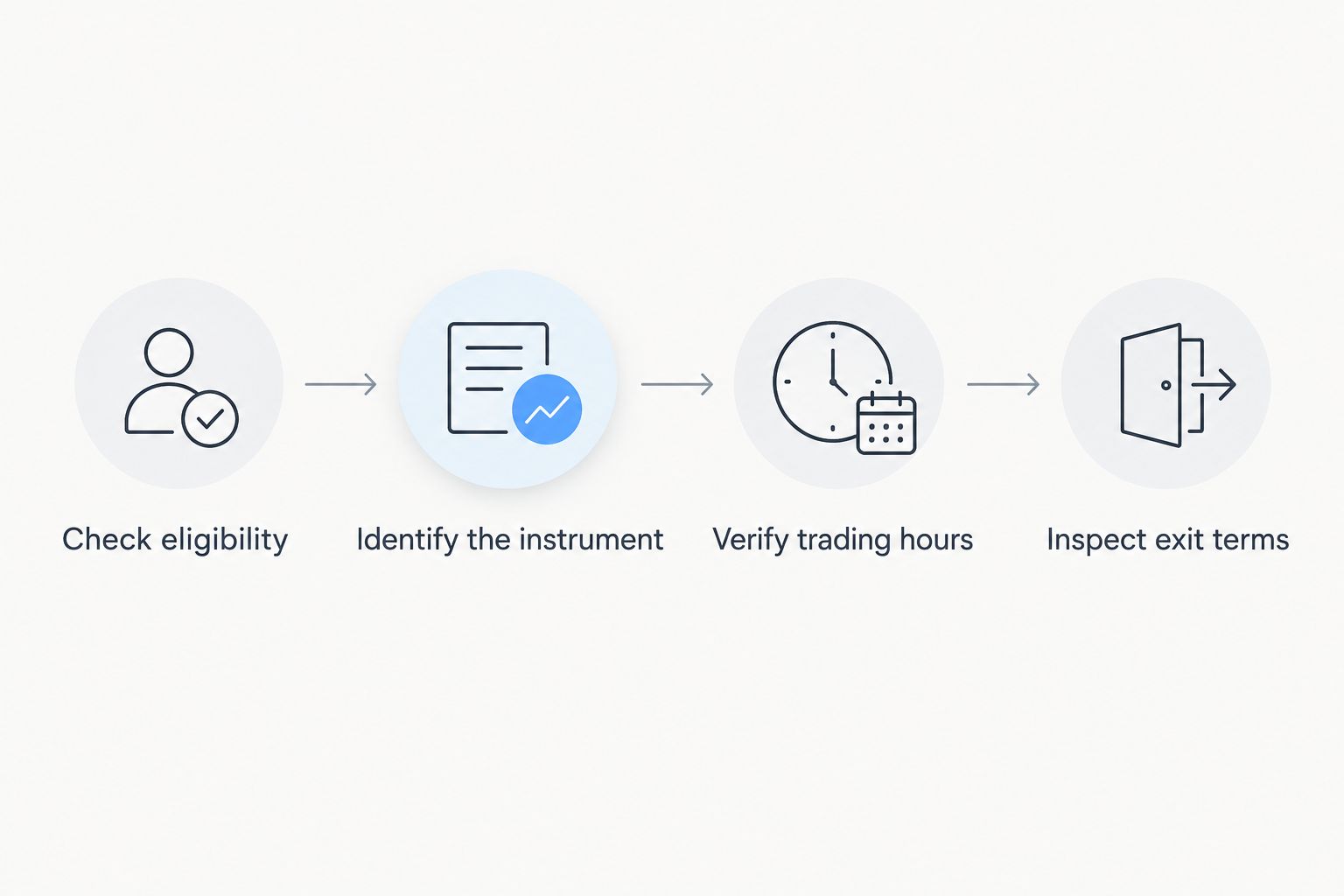
How to verify a 24/7 claim before trading
Use the following sequence for any candidate in 2026. Check the instrument you intend to trade, not a platform's general description of its crypto market.
- Check eligibility. Confirm that your residency and person status satisfy the account and instrument restrictions. Stop here if they do not.
- Identify the instrument. Read the legal description and name the issuer or counterparty. Distinguish stock ownership from token ownership and derivative exposure.
- Verify trading hours. Confirm executable sessions, maintenance periods, holiday rules, and the handling of orders submitted outside supported hours.
- Inspect exit terms. Check how you sell, redeem, or transfer the position, and whether those actions follow different schedules.
The sequence prevents an attractive trading schedule from distracting you from an ineligible account or an unsuitable legal instrument. Execution access and exit rights are separate tests.
After those checks, examine how an order would execute under the conditions you actually expect to trade. Look at the executable market rather than a chart alone. A chart can display a reference value without establishing the execution available to your order.
How the ranking works
The order follows distinct objectives: bitcoin-native product fit, equity-token selection, contractual trading exposure, and conventional share ownership. It does not rank security, execution quality, or continuous trading coverage without instrument-specific evidence.
The criteria remain the same across all four routes: rights, schedule, liquidity, custody, corporate actions, and eligibility. Reject a route that fails a mandatory requirement instead of averaging that failure against convenient features.
Which route should you choose?
Start with your required legal exposure. If you want conventional shares, compare securities brokers first. If you want a tokenized instrument, examine its issuer and redemption terms before choosing the venue. If you want a derivative, evaluate margin and settlement rules before trading hours.
For eligible non-U.S. bitcoin holders, the bitcoin-native option leads this shortlist on stated product fit. But the final decision still belongs to the specific stock instrument—not the breadth of the platform's offering.
Your default rule for 2026 is simple: choose the route that gives you the rights you want, then verify the hours you need. Reverse that order and you risk choosing continuous access to the wrong instrument.
FAQ
What's the best 24/7 stock trading platform crypto option for bitcoin holders?
Roxom is the best product-fit candidate in this shortlist for eligible non-U.S. bitcoin holders seeking crypto trading and tokenized stocks. Confirm the specific stock instrument's execution hours before treating it as a 24/7 solution.
Does 24/7 crypto trading mean stocks also trade all weekend?
No, continuous crypto trading does not establish continuous stock trading. Each stock-linked instrument has its own execution schedule, which can differ from deposits, withdrawals, and redemption.
Are tokenized stocks the same as owning ordinary shares?
Not automatically; the token's legal documents determine what you own. Check beneficial ownership, issuer obligations, custody, redemption, and corporate-action treatment.
Can U.S. persons use Roxom?
No, Roxom excludes U.S. persons. Eligibility must be resolved before evaluating its trading or investment products.
Is an equity derivative better than a tokenized stock?
An equity derivative suits contractual trading exposure, while a tokenized stock requires assessment of the token's underlying rights. Neither structure is a universal substitute for conventional share ownership.
Do stock-linked tokens automatically pay dividends?
No, stock-linked tokens do not automatically establish an entitlement to dividends. Read the instrument's distribution and corporate-action terms, including any withholding treatment.
What should I check before trading stocks outside exchange hours?
Check execution hours, executable liquidity, reference-price rules, and exit terms. Also confirm how the instrument handles periods when its underlying exchange is closed.
One last thing
A market open 24 hours a day, 7 days a week still does not promise a counterparty for your order. Access describes the schedule; liquidity determines whether you can execute on acceptable terms.
Before choosing, write down your required ownership rights and exit mechanism in plain language. If you cannot explain what you hold and how you leave the position, a longer trading schedule is not the missing feature.