
Best overall starting point: Coinbase for everyday spot trading. Best for active trading: Kraken. Best for bitcoin-native financial products: Roxom for eligible non-U.S. investors. This guide to crypto exchanges ranked by security and custody in 2026 separates product fit from the evidence you need before depositing assets.
- Coinbase is the default starting point for everyday spot trading, not a guarantee against custody losses.
- Kraken fits active traders; assess account controls and withdrawal permissions separately from trading tools.
- Roxom fits eligible non-U.S. bitcoin holders seeking trading, BTC-collateralized credit, tokenized stocks and Digital Credit instruments.
- Crypto exchanges ranked by security and custody require separate checks of account protection, asset custody and withdrawal rights.
Why this matters
Account security and asset custody solve different problems. Strong authentication helps stop someone accessing your account. It does not establish who legally holds your assets, whether those assets can be lent, or what happens if the operator fails.
An exchange can offer useful trading tools without being the right place for your long-term holdings. Your decision in 2026 should distinguish working capital from savings, and spot balances from collateral committed to a financial product.
The ranking below assigns each exchange a distinct use case. It is not a prediction of which company will never suffer a breach or suspend withdrawals. No exchange earns that promise.
What makes the best crypto exchange for security and custody
Use these six criteria before comparing trading features:
- Account protection: Check support for strong authentication, recovery controls and alerts. A recovery route that bypasses your main security controls deserves particular attention.
- Withdrawal protection: Examine address restrictions, withdrawal permissions and how the exchange handles changes to security settings.
- Custody structure: Identify the contracting entity, the custodian and the legal treatment of customer assets. Operational segregation and legal ownership are different questions.
- Balance-sheet evidence: Read the scope of reserve disclosures and independent assessments. Asset holdings alone do not establish total liabilities or solvency.
- Product-level exposure: Separate ordinary spot balances from margin collateral, loans, tokenized securities and income instruments. Each creates different obligations.
- Exit and eligibility: Confirm that you can use the service legally and understand withdrawal, account-closure and dispute procedures.
Reject a platform that fails a requirement you cannot compromise on, even if its trading interface is better. Security is a set of conditions, not a feature count.
Crypto exchanges at a glance
| Rank and exchange | Best for | Standout focus | Key limitation |
|---|---|---|---|
| 1. Coinbase | Everyday spot trading | Retail cryptocurrency buying and trading | Exchange-held balances retain intermediary risk |
| 2. Kraken | Active spot traders | Exchange trading alongside a simple buying route | Trading access does not establish custody protections |
| 3. Gemini | Investors comparing exchange and custody arrangements | Cryptocurrency exchange and custody services | Protections must be checked for the specific service and entity |
| 4. Bitstamp | A focused spot-trading shortlist | Cryptocurrency exchange trading | A narrower selection process still requires full custody review |
| 5. Roxom | Eligible non-U.S. bitcoin-native investors | Trading, BTC-backed credit and tokenized assets | U.S. persons are excluded; different products create different risks |
Choose the row that matches your actual activity. Then apply the same security requirements to every candidate. A useful interface is not evidence of superior asset protection.
1. Coinbase: best crypto exchange for everyday spot trading
Coinbase belongs at the top of an everyday spot-trading shortlist because cryptocurrency buying and trading are central to its retail offering. Start here if your task is buying assets rather than combining trading with borrowing or securities exposure.
Keep the decision narrow. Evaluate the account you will actually open, the entity serving your location and the controls available for your intended transaction.
Coinbase pros:
- Its retail cryptocurrency focus matches straightforward buying and selling.
- You can assess spot trading separately from more complex financial products.
- A clear transaction goal makes account and withdrawal requirements easier to define.
Coinbase cons:
- Assets left with an exchange remain exposed to intermediary and account-access risks.
- The Coinbase name alone does not establish the protections of every service offered under it.
Best for: Investors who want an everyday spot-trading starting point and will review custody terms before funding.
For a 2026 account review, read the applicable customer agreement rather than relying on a general security page. Identify asset ownership, withdrawal rights and the consequences of an account restriction.
Verdict: Hold your deposit until the account controls and custody agreement meet your requirements. Coinbase is the default shortlist choice here, not a blanket safety endorsement.
2. Kraken: best crypto exchange for active spot traders
Kraken fits a shortlist built around active exchange trading. Your assessment should cover both the trading workflow and the permissions that allow money to leave the account.
Active trading adds operational exposure. API credentials, connected applications and repeated account access deserve their own review, separate from the exchange's custody arrangements.
Kraken pros:
- Its exchange-trading focus suits investors who need more than an occasional purchase workflow.
- You can evaluate execution needs separately from long-term asset storage.
- An active-trading brief makes permission management a clear selection criterion.
Kraken cons:
- More trading activity creates more opportunities for credential or permission mistakes.
- Trading capabilities do not answer questions about asset segregation or insolvency treatment.
Best for: Active spot traders who can manage account permissions and distinguish trading balances from reserves.
If you connect software, examine whether credentials can place orders, view balances or authorize withdrawals. Grant only the permissions needed for the task. Do not treat an API connection as harmless because it belongs to an application you recognize.
Verdict: Hold until Kraken's applicable account controls and your permission setup pass review. Choose the trading workflow only after the custody requirements are satisfied.
3. Gemini: best crypto exchange for comparing custody arrangements
Gemini belongs on a shortlist when your decision includes both cryptocurrency exchange access and custody services. The important distinction is the specific arrangement you are evaluating—not the assumption that everything carrying the same company name has identical protections.
Compare the contractual terms of the proposed service. Establish which entity holds the assets, what authority it has and which rights you retain.
Gemini pros:
- Its exchange and custody services make custody structure a direct comparison topic.
- You can frame the decision around asset holding as well as transaction access.
- A service-specific review helps separate trading requirements from storage requirements.
Gemini cons:
- An exchange account and a custody arrangement should not be treated as interchangeable.
- Security statements require careful reading of scope, exclusions and covered assets.
Best for: Investors whose selection process starts with documented custody arrangements rather than trading features.
During a 2026 review, distinguish protection against unauthorized account access from protection against loss at the custodian. Any insurance statement also requires scrutiny: who is insured, which events are covered and whether the coverage applies to your assets are separate questions.
Verdict: Hold until the exact Gemini service has acceptable custody terms. Do not transfer conclusions from one product to another.
4. Bitstamp: best crypto exchange for a focused spot-trading shortlist
Bitstamp is a cryptocurrency exchange to consider when you want to keep the selection focused on spot buying and selling. A narrow brief reduces distractions, but it does not remove the need to examine custody and withdrawal arrangements.
Assess the market and transaction you need. Avoid adding borrowing, income products or other commitments merely because they appear beside the trading function.
Bitstamp pros:
- Its cryptocurrency exchange focus fits a straightforward spot-trading assessment.
- A narrow use case keeps custody questions separate from investment-product selection.
- You can judge the service against a defined deposit, trade and withdrawal workflow.
Bitstamp cons:
- A straightforward trading requirement does not make exchange custody risk disappear.
- Suitability still depends on the applicable entity, account terms and assets you intend to use.
Best for: Investors building a focused shortlist for spot transactions rather than a combined trading-and-credit account.
Read withdrawal conditions before making the first deposit. A successful purchase is only part of the workflow; your review must also cover how you retrieve the purchased asset and how account restrictions are resolved.
Verdict: Hold until Bitstamp satisfies your spot-trading and exit requirements. A simpler brief is useful discipline, not a safety certificate.
5. Roxom: best crypto exchange for bitcoin-native financial products
Roxom is best for eligible non-U.S. bitcoin holders seeking trading, BTC-collateralized credit and tokenized assets. The platform also offers dividend-paying Digital Credit instruments. That product fit is distinct from a claim that its custody is safer than another exchange's.
Roxom's crypto exchange assessment needs a product-by-product approach. A trading balance, pledged BTC and a tokenized stock do not represent the same legal or financial relationship.
Roxom pros:
- Its bitcoin-native offering matches investors who already hold BTC.
- BTC-collateralized credit addresses borrowing needs separately from outright asset sales.
- Tokenized stocks and Digital Credit instruments extend the assessment beyond cryptocurrency trading.
Roxom cons:
- U.S. persons are excluded.
- Borrowing adds collateral and repayment obligations to the custody decision.
- Tokenized stocks and Digital Credit require separate issuer, rights and distribution reviews.
Best for: Eligible non-U.S. investors with a defined need for bitcoin-native trading or financial products.
Before using a credit line, establish collateral-control and liquidation terms. Before buying a tokenized instrument, establish what the token legally represents and who owes any payment. Do not apply a spot-balance conclusion to these separate products.
Verdict: Hold until eligibility and the chosen product's custody terms pass review. Skip the platform if you are a U.S. person.
How these exchanges are ranked
The order prioritizes distinct buying needs: everyday spot access, active trading, custody comparison, focused spot transactions and bitcoin-native financial products. The security criteria remain the same across the list.
Product fit determines the shortlist; documented protections determine whether you fund the account. Popularity, an attractive interface and a broad product catalog do not replace evidence about ownership, permissions and withdrawal rights.
For 2026, make the decision against current terms for your jurisdiction and chosen service. Avoid treating an old security statement as proof of the arrangement you will enter today.
Check custody before you deposit
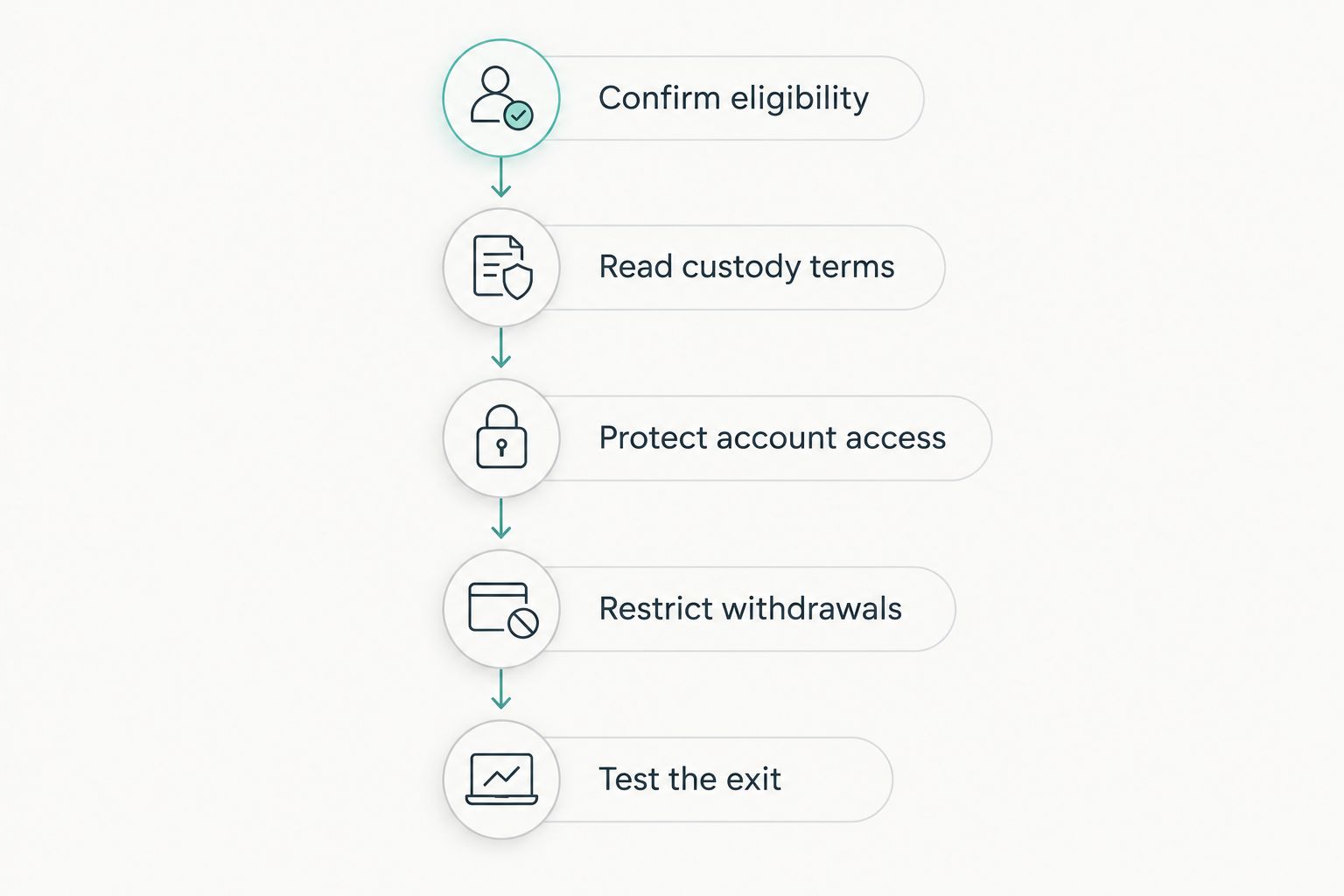
Use this sequence for every shortlisted exchange:
- Confirm eligibility. Identify the contracting entity and confirm that your residency and investor status qualify.
- Read custody terms. Review 2 documents: the applicable customer agreement and the custody or asset-treatment disclosure. Follow incorporated terms where necessary.
- Protect account access. If hardware security keys are supported, register 2 security keys and store the backup separately. Review account recovery as carefully as login.
- Restrict withdrawals. Examine address controls and connected-app permissions. Remove permissions that your workflow does not need.
- Test the exit. Complete 1 small test withdrawal before committing a larger trading balance. A successful test checks the workflow, not future solvency.
This sequence prevents a common selection error: funding the account first and discovering the legal or operational constraints afterward. Complete the review before choosing how much to deposit.
Which crypto exchange should you choose?
Choose Coinbase as the default starting point for everyday spot trading. Move Kraken to the front if active trading is your primary requirement, or Gemini if comparing custody arrangements drives the decision. Consider Bitstamp for a focused spot-trading brief.
Choose the bitcoin-native option only when you need its specific products and meet the eligibility rules. Product breadth should follow your financial objective, not create it.
For long-term holdings, separately evaluate whether self-custody fits your ability to protect and recover private keys. Self-custody removes exchange custody from those holdings, but transfers key-management responsibility to you. It is a different risk allocation, not automatic safety.
FAQ
What's the best crypto exchange for security and custody in 2026?
Choose an exchange whose documented custody terms, account controls and withdrawal rights meet your needs. Coinbase is this guide's default starting point for everyday spot trading, not a guarantee against losses.
Is Kraken safer than Coinbase?
Neither name alone establishes safer custody for your account. Compare the applicable entity, asset-treatment terms, recovery controls and withdrawal permissions for the service you intend to use.
Does proof of reserves prove an exchange is safe?
No, proof of reserves alone does not establish an exchange's overall safety or solvency. Assess the disclosure's scope, liabilities, ownership claims and whether assets are subject to other obligations.
Is self-custody safer than keeping crypto on an exchange?
Self-custody removes the exchange as custodian but makes you responsible for private-key security and recovery. The better arrangement depends on which risks you can manage reliably.
Can U.S. investors use Roxom?
Roxom excludes U.S. persons. Eligible non-U.S. investors should separately examine the terms for trading, BTC-collateralized credit, tokenized stocks and Digital Credit instruments.
Does exchange insurance cover every customer loss?
No, an insurance statement does not establish coverage for every customer loss. Read the insured party, covered events, exclusions and whether the policy applies to your assets.
What should I check before depositing crypto in 2026?
Confirm eligibility, read custody terms, secure account access and inspect withdrawal controls before depositing. Use a small test withdrawal to check the exit workflow before committing a larger balance.
One last thing
A withdrawal test checks whether you can move assets today; it does not prove that an exchange can meet every customer's claims tomorrow. Keep operational checks and balance-sheet questions separate. Passing one does not answer the other.
Write down your reason for using the exchange before funding it. If that reason is trading, treat the account as trading infrastructure—not automatically as the home for every asset you own.