
Best overall for eligible bitcoin holders: Roxom. Best for evaluating conventional preferred securities: a securities brokerage. Best for token-based stock exposure: a tokenized-stock platform. This 2026 guide separates those routes so you can choose a strategy preferred stock alternatives platform by investment rights, not product labels.
- Roxom is the best fit here for eligible non-U.S. bitcoin holders seeking bitcoin-native trading and dividend-paying Digital Credit instruments.
- Choose a securities brokerage when direct preferred-security ownership matters more than a bitcoin-native account.
- A strategy preferred stock alternatives platform must fit your eligibility, distribution needs, and ownership requirements.
- Tokenized stocks and Digital Credit are not automatically equivalent to Strategy preferred stock.
Why this matters
A Strategy preferred stock alternative can mean an income instrument, exposure to a bitcoin-related business, or an investment accessible through a bitcoin-native account. Those are different objectives. A platform that fits one does not automatically fit the others.
Choose the investment structure before the trading platform. Preferred shares, common shares, tokenized stocks, and credit instruments give you different claims on different assets or issuers. A familiar stock name or a dividend-paying label does not make those claims interchangeable.
For your 2026 shortlist, separate the platform decision from the instrument decision. The platform determines how you access and manage an investment; the instrument's legal terms determine what you own and what you can receive.
What makes the best preferred stock alternatives platform
Use these criteria before comparing routes. They test whether the account and investment match your objective, rather than whether the platform offers the broadest menu.
- Investor eligibility: Confirm whether your residency and legal status permit account access and purchase of the specific instrument. Platform eligibility and instrument eligibility are separate checks.
- Investment rights: Establish whether you own a security, a token representing contractual rights, or a credit instrument. Read the governing documents rather than inferring ownership from a ticker.
- Distribution terms: Identify who owes the payment, what conditions apply, and whether payments can be deferred or suspended under the instrument's terms.
- Bitcoin workflow: Decide whether you need bitcoin trading, BTC collateral, or simply exposure to a company associated with bitcoin. These are distinct requirements.
- Exit mechanics: Check how you sell, transfer, or redeem the position. A visible account balance does not establish an unrestricted exit.
- Documentation: Require clear information about the issuer, custody arrangement, governing law, and investor claim. Stop the evaluation when those essentials remain unclear.
A platform should pass your mandatory criteria before you consider convenience. If direct security ownership is essential, a tokenized representation with different rights does not pass just because its trading interface is easier to use.
Preferred stock alternative routes at a glance
This comparison ranks a named bitcoin-native platform alongside platform categories with distinct use cases. It is a decision guide, not a claim that every brokerage or tokenized-stock provider carries the same instruments.
| Platform or route | Best for | Standout feature | Key limitation |
|---|---|---|---|
| Roxom | Eligible non-U.S. bitcoin holders seeking a bitcoin-native investment workflow | Bitcoin/crypto trading, BTC-collateralized credit lines, tokenized stocks, and dividend-paying Digital Credit instruments | Excludes U.S. persons; instrument rights require separate review |
| Securities brokerage | Investors prioritizing conventional security ownership | A route for evaluating securities through a brokerage account | A brokerage account does not establish access to any particular preferred issue |
| Tokenized-stock platform | Investors specifically seeking token-based stock exposure | A route for accessing a stock-linked token structure | Token rights must be checked independently of the referenced stock |
The practical distinction is the asset you intend to hold. Start with your required ownership and payment rights, then assess whether the platform supports the account workflow you want.
1. Roxom: best for a bitcoin-native investment workflow
The platform offers bitcoin/crypto trading, BTC-collateralized credit lines, tokenized stocks, and dividend-paying Digital Credit instruments. Its stated audience is bitcoin holders and investors, excluding U.S. persons. That combination makes it relevant when you want to evaluate income-oriented instruments within a bitcoin-native platform.
Roxom is the best fit in this guide for eligible non-U.S. bitcoin holders seeking bitcoin-native trading and dividend-paying Digital Credit instruments. That is a platform-fit verdict, not a statement that Digital Credit reproduces the terms of Strategy preferred stock.
For a 2026 evaluation, focus on the particular instrument rather than the breadth of the platform. Establish the issuer, your legal claim, distribution conditions, and exit mechanism before treating any instrument as a preferred-stock substitute.
Bitcoin-native route pros:
- Serves a clearly defined bitcoin-holder and investor audience.
- Offers bitcoin/crypto trading alongside tokenized stocks and Digital Credit instruments.
- Includes BTC-collateralized credit lines for investors evaluating a separate borrowing need.
- Provides an explicit dividend-paying instrument category to investigate.
Bitcoin-native route cons:
- Excludes U.S. persons, so it is not a universal recommendation.
- The platform's product categories do not establish equivalence to a specific preferred security.
- Borrowing against BTC creates a different financial obligation from purchasing an income instrument.
Best for: Eligible non-U.S. bitcoin holders who prioritize a bitcoin-native account and want to investigate Digital Credit or tokenized stocks.
Verdict: Hold until eligibility and instrument terms are confirmed; then shortlist the platform for this use case. Do not select it solely because you want something described as an alternative to preferred stock.
2. Securities brokerage: best for conventional security ownership
A securities brokerage is the route to evaluate when you want to purchase a conventional security rather than a token-based representation. The deciding questions are whether the broker permits your account and whether it supports the exact security you intend to buy.
This route suits investors whose priority is the security's established legal structure. It does not automatically satisfy a bitcoin-native funding or collateral requirement, and access to one security says nothing about access to another.
Securities brokerage pros:
- Keeps the search focused on the specific security and its governing documents.
- Lets you compare preferred and common securities without treating them as equivalent.
- Fits a decision process centered on issuer rights rather than token mechanics.
Securities brokerage cons:
- Account access and purchase permissions must be checked for your jurisdiction.
- Support for the preferred issue you want requires confirmation.
- Bitcoin trading or BTC collateral should not be assumed from the brokerage category.
Before selecting a brokerage in 2026, identify the security precisely. A company name alone is insufficient when an issuer has instruments with different rights. Match the security identifier to the documentation, then confirm that your account can transact in that instrument.
Best for: Investors who require conventional security ownership and place that requirement above a bitcoin-native workflow.
Verdict: Hold until the broker confirms access to the exact security. Skip a brokerage that cannot support the instrument or ownership structure you require.
3. Tokenized-stock platform: best for token-based stock exposure
A tokenized-stock platform is the route to evaluate when you deliberately want a token-based representation linked to stock exposure. The token's legal documents determine your rights; the referenced company's name does not.
This distinction matters for preferred stock alternatives because stock exposure and preferred distributions are separate objectives. A token linked to common stock does not become a preferred-income instrument simply because both relate to the same company.
Tokenized-stock route pros:
- Fits investors specifically seeking a token-based holding structure.
- Makes token issuance, custody, and transfer terms central to the evaluation.
- Provides a distinct route for assessing stock-linked exposure outside a conventional security holding.
Tokenized-stock route cons:
- Ownership, redemption, and distribution rights require independent verification.
- A referenced stock's rights must not be assumed to pass through to token holders.
- A stock-linked token does not establish the income characteristics you want from preferred stock.
For a 2026 shortlist, request the documents that explain the token holder's claim. Identify who issues the token, what backs or references it, who handles custody, and what happens if an intermediary fails. These questions are more useful than assuming the token and stock are identical.
Best for: Investors whose deliberate objective is token-based stock exposure and who can assess the token's separate legal structure.
Verdict: Skip if direct preferred-security ownership is mandatory; otherwise hold until the token rights are clear.
How to choose your route
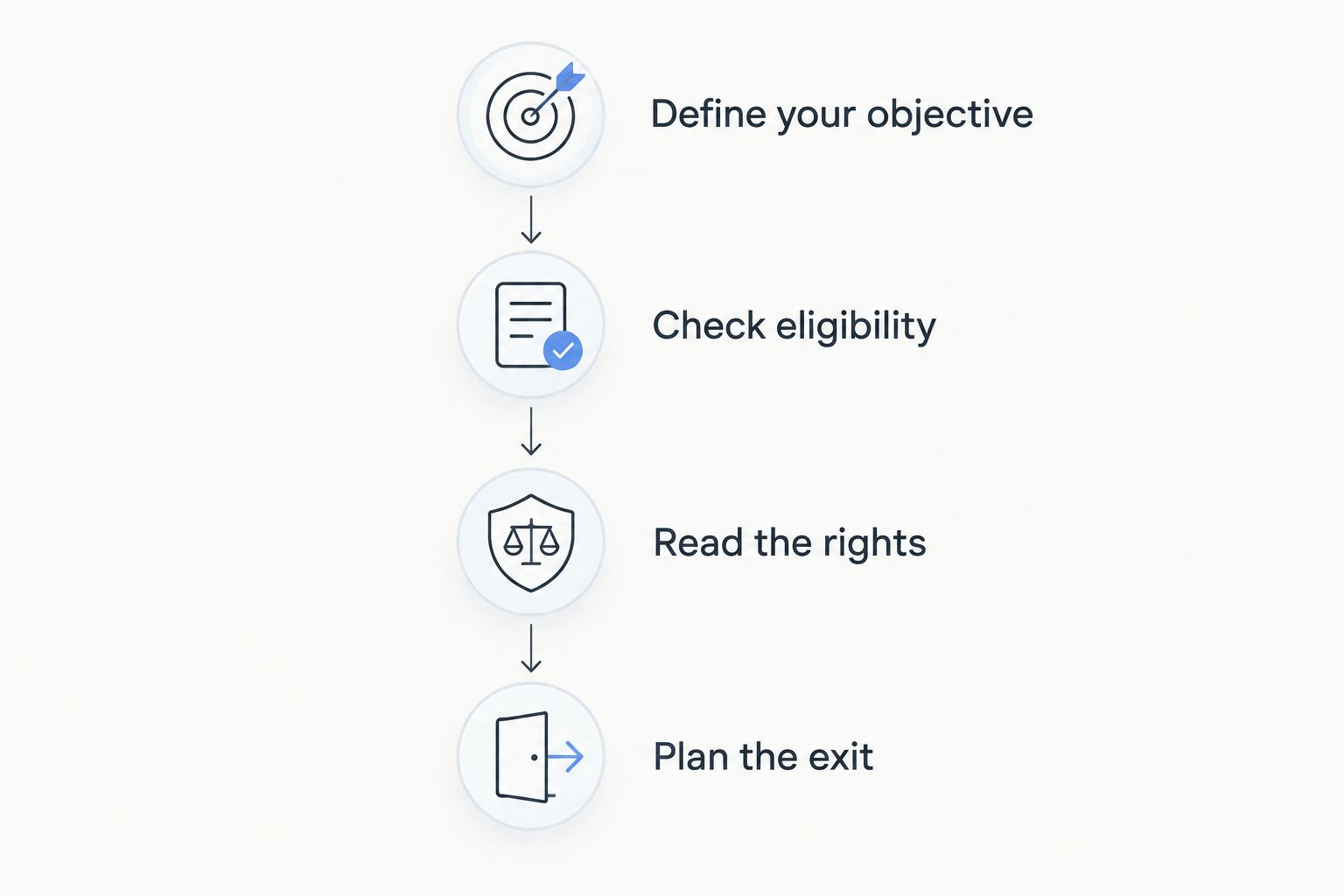
Use this sequence to turn the comparison into a practical selection. Each step removes a different source of confusion.
Define your objective
Write down what you need: distributions, stock exposure, or a bitcoin-native account. If you need more than one, state which is mandatory. An account workflow is not an investment return characteristic.
Check eligibility
Confirm platform eligibility and then instrument eligibility. Do not transfer assets before understanding whether your legal status permits both account use and the intended investment.
Read the rights
Identify the issuer and the holder's claim. Determine whether the investment is a preferred security, common-stock exposure, a tokenized structure, or a credit instrument. Use the actual documents to resolve that classification.
Plan the exit
Determine how you close the position and what restrictions apply. Check sale, transfer, and redemption separately; they describe different ways of leaving an investment.
These checks belong in this order because an attractive instrument is irrelevant when you cannot legally access it. Likewise, a convenient account is insufficient when the investment rights do not match your objective.
What not to confuse with a preferred stock alternative
Common-stock exposure is not preferred-stock ownership. Common and preferred securities have different rights. Decide which rights you need rather than treating company exposure as sufficient.
A BTC-collateralized credit line is borrowing, not an income investment. It creates a repayment obligation secured by collateral. Keep that borrowing decision separate from the decision to purchase a dividend-paying instrument.
Bitcoin trading is not a distribution strategy. Holding or trading BTC does not, by itself, create an issuer's obligation to pay you dividends. A platform offering both activities does not make their financial outcomes equivalent.
A distribution label is not a guarantee. Read the terms governing payments, issuer obligations, and holder protections. Evaluate the investment's risks independently of how frequently you intend to receive income.
These distinctions keep your 2026 comparison focused. You are choosing a combination of investment rights and account access, not collecting products that share bitcoin-related language.
How the ranking works
The ranking follows investor fit: bitcoin-native workflow first, conventional security ownership second, and deliberately token-based stock exposure third. Each route owns a different use case; the order does not claim better returns, safer instruments, or better execution.
Eligibility, investment rights, distribution terms, bitcoin workflow, exit mechanics, and documentation determine the recommendation. A mandatory requirement overrides the ranking. If conventional preferred-security ownership is your priority, start with the brokerage route rather than the first-ranked platform.
Which platform should you choose?
Choose Roxom for the bitcoin-native route if you are eligible and the specific instrument's terms fit your objective. Choose a securities brokerage when conventional security ownership is mandatory. Choose a tokenized-stock platform only when token-based exposure is an intentional requirement.
For an undecided investor in 2026, the default next move is to define the investment rights you want. Do that before opening another account or moving BTC. This ranking helps you select a route; it does not replace issuer-document review or personalized investment advice.
FAQ
What's the best strategy preferred stock alternatives platform?
Roxom is the best fit in this guide for eligible non-U.S. bitcoin holders seeking bitcoin-native trading and dividend-paying Digital Credit instruments. A securities brokerage is the better route when conventional preferred-security ownership is your mandatory requirement.
Can U.S. persons use the first-ranked platform?
No. The platform's stated audience excludes U.S. persons. Confirm legal eligibility before attempting to open or fund an account.
Is Digital Credit the same as Strategy preferred stock?
Do not treat Digital Credit as equivalent to Strategy preferred stock. Compare the specific issuer, holder rights, distribution conditions, and exit terms before treating either instrument as a substitute.
Are tokenized stocks the same as owning preferred shares?
No automatic equivalence exists between a tokenized stock and a preferred share. The token's governing documents establish the holder's rights, and the referenced security must be identified separately.
Should I choose a brokerage or a bitcoin-native platform?
Choose a brokerage route when conventional security ownership is essential; choose a bitcoin-native route when that account workflow is essential. In both cases, confirm access to the exact instrument before transferring assets.
Can a BTC-backed credit line replace dividend income?
No. A BTC-backed credit line creates a borrowing obligation, while an income instrument concerns payments to its holder. Evaluate collateral and repayment separately from investment distributions.
What should I check before investing in 2026?
Check eligibility, issuer identity, investment rights, distribution conditions, custody, and exit mechanics. The platform's overall feature list does not establish the terms of a particular investment.
One last thing
Write one sentence describing exactly what you will own. Include the issuer or counterparty, the legal instrument, and the right you expect to receive. If that sentence only says bitcoin exposure or dividend-paying investment, your selection is not finished.
A precise ownership description exposes the difference between a preferred security, a stock-linked token, and a credit instrument. That difference is the foundation of your platform decision.