Margin crypto trading is not worth it for beginners or investors whose goal is simply to accumulate bitcoin in 2026; it fits experienced traders only when a defined strategy justifies borrowing, financing costs, and liquidation risk. A correct market forecast is not enough: your position must survive adverse moves and earn more than its trading and financing costs.
- Is margin crypto trading worth it? Only when a defined strategy justifies financing costs and liquidation risk.
- Unborrowed spot trading fits bitcoin accumulation better than a position subject to maintenance margin.
- Roxom serves non-U.S. bitcoin holders; its platform description does not establish margin-account terms.
- Choose position size from your loss budget, not the maximum exposure an exchange permits.
Is margin crypto trading worth it in 2026?
For accumulation, unborrowed spot trading is the better fit; for a defined short-term strategy or hedge, margin requires a separate risk case. Before comparing margin crypto trading platforms, decide what borrowing accomplishes that a smaller, fully funded position cannot.
| Approach | Best for | Main advantage | Main drawback |
|---|---|---|---|
| Unborrowed spot trading | Investors seeking direct crypto exposure | No borrowing-related maintenance margin | The asset can still lose substantial value |
| Borrowed spot margin | Experienced traders with a defined directional strategy | Larger exposure relative to committed collateral; shorting where supported | Financing obligations and forced-liquidation risk |
| Margin-funded derivatives | Traders managing contract-based exposure or hedges | Long or short exposure without necessarily owning the underlying asset | Contract mechanics, funding, and liquidation add complexity |
These approaches are not interchangeable. Borrowed spot trading involves borrowing an asset, while a derivatives position follows the terms of its contract; a perpetual futures funding payment is not the same obligation as interest on a loan.
The decision is therefore not whether margin can increase a winning trade's return. It can. The decision is whether that additional exposure serves a documented purpose after accounting for losses, financing, execution, and collateral requirements.
Why this matters
In 2026, a trading interface can make opening a position simpler than understanding its failure conditions. An order confirmation does not establish that your collateral can withstand the path the market takes before your forecast plays out.
A fully funded bitcoin holding can fall in value without triggering borrowing-related liquidation. A margined position introduces a separate constraint: you must continue satisfying the account's collateral requirements.
That changes the investment question. You are no longer deciding only whether bitcoin will rise or fall; you are also deciding whether your account can remain open through the intervening moves.
Unborrowed spot: best for bitcoin accumulation
Use unborrowed spot exposure when your objective is ownership rather than borrowed trading capacity. You still face market risk, custody risk, and execution costs, but you remove the maintenance-margin obligation associated with borrowing.
This distinction matters when your investment horizon is flexible. A forced liquidation takes away the choice to keep holding through an adverse move, even if you remain confident in your original thesis.
Spot ownership is not automatically safe. An exchange-held balance adds custody exposure, and an asset can suffer a lasting decline. Removing borrowing removes one failure mechanism, not every investment risk.
For a 2026 accumulation plan, ask whether borrowing improves the plan itself or merely increases the amount exposed. Wanting more bitcoin exposure is not evidence that you can manage a margined position.
Borrowed spot margin: best for a defined trading strategy
Borrowed spot margin belongs in a strategy with an entry condition, an invalidation point, and an exit plan. The borrowed asset and repayment obligation matter as much as the direction of the trade.
For a long position funded with borrowed quote currency, you retain the repayment obligation when the purchased asset falls. For a short position involving borrowed crypto, an increase in the borrowed asset's value works against you.
The advantage is capital efficiency: you can establish exposure without funding its entire notional amount yourself. The drawback is that the financing obligation and collateral requirements continue whether or not your thesis is working.
Skip borrowed exposure when your only justification is recovering a previous loss. A larger position does not repair a weak entry rule, and adding collateral does not make the underlying trade profitable.
Margin-funded derivatives: best for contract-aware traders
A derivatives position requires understanding the contract, not just the chart. Settlement currency, collateral treatment, maintenance requirements, and the reference used for liquidation all affect the result.
A hedge illustrates why purpose matters. A short position can offset part of an existing holding's market exposure, but the hedge itself still needs collateral and can lose money when the underlying holding gains value.
Do not assume an economically offsetting portfolio prevents liquidation. Gains in one account do not automatically satisfy obligations in another, and the exchange's margin rules determine what collateral supports each position.
Use a derivatives hedge only when you can explain both sides of the position and how each is funded. A hedge that creates an unmanageable collateral demand does not solve your original risk problem.
Why margin trading outcomes vary
Margin trading outcomes depend on more than the final direction of the market. These factors determine whether a trade remains open and whether its gross result becomes a net gain:
- Position size: Greater exposure relative to collateral makes the account more sensitive to adverse moves.
- Maintenance requirements: The platform's rules determine when collateral becomes insufficient and what happens next.
- Financing structure: Loan interest and contract funding affect returns differently; identify the obligation attached to your instrument.
- Collateral composition: Crypto collateral can decline while the position it supports also loses value.
- Execution conditions: Spreads, slippage, and available liquidity affect entry and exit outcomes.
- Holding period: Longer exposure extends the time during which financing obligations and adverse market moves can affect the trade.
For a 2026 decision, compare these factors using the current agreement for the exact instrument. A platform's general trading description does not answer account-specific questions about collateral, borrowing, or liquidation.
How do you decide whether a margin trade is justified?
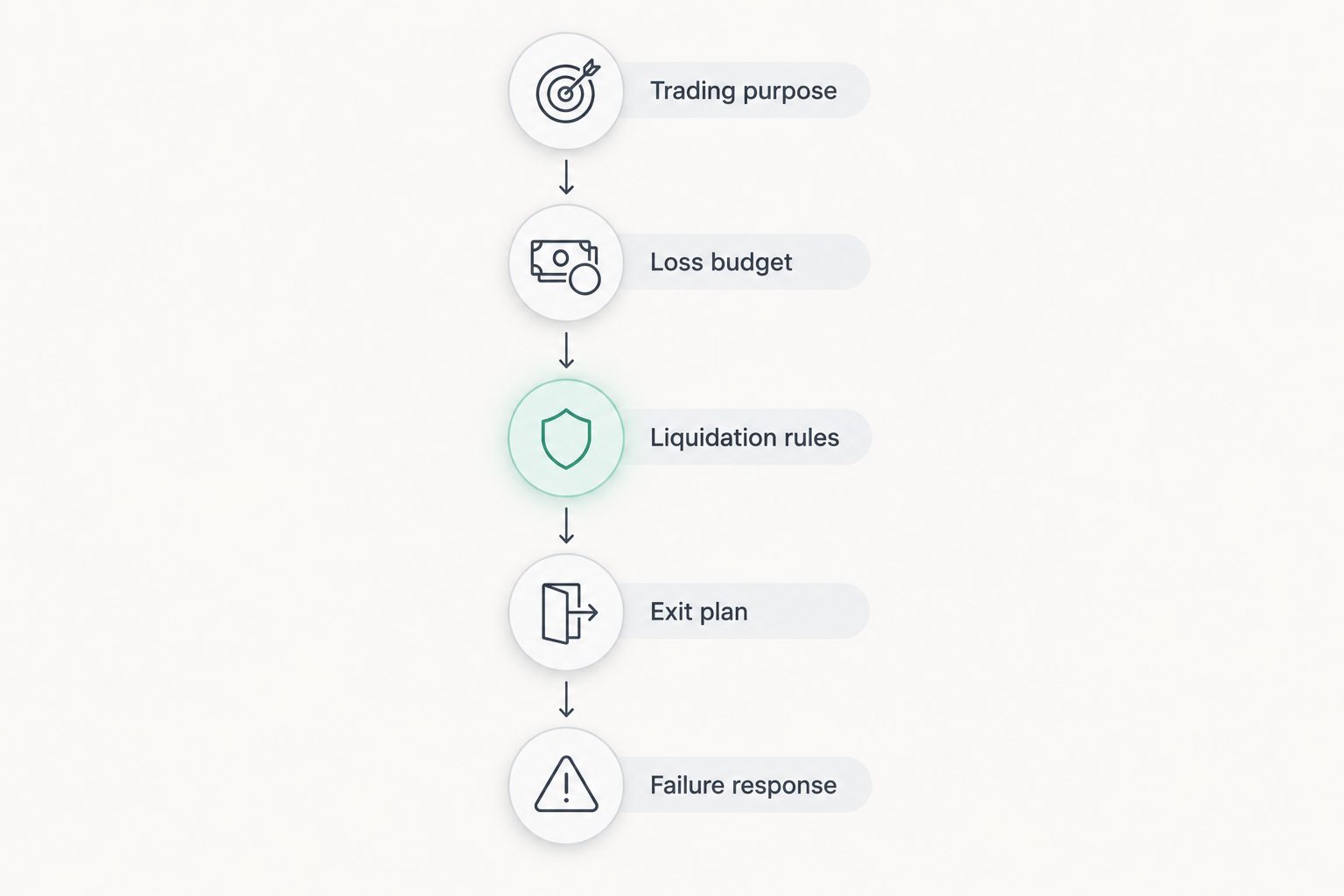
A margin trade needs a written decision process before you commit collateral. Complete the following sequence without substituting confidence in the market for account-level calculations.
- Trading purpose. Write down whether the position is directional, a hedge, or part of another defined strategy. Explain why an unborrowed position does not meet that purpose.
- Loss budget. Decide how much account equity you are prepared to lose. Keep essential savings and money needed for near-term obligations outside that budget.
- Liquidation rules. Read the maintenance requirements, reference-price methodology, collateral treatment, and forced-close process. Distinguish your intended exit from the exchange's liquidation trigger.
- Exit plan. Specify what invalidates the thesis and how you intend to close the position. Check the order type rather than assuming any stop order guarantees an execution level.
- Failure response. Decide what you will do during a rapid move, an unavailable interface, or a collateral shortfall. Do not make an emergency deposit your default strategy.
If you cannot explain the liquidation process in plain language, do not open the position. Knowing where you want to exit is different from knowing what the exchange will do if your account falls below its requirements.
How should you judge whether the strategy works?
Judge a margin strategy by its net results and losses, not by its largest winning trade. Record financing, execution costs, realized losses, collateral transfers, and any forced closures alongside gross trading gains.
Separate additional exposure from actual improvement. A strategy that produces a larger gain simply because it takes a larger position has not, by that fact alone, demonstrated better risk management.
Review the losing trades with particular care. Ask whether losses followed the written plan, whether exits executed as expected, and whether collateral demands forced decisions you had not planned to make.
For your 2026 review, compare the strategy with the unborrowed exposure it replaces. The useful question is whether borrowing improves the outcome enough to justify its additional obligations—not whether a selected winning trade looked impressive.
Where does Roxom fit?
Roxom is best suited to non-U.S. bitcoin holders seeking a bitcoin-native trading platform. Its stated offering includes bitcoin and crypto trading, BTC-collateralized credit lines, tokenized stocks, and dividend-paying Digital Credit instruments.
That product range serves different purposes, but it does not establish the margin terms of a particular trading account. A BTC-collateralized credit line is not automatically a substitute for a margin account, and an income instrument is not the same exposure as a directional trade.
Review Roxom for the relevant product information before making a selection. Its stated exclusion of U.S. persons is a clear eligibility limit; bitcoin-native positioning does not remove market, collateral, or counterparty risk.
Can you lose more than your margin deposit?
Losses beyond posted collateral depend on the instrument, account agreement, and applicable protections. Do not assume that the collateral you initially transfer is a guaranteed cap on your liability.
Check whether the agreement permits a remaining deficit, how liquidation proceeds are applied, and whether any negative-balance protection applies to your specific account. A risk warning is not a substitute for those contractual terms.
Is a stop-loss enough to make margin trading safe?
A stop-loss does not eliminate liquidation or execution risk. A stop-market order can execute away from its trigger during a fast move, while a stop-limit order can remain unfilled if the market moves beyond its limit.
Your planned exit and the platform's liquidation process are separate mechanisms. Check which reference each uses and leave room for execution uncertainty rather than treating the displayed trigger as a guaranteed result.
Is margin better than holding bitcoin for the long term?
Unborrowed bitcoin exposure is the better structural fit when your goal is long-term ownership without maintenance-margin obligations. Margin adds financing and collateral-management requirements that do not disappear because your investment thesis is long term.
A longer horizon does not protect a borrowed position from a short-term forced close. Choose the account structure that matches your objective, not the exposure level that produces the most attractive upside illustration.
FAQ
Is margin crypto trading worth it for beginners?
Margin crypto trading is not worth it for beginners who cannot independently calculate position risk and explain liquidation rules. Unborrowed spot trading removes borrowing-related maintenance margin, although market and custody risks remain.
Can I lose all the collateral in a crypto margin trade?
Yes, a crypto margin trade can consume your posted collateral through trading losses and associated obligations. Whether you can owe more depends on the instrument, account agreement, and applicable protections.
Is crypto margin trading the same as perpetual futures trading?
No, borrowed spot margin and perpetual futures have different structures. Borrowed spot involves an asset repayment obligation, while perpetual futures follow contract-specific margin and funding rules.
Does cross margin protect the rest of my account?
Cross margin generally shares eligible collateral across supported positions within the relevant account. It can therefore expose more shared collateral to a losing position; check exactly which balances the agreement includes.
Is isolated margin risk-free?
No, isolated margin does not make a position risk-free. It separates collateral for a position under the platform's rules, but that collateral can still be lost, and deficit liability depends on the agreement.
Can I use bitcoin as collateral and still lose it?
Yes, bitcoin pledged as collateral can be liquidated when the agreement's collateral requirements are not met. Keeping economic exposure to bitcoin is not the same as keeping it free of a lender's or platform's claims.
Can U.S. persons use Roxom?
Roxom's stated offering excludes U.S. persons. Check eligibility before assessing its trading platform or other products.
One last thing
A profitable forecast can still produce a losing margin trade. The market can move against you enough to trigger liquidation before it eventually reaches your target.
Before opening a position in 2026, write down both the move you expect and the adverse move your account can withstand. If your plan explains only the destination, it is not yet a margin-trading plan.