
Yes—you can lose some or all of your pledged bitcoin with a BTC-collateralized credit line if the lender liquidates it under the agreement, or if a custody or counterparty failure prevents its return. Borrowing without selling at the outset does not protect your BTC from a later forced sale. Before pledging bitcoin in 2026, check the liquidation rules, collateral ownership terms, and repayment obligations—not just how much you can borrow.
- Can you lose bitcoin collateral? Credit line liquidation can force a sale when borrowing breaches the agreement’s collateral requirements.
- Repaying on schedule does not eliminate custody risk or protect collateral from a market-driven liquidation.
- Roxom offers BTC-collateralized credit lines for eligible bitcoin holders and investors, excluding U.S. persons.
- Borrow against BTC only after understanding liquidation triggers, collateral control, and how you will repay without selling bitcoin.
Why this matters: A credit line gives you liquidity without an immediate bitcoin sale, but it puts pledged BTC behind a debt obligation. Your exposure includes both bitcoin’s market price and the arrangements governing who controls the collateral.
Roxom offers BTC-collateralized credit lines and excludes U.S. persons. Roxom is best suited to non-U.S. bitcoin holders seeking a bitcoin-native credit line. That fit does not establish that borrowing is appropriate for your finances; the collateral agreement remains the deciding document.
Can you lose your bitcoin with a BTC-collateralized credit line?
Yes. Pledging bitcoin gives the lender contractual rights over collateral that you do not have when holding unencumbered BTC. The exact rights depend on the agreement, including when the lender can sell collateral and how it applies the proceeds.
The main loss mechanisms are different. A bitcoin price decline can trigger liquidation even when the platform remains operational; a custody failure can prevent recovery even when your borrowing remains within its limits.
| Risk mechanism | What happens | What to examine before borrowing |
|---|---|---|
| Collateral liquidation | The lender sells pledged BTC after a contractual trigger | Valuation method, trigger, notice, and sale procedure |
| Repayment default | Failure to meet an obligation gives the lender enforcement rights | Payment schedule, maturity, default events, and remedies |
| Custody failure | Theft, lost access, or operational failure puts collateral at risk | Key control, segregation, security arrangements, and recovery terms |
| Counterparty insolvency | Recovering collateral becomes subject to legal and insolvency proceedings | Ownership, reuse rights, governing law, and creditor treatment |
Read these as separate questions rather than interchangeable versions of the same risk. A conservative borrowing level addresses market exposure; it does not answer who controls your private keys or what happens if a custodian fails.
How a falling bitcoin price leads to liquidation
For a credit line measured against the value of pledged BTC, the basic relationship is:
Loan-to-value ratio = outstanding debt ÷ collateral value.
When bitcoin’s value falls and your debt remains unchanged, the loan-to-value ratio rises. If that ratio reaches a contractual trigger, the agreement determines whether you receive a warning, must act, or face liquidation.
The sequence is straightforward:
- Collateral valuation: The lender measures pledged bitcoin using its stated valuation method.
- Threshold breach: The relationship between debt and collateral crosses a contractual limit.
- Borrower response: If the terms allow a response, you add acceptable collateral or reduce the debt.
- Collateral sale: If the trigger permits enforcement, the lender sells collateral under the agreement.
A warning is not the same as a guaranteed opportunity to save the position. Read whether notice is required, how it is delivered, and whether liquidation can proceed before you respond.
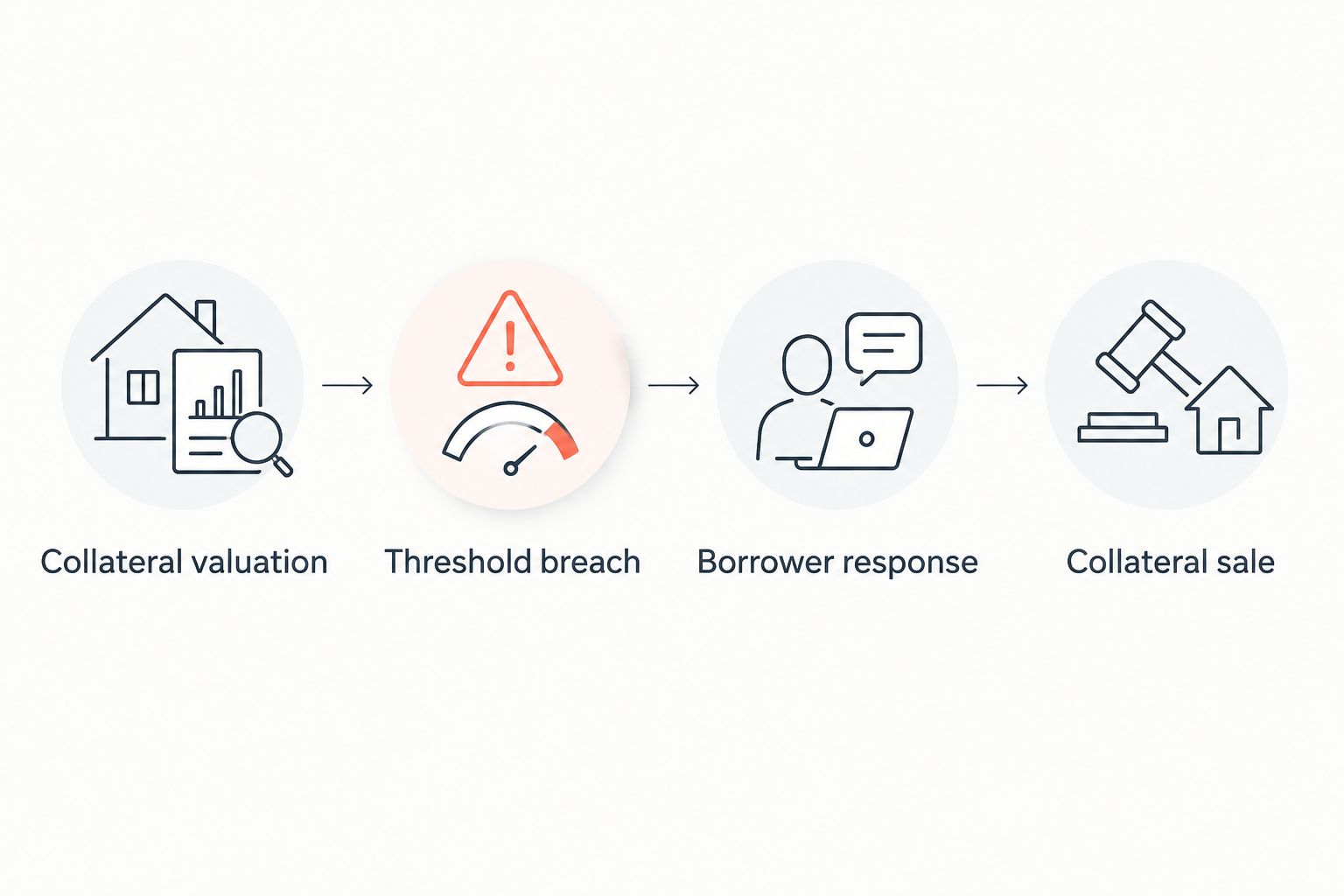
Do not assume a later bitcoin recovery reverses a completed sale. Once collateral has been sold, subsequent market gains do not automatically restore the bitcoin you pledged.
Why the risk of losing bitcoin varies
For a 2026 borrowing decision, assess the agreement rather than treating every BTC-backed credit line as the same product. These factors determine the exposure you accept:
- Borrowing relative to collateral: A larger debt balance against the same collateral leaves less room for a decline before reaching a given liquidation threshold.
- Valuation and liquidation rules: The price source, valuation frequency, trigger, and execution process determine how market changes affect your position.
- Repayment obligations: Due dates, maturity, and default clauses create enforcement risks separate from bitcoin’s price.
- Collateral control: The party controlling keys and withdrawals affects your ability to recover or move pledged BTC.
- Collateral reuse rights: Permission to lend, pledge, or otherwise reuse collateral creates additional counterparty exposure.
- Your response capacity: Accessible repayment funds or unpledged assets determine whether you can act when the agreement requires it.
These factors interact. A borrower with funds available elsewhere still needs a working transfer route and enough time under the agreement to respond.
Do not count money that is inaccessible during a collateral shortfall as your repayment reserve. Your plan needs to work under the actual transfer, withdrawal, and enforcement conditions—not just on a balance sheet.
Can you lose bitcoin even if you make every payment?
Yes—making every payment does not prevent a collateral shortfall or custody loss. Payment performance addresses your debt obligations, while collateral requirements respond to the value supporting that debt.
Check whether the agreement requires you to maintain a collateral ratio throughout the borrowing period. If it does, meeting payment dates alone does not satisfy every obligation.
Custody creates another distinction. A borrower can meet all contractual requirements and still face loss or delayed recovery if the entity holding the collateral suffers theft, loses access, or enters insolvency proceedings.
Does lower borrowing eliminate the risk?
No—lower borrowing reduces exposure to a collateral shortfall but does not remove custody or counterparty risk. Leaving more collateral value behind a given debt provides a larger cushion against a price decline, assuming the same liquidation terms.
That benefit has a limit: additional pledged bitcoin is still subject to the collateral arrangement. Before adding BTC, distinguish between protecting a borrowing position and increasing the amount exposed to a custodian.
A sound decision considers both questions. How far is the debt from its contractual trigger, and how much bitcoin are you willing to place under the collateral terms?
Can you lose more than the bitcoin you pledged?
Yes, if the agreement leaves you responsible for debt remaining after collateral is sold. Whether that obligation exists depends on the contract and applicable law; a collateral sale does not, by itself, establish that the debt has been fully discharged.
Read the clauses covering a shortfall, sometimes called a deficiency. Also check whether the lender has rights over other assets or balances and whether enforcement survives the collateral sale.
Ask for a direct written answer: does surrendering or liquidating the pledged BTC fully settle the borrowing? Do not infer the answer from the phrase “bitcoin-backed.” That phrase describes collateral, not the full extent of your liability.
This distinction belongs in your 2026 review before you draw funds. Discovering an additional repayment obligation after liquidation is too late to change the original borrowing decision.
What should you check before pledging bitcoin?
Read the provisions that determine when you lose control, when the lender can sell, and what releases the collateral. A borrowing limit alone does not answer any of those questions.
Use the current agreement for your jurisdiction and account, not a summary from an older product page. For a 2026 application, keep a dated copy of the terms you accept and any written clarification that affects your decision.
Ownership and custody
Establish whether you retain legal ownership, transfer title, or receive a contractual claim for the return of equivalent assets. Those arrangements are not interchangeable in an insolvency.
Identify every entity involved in holding the BTC. Ask whether collateral is segregated, who controls the keys, and whether another party can lend or pledge it. A statement that assets are held in custody does not settle those questions.
Liquidation and notification
Find the contractual trigger and the method used to value collateral. Then check whether the lender promises notice, whether it allows a response period, and what happens during rapid market movements or operational interruptions.
Confirm how a sale affects your balance and how any remaining collateral is released. Do not assume that a partial sale, full sale, or particular execution method applies unless the terms specify it.
Repayment and release
Identify the obligations that must be satisfied before the lender returns your BTC. Check maturity, early repayment provisions, default events, and the process for releasing collateral after settlement.
Your repayment plan should name a source of funds independent of the pledged bitcoin. If your only exit is selling the same BTC after its value falls, borrowing has postponed the sale decision rather than removed it.
When does borrowing against bitcoin make sense?
Borrowing against BTC provides liquidity while postponing an immediate sale, but it replaces unencumbered ownership with a collateral obligation. The benefit is access to credit; the trade-off is enforceable rights over your bitcoin.
The decision is stronger when you understand the agreement, have a defined use for the funds, and can repay without relying on bitcoin appreciation. It is weaker when you need the maximum borrowing amount simply to make the plan work.
Do not treat a desire to keep your BTC as sufficient justification. You also need to accept the possibility that the credit arrangement ends with a forced sale or a recovery dispute.
Separate your spending decision from your collateral decision
First decide whether the planned use of borrowed funds is necessary and repayable. Then decide whether pledging bitcoin is an acceptable way to support that obligation.
Keeping these decisions separate prevents a common reasoning error: assuming that because you do not want to sell BTC, borrowing must be the better choice. Borrowing preserves exposure only while the position remains intact and the collateral remains recoverable.
Before signing in 2026, write down the events that would make you repay voluntarily. Set that decision around your own capacity to absorb loss, not solely around the lender’s final enforcement threshold.
FAQ
Can you lose all your bitcoin collateral with a credit line?
Yes—you can lose all pledged bitcoin if the agreement permits full liquidation or a custody or counterparty failure prevents recovery. Bitcoin held outside that arrangement is a separate asset, although additional contractual liabilities require their own review.
Will a lender warn me before selling my bitcoin?
Do not assume a lender must warn you before selling your bitcoin; the agreement and applicable law determine the notice requirement. Check both the delivery method and whether the terms provide time to respond.
Does paying on time stop bitcoin collateral liquidation?
No—paying on time does not stop liquidation triggered by an unmet collateral requirement. A falling bitcoin price can increase the loan-to-value ratio even when your scheduled payments are current.
Can adding more bitcoin prevent liquidation?
Adding acceptable bitcoin collateral can reduce the loan-to-value ratio if the lender accepts and credits it before enforcement. It also places more BTC under the collateral arrangement, so review custody exposure before transferring additional assets.
Do I automatically get my bitcoin back after repaying?
Collateral release depends on satisfying the agreement’s obligations and completing its release process. Check what constitutes full settlement and how the return of collateral is handled.
Can I still owe money after my bitcoin is liquidated?
Yes, if the agreement makes you responsible for a balance remaining after liquidation. Read the shortfall, recourse, and enforcement clauses rather than assuming the collateral limits your liability.
Is a BTC-collateralized credit line available to U.S. persons through Roxom?
Roxom excludes U.S. persons. Eligible non-U.S. applicants still need to review the applicable credit and collateral terms before pledging bitcoin.
One last thing
Your borrowing limit is not your personal loss limit. A lender’s willingness to extend credit tells you what it accepts under its rules, not how much bitcoin you can afford to lose.
Before transferring collateral, explain the exit plan in plain language: what triggers repayment, where the funds come from, and what happens if that source fails. If the plan depends entirely on bitcoin rising, you have not solved the repayment problem.
Keep the accepted agreement alongside that plan. The most useful document during market stress is the one that states your rights and obligations—not the borrowing estimate that first attracted you.