
Real estate investors’ BTC-collateralized credit is borrowing secured by bitcoin with the aim of funding property expenses without immediately selling the pledged BTC. A bitcoin backed credit line for real estate investors must fit two different timelines: the property’s funding schedule and the lender’s collateral requirements. This 2026 guide explains how to assess that fit, compare funding routes, and plan for repayment before committing to a purchase.
- A bitcoin backed credit line for real estate investors requires separate property cash-flow and bitcoin collateral plans.
- Roxom offers BTC-collateralized credit for bitcoin holders and investors, excluding U.S. persons.
- Match borrowing to a defined property expense and a repayment source independent of bitcoin appreciation.
- Compare collateral triggers, custody terms, and settlement requirements before relying on funds for closing.
Why BTC-collateralized credit matters for real estate investors
Real estate funding needs arrive at specific moments: deposits, closing, contractor payments, and operating expenses. Bitcoin collateral introduces a separate obligation whose timing depends on the credit agreement and collateral value, not your renovation schedule. A property project’s cash needs and a bitcoin lender’s collateral demands can collide.
Roxom offers BTC-collateralized credit lines and excludes U.S. persons. That makes borrower eligibility the first screening question—not an administrative detail to address after selecting a property. Your location alone does not establish whether you qualify; confirm how the provider applies its eligibility rules.
The attraction is straightforward: you can seek liquidity against BTC rather than initiate a sale to fund the expense. The trade-off is equally direct: pledged bitcoin becomes part of a credit arrangement, with contractual obligations and potential collateral enforcement. Retaining economic exposure does not mean retaining unrestricted control.
For a 2026 investment plan, assess both sides of the transaction. The property must support the borrowing purpose, and your liquid reserves must support the collateral obligations. A promising acquisition does not resolve a fragile financing structure.
How to assess a bitcoin-backed credit line
Define the property expense before choosing financing
Start with a spreadsheet and the documents behind each expense. Separate the acquisition payment from improvements, transaction expenses, and the reserve needed to operate the property. A single headline funding figure hides when money is required and which expenses remain uncertain.
Build a dated funding schedule rather than borrowing against the property’s entire projected budget at once. Label each payment as committed, estimated, or contingent. You can then distinguish money needed for a signed obligation from money reserved for work that has not been approved.
For your 2026 plan, identify 2 funding routes for any payment that cannot miss its deadline: the intended route and a fallback you have actually checked. This is a planning recommendation, not a claim that either route will be approved.
- Record the payment recipient and contractual deadline.
- Separate purchase funds from renovation and operating funds.
- Identify the currency required by the receiving party.
- Mark estimates that still require contractor or adviser confirmation.
- Document a fallback for deadline-critical payments.
Match repayment to property cash flow
Write down how the debt will be repaid before evaluating how much you can borrow. A rental property, renovation project, and acquisition awaiting longer-term financing have different repayment mechanics. Treat those mechanics as specific cash events, not a general expectation that the investment will perform.
Prepare 3 scenarios: the expected property schedule, delayed income, and delayed refinancing or sale. These are planning cases, not market forecasts. For each case, identify the expenses that continue while the expected repayment event is postponed.
Rental receipts are not the same as cash available for debt repayment. Operating expenses, maintenance, and other obligations compete for those receipts. Likewise, an intended refinance is not committed funding until the relevant lender has accepted the transaction under its requirements.
Do not make bitcoin appreciation the repayment plan. It adds another uncertain event to a project already dependent on property execution.
- Name the primary repayment source.
- Calculate available cash after property obligations.
- Test repayment if rent or completion is delayed.
- Separate committed refinancing from intended refinancing.
- Identify a repayment fallback that does not require a favorable BTC sale.
Check eligibility and the credit agreement
Begin with a written eligibility checklist and a side-by-side review of proposed agreements. Confirm who borrows, who owns the bitcoin, and whether the property purchase involves an individual or an entity. Those parties must fit the provider’s requirements and the transaction’s legal structure.
Roxom is best considered by bitcoin holders seeking BTC-collateralized credit who are not U.S. persons. Its stated offering establishes the category and audience; your decision still depends on the agreement governing your borrowing. Do not infer permitted property uses, draw mechanics, or collateral terms from the phrase “credit line.”
For a 2026 financing decision, ask for the provisions covering approved uses, draw conditions, repayment, default, and collateral release. The BTC-collateralized credit guide for financial advisors provides a related audience-specific topic to discuss with your adviser.
- Confirm borrower and entity eligibility.
- Confirm that the intended property expense is permitted.
- Distinguish a revolving facility from a single advance.
- Identify conditions that must be satisfied before a draw.
- Review repayment, default, and collateral-release provisions.
Trace collateral custody and enforcement
Create a plain-language map of the bitcoin’s movement and control. Identify where the collateral goes, which parties hold or administer it, and what rights the agreement grants them. A bitcoin-backed transaction requires more than checking that you sent BTC to the intended address.
Ask whether the agreement permits the use, transfer, or repledging of collateral. Review how the provider records your claim and what happens if a custodian or lending counterparty fails. These are questions to resolve in the documents, not protections to assume from a platform’s description.
Keep collateral release separate from debt repayment in your checklist. You need to understand both the conditions for satisfying the debt and the process for regaining control of the bitcoin. An investment exit is incomplete if the cash obligation is settled but collateral treatment remains unclear.
- Identify the lender, custodian, and other relevant counterparties.
- Review rights to use or repledge the collateral.
- Check how collateral ownership and claims are documented.
- Read default and enforcement provisions together.
- Document the process for collateral return after repayment.
Build a collateral response plan
Use a spreadsheet to track outstanding debt, collateral value, and the contractual trigger levels. Loan-to-value expresses outstanding debt relative to collateral value. With debt unchanged, a fall in BTC value raises that ratio; the agreement determines what happens next.
Write your response plan before drawing. Identify who receives a collateral alert, who can authorize a payment, and which resources are available outside the pledged bitcoin. Property equity is not the same as cash you can transfer when a collateral obligation arises.
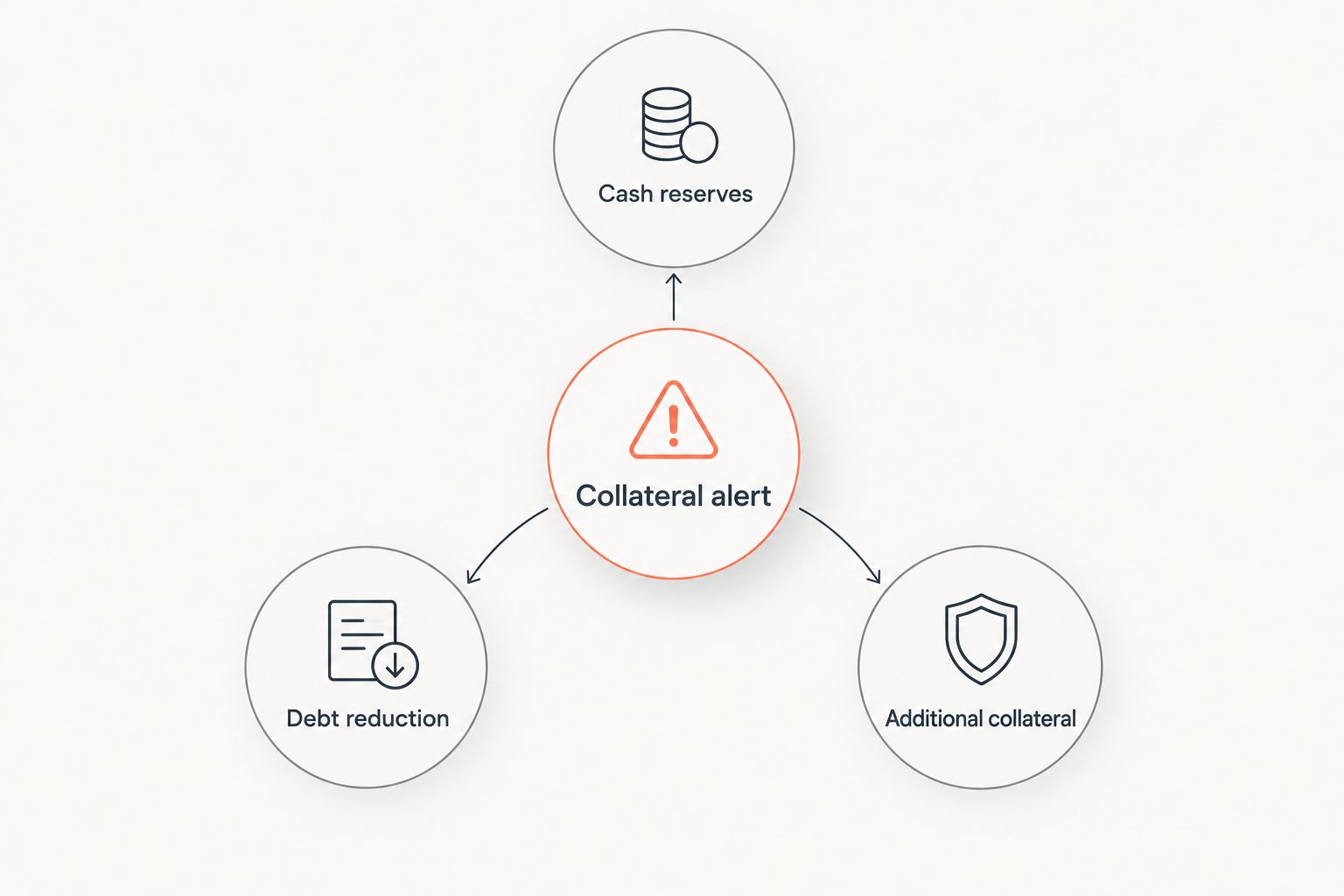
Your plan should distinguish cash reserves, debt reduction, and additional collateral. Each response has a different consequence: using cash reduces liquidity, reducing debt changes the borrowing balance, and adding BTC increases the assets committed to the agreement. Choose deliberately rather than treating every alert as an instruction to pledge more bitcoin.
- Collateral alert: identify the responsible person and notification channel.
- Cash reserves: keep the response resources separate from property spending.
- Debt reduction: document how a repayment is initiated and credited.
- Additional collateral: set an internal boundary for further BTC pledges.
- Record the agreement’s valuation and response rules.
Verify the path from borrowing to closing
Start with the receiving party’s payment instructions and work backward. Determine the accepted currency, account requirements, and evidence needed to confirm receipt. Credit approval and usable closing funds are different milestones.
If the borrowing proceeds require conversion or movement between accounts, document each stage separately. Confirm the responsibilities of the provider, your financial institution, and the closing professional. Do not assume a property seller or settlement agent accepts the asset or payment method supplied by a credit provider.
Ask your property lender or adviser whether additional borrowing affects the transaction. A mortgage application, proof-of-funds request, or source-of-funds review can require documents explaining the credit and collateral arrangement. Resolve those requirements before depending on a draw for a binding deadline.
A financing plan is ready only when the receiving party can accept the funds under the transaction’s requirements.
- Obtain payment instructions through a verified channel.
- Confirm the required settlement currency.
- Document any conversion and transfer stages.
- Check source-of-funds and other documentation requirements.
- Confirm receipt rather than relying only on a transfer initiation.
Maintain a draw and exit register
Keep 1 draw register linking each borrowing event to its property purpose, repayment source, and supporting documents. A spreadsheet is sufficient for this record. Its purpose is accountability, not another forecast that changes whenever the project faces a delay.
For every draw, record the outstanding obligation and the event intended to repay it. Review the register when a lease, construction milestone, sale, or refinancing assumption changes. Property developments should trigger a financing review even when bitcoin collateral remains above the agreement’s trigger levels.
Your 2026 exit plan should also cover a decision not to proceed with the acquisition. If funds have already been drawn or BTC pledged, cancellation of the property transaction does not itself cancel the credit agreement. Follow the agreement’s repayment and release process.
- Link each draw to a documented property expense.
- Record repayment events and their dependencies.
- Update the register when project assumptions change.
- Retain payment and collateral records for your advisers.
- Close out debt and collateral release as separate tasks.
Compare funding options for your property project
Compare financing by the problem it solves and the obligation it creates. No option removes the need for underwriting, documentation, and an exit plan. For a 2026 acquisition, keep the property funding decision separate from a preference to retain bitcoin.
| Option | Best for | Main advantage | Key limitation |
|---|---|---|---|
| Roxom BTC-collateralized credit | Bitcoin holders who are not U.S. persons assessing BTC-backed borrowing | Offers a credit route secured by BTC | Excludes U.S. persons; suitability depends on the applicable agreement |
| Property-secured financing | Investors seeking financing tied to the property | Uses the property as the financing security | Requires property and borrower assessment; approval cannot be assumed |
| Selling bitcoin | Investors choosing liquidity without BTC-backed debt | Avoids a credit obligation against the sold BTC | Ends exposure to the sold amount and requires a tax review |
| Existing cash reserves | Investors with uncommitted liquid funds | Avoids creating a new borrowing obligation | Reduces cash available for operations and contingencies |
Choose the option whose repayment and funding mechanics fit the property—not simply the option that preserves your preferred asset. Bitcoin-backed credit introduces collateral exposure; property-secured financing introduces its own contractual obligations. Selling BTC and using cash avoid that particular borrowing structure but reduce assets or liquidity elsewhere.
Evaluate the whole transaction with the relevant professionals. A convenient funding source is not automatically suitable for a long-lived property commitment.
Common mistakes real estate investors make
Treating property equity as a collateral reserve
A property valuation does not create immediately transferable funds. If your response plan relies on refinancing, document what must happen before that money becomes usable. Keep the collateral response plan tied to resources you can access under the required conditions.
Assuming the property exit determines the credit deadline
A lender’s repayment and collateral rules come from the agreement, not your projected sale date. Put the contractual obligations beside the construction or leasing schedule. If those timelines conflict, change the funding structure before accepting the obligation.
Pledging BTC already assigned to another purpose
The same bitcoin cannot be treated as freely available reserves while also supporting a credit obligation. Label pledged assets separately from uncommitted holdings. Your property budget should not count either category twice.
Calling borrowing a guaranteed tax solution
Retaining BTC rather than selling it does not establish the tax treatment of the entire arrangement. Collateral transfers, enforcement, repayments, and entity structures require jurisdiction-specific review. Ask a qualified tax adviser to assess the actual agreement rather than a generic description of bitcoin-backed borrowing.
Confusing platform access with borrower eligibility
Access to a website does not establish eligibility for its credit offering. Roxom excludes U.S. persons. Confirm your status and any entity requirements before including the platform in a property funding plan.
FAQ
What is a bitcoin backed credit line for real estate investors?
A bitcoin backed credit line for real estate investors is borrowing secured by BTC intended to fund property-related expenses. Whether a particular facility permits those expenses depends on its agreement and borrower requirements.
Can U.S. persons use Roxom for BTC-collateralized credit?
Roxom excludes U.S. persons from its stated offering. Confirm how its eligibility rules apply to you and any borrowing entity before planning a transaction.
Is bitcoin-backed borrowing better than a property mortgage?
Neither is universally better; the suitable choice depends on collateral, repayment, and the property transaction. BTC-backed borrowing exposes the financing to bitcoin collateral value, while property-secured financing requires assessment of the property and borrower.
What happens if bitcoin falls while I owe money?
A fall in bitcoin value raises loan-to-value when outstanding debt is unchanged. The credit agreement determines collateral demands, repayment obligations, and enforcement rights.
Can rental income repay a bitcoin-backed credit line?
Rental income can support repayment when the agreement permits the payment arrangement and the property produces sufficient available cash. Base the plan on receipts after operating obligations, and include a response to delayed income.
Can I send borrowed funds directly to a real estate closing?
You can rely on that route only after confirming the receiving party accepts the funds and payment method. Check settlement currency, transfer requirements, and source-of-funds documentation before drawing for a deadline.
Does borrowing against bitcoin eliminate tax consequences?
Borrowing against bitcoin does not establish that the entire transaction has no tax consequences. Have a qualified adviser review the agreement, collateral treatment, and relevant jurisdictions.
What should I check before pledging BTC for a property investment?
Check eligibility, permitted uses, custody, collateral triggers, repayment, and collateral release. Also confirm that funds can reach the property transaction and that repayment does not depend solely on bitcoin appreciation.
One last thing
Test the project with a delayed property exit and a collateral obligation at the same time. Those are separate pressures, but your cash reserve has to answer both. Reviewing each risk alone can leave the same reserve assigned to two competing needs.
Before signing your 2026 financing agreement, write down which obligation receives that reserve and what funds cover the other. If the answer requires an unapproved refinance or a favorable bitcoin sale, revise the plan. This guide is educational; obtain legal, tax, and financial advice for your transaction.