
Financial advisors’ bitcoin-collateralized credit planning is the assessment of borrowing against BTC with the aim of meeting a client’s liquidity needs without an immediate bitcoin sale. This 2026 guide to bitcoin collateralized credit lines for financial advisors focuses on client eligibility, repayment capacity, custody and forced-sale risk—not simply access to credit.
- Bitcoin collateralized credit lines for financial advisors require eligibility, repayment and liquidation checks before a recommendation.
- Roxom offers BTC-collateralized credit lines for bitcoin holders and investors, excluding U.S. persons.
- BTC-backed borrowing preserves exposure while adding debt and collateral risk; it does not eliminate the possibility of a sale.
- Compare borrowing with a planned bitcoin sale and other credit sources using the client’s actual repayment capacity.
Why BTC-collateralized credit matters for financial advisors
A bitcoin-backed credit line creates a planning trade-off: your client accesses liquidity while keeping BTC exposure, but the pledged asset also supports a debt obligation. A decline in collateral value can undermine that arrangement precisely when the client least wants to sell.
Your responsibility extends beyond finding a lender. You must distinguish an acceptable liquidity bridge from borrowing that depends on bitcoin appreciating, then document why the proposed arrangement fits the client’s circumstances.
Roxom fits non-U.S. bitcoin holders seeking BTC-collateralized credit, not U.S. persons. Roxom describes a bitcoin-native platform offering these credit lines alongside bitcoin/crypto trading, tokenized stocks and dividend-paying Digital Credit instruments. Those offerings do not establish suitability for any individual client.
For your 2026 review, separate the borrowing decision from the platform decision. First determine whether debt serves the client’s objective; only then evaluate providers. A platform’s other investment offerings are not evidence that its credit arrangement meets your client’s needs.
Assess a BTC-backed credit line in six steps
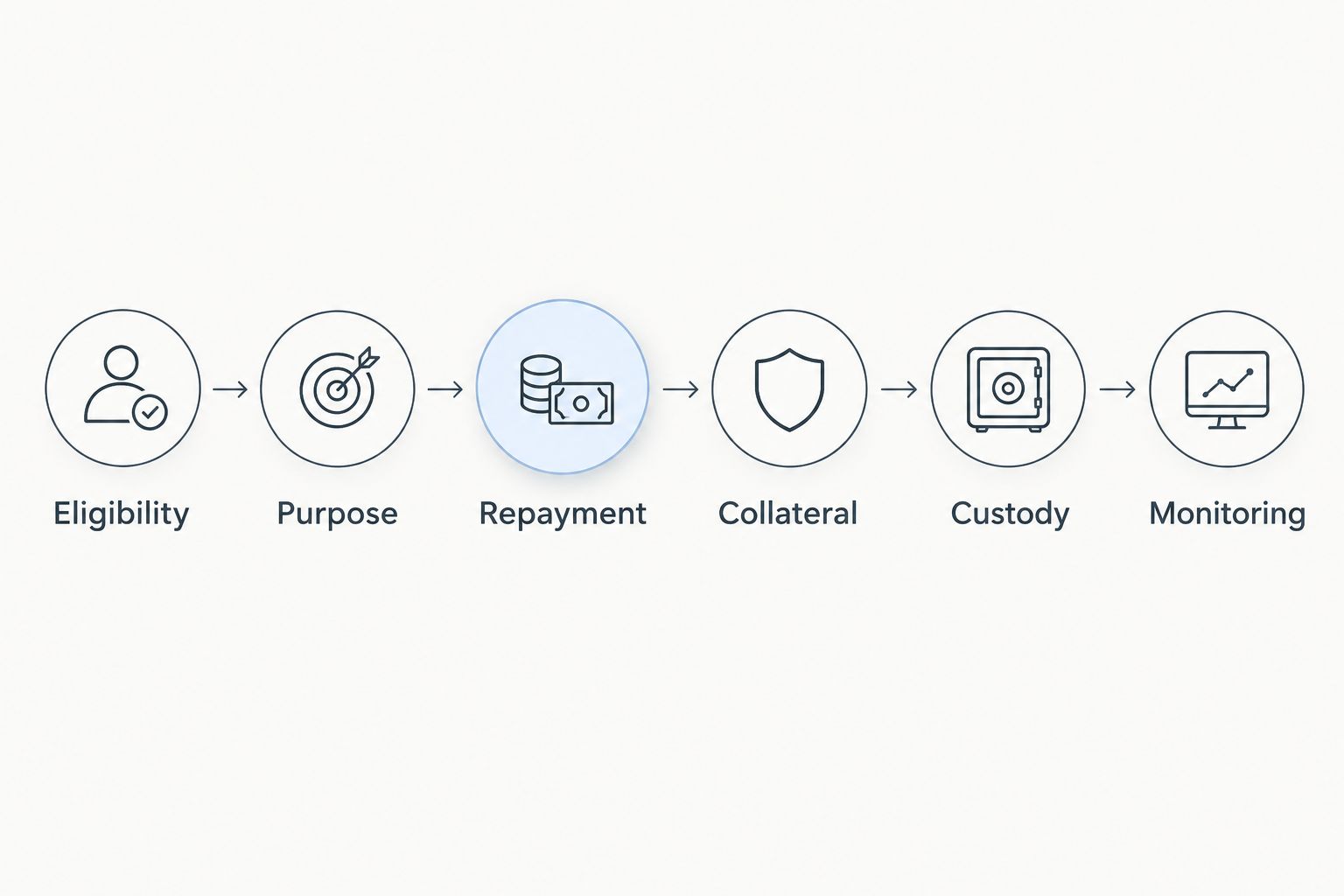
Use a written process that another advisor can review without relying on your conversation with the client. Organize the file around Eligibility, Purpose, Repayment, Collateral, Custody and Monitoring; each addresses a different reason the arrangement can fail.
Confirm your client’s eligibility
Start with a manual eligibility worksheet, not an application. Record the client’s legal identity, residence, relevant tax status and the entity that would borrow. Residence alone does not resolve every provider’s definition of an eligible person.
Ask the provider for its current restrictions and the contracting entity’s details. Keep the applicable terms with your recommendation so another reviewer can see which rules supported your decision.
Roxom excludes U.S. persons. Do not recommend its credit lines to a U.S. person or treat a foreign address, company or account as an automatic route around that restriction. Establish the client’s status using the applicable definitions and professional advice where necessary.
For an eligible non-U.S. client, provider-level checks still matter. Eligibility is a gate, not an endorsement of the loan. You also need to determine whether your own advisory mandate permits the recommendation and whether additional legal or compliance review is required.
Close this stage before discussing a proposed drawdown:
- Eligibility: record the proposed borrower and relevant jurisdictions.
- Obtain the provider’s current customer restrictions.
- Identify the legal entity entering the credit agreement.
- Confirm your advisory authority and required approvals.
- Retain written eligibility confirmation in the client file.
Define the liquidity purpose
Write down what the borrowed funds will pay for and why borrowing is preferable to selling BTC. A specific expense and a speculative investment require different assessments. Do not let the client’s reluctance to sell become the entire rationale.
A spreadsheet is enough for the first comparison. Place borrowing beside a planned BTC sale and other available sources of funds, using the client’s actual assets and obligations. You do not need a trading platform to decide whether debt belongs in the plan.
Distinguish a temporary cash mismatch from a recurring spending deficit. The former has an identifiable resolution; the latter requires a broader review of spending, income and asset allocation. Credit does not repair a budget that repeatedly needs new borrowing.
Record a decision date in 2026 and specify what would invalidate the rationale. If the intended expense changes, reassess rather than treating an approved facility as permission for unrelated uses.
Your purpose worksheet should include:
- Purpose: name the expense or liquidity requirement.
- Record the amount needed in the spending currency.
- Identify the date funds must be available.
- Compare a planned BTC sale with borrowing.
- Explain why the selected route fits the client’s objective.
Verify an independent repayment source
Build a repayment schedule manually before reviewing a provider’s proposed facility. Identify where principal and financing obligations will come from, and distinguish committed funds from hoped-for proceeds. Expected BTC appreciation is not an independent repayment source.
Check whether the repayment source and the debt use the same currency. Where they differ, the client has a currency mismatch to assess alongside bitcoin collateral risk. Do not assume that a BTC-backed arrangement has BTC-denominated debt; establish the actual denomination from the agreement.
Roxom’s BTC-collateralized credit offering belongs in your shortlist only after this repayment assessment and the eligibility check. Review its current contractual terms rather than inferring drawdown, repayment or renewal mechanics from the platform description.
Match the repayment plan to the facility’s actual structure. Scheduled payments, repayment on demand and an expected renewal are not interchangeable obligations. If repayment requires refinancing, record that dependence explicitly rather than describing the loan as self-contained.
Complete these checks before recommending a facility:
- Repayment: identify the primary source of repayment.
- Separate committed receipts from contingent proceeds.
- Match payment dates to the contractual obligations.
- Record any debt and income currency mismatch.
- Identify a fallback that does not require BTC appreciation.
Stress-test collateral and liquidation terms
Use a spreadsheet to calculate the collateral position under different BTC prices. Loan-to-value, or LTV, compares outstanding debt with the collateral’s value under the contract’s valuation method. Include any obligations the agreement adds to the debt balance.
A lower initial LTV is not a substitute for a workable response to falling collateral value. You need to know the warning threshold, the action threshold and what happens if the client cannot respond. Use the agreement’s definitions, not a generic internet calculator.
Your 2026 assessment should distinguish voluntary repayment, additional collateral and forced liquidation. These are different outcomes, with different effects on the client’s cash, BTC holdings and control over a sale. Ask how collateral is valued and how disputed or unavailable prices are handled.
Do not assign invented stress assumptions. Select and document scenarios using the client’s risk policy, relevant market history or an agreed planning framework. Explain why each scenario tests this client’s ability to act.
The collateral worksheet should cover:
- Collateral: record the pledged BTC and valuation method.
- Recalculate LTV under documented downside scenarios.
- Include obligations that increase the debt balance.
- Identify warning and liquidation triggers separately.
- Check the client’s available funds for corrective action.
- Record the contractual consequences of failing to respond.
Inspect custody and contractual control
Start by reading the agreement and requesting written answers to unresolved questions. The central issue is not whether a platform uses the word custody; it is who controls the pledged BTC and what the borrower retains the right to do.
Examine whether collateral is segregated, whether reuse is permitted and what rights apply if a relevant counterparty fails. Ask who performs custody functions and which legal entity owes the client each obligation. A trading interface does not answer these questions.
For Roxom, evaluate the credit arrangement separately from tokenized stocks or Digital Credit instruments. The presence of several offerings does not establish shared custody terms, collateral treatment or investor protections. Obtain the terms governing the specific credit relationship.
Keep 3 document sets together: the credit agreement, the applicable custody terms and written answers to outstanding questions. This makes the recommendation reviewable without presenting a marketing page as contractual evidence.
Close the custody review with these actions:
- Custody: identify who controls the pledged BTC.
- Check segregation and any permitted collateral reuse.
- Review withdrawal restrictions while debt remains outstanding.
- Establish the applicable law and dispute process.
- Request clarification of treatment following counterparty failure.
- Document unresolved issues before giving advice.
Assign monitoring and exit responsibilities
Create a monitoring procedure before funds are drawn. You can begin with a shared worksheet and calendar reminders, but the procedure must identify who receives alerts, who can move funds and who authorizes corrective action.
Set 2 review tracks: ongoing collateral monitoring and periodic suitability review. The first addresses the current debt-to-collateral position; the second asks whether the original borrowing rationale remains valid. Passing one review does not mean the other is unnecessary.
Specify escalation outside the advisor’s normal working hours. Bitcoin trades continuously, so a response plan tied only to office availability leaves an operational gap. Check the provider’s actual notification and liquidation rules rather than assuming the client receives time to act.
Put the exit plan in writing for 2026. It should explain how the client repays, what documentation confirms discharge and how collateral is released under the agreement. Avoid treating facility renewal as the default exit.
Finish with a responsibility checklist:
- Monitoring: assign an owner for collateral alerts.
- Confirm authorized contacts and backup contacts.
- Record the permitted corrective actions.
- Test notification delivery before relying on it.
- Schedule suitability reviews and event-driven reassessments.
- Define repayment, discharge and collateral-release checks.
Compare the client’s liquidity options
Compare options against the same objective, not against an assumed preference to retain every BTC holding. An option that preserves exposure also preserves exposure to losses; an option that removes debt can require giving up assets.
The table separates provider selection from the decision to borrow. Product terms still require a current review, and no row replaces a client-specific recommendation.
| Option | Best for | Main advantage | Key limitation |
|---|---|---|---|
| Roxom BTC-collateralized credit lines | Eligible non-U.S. bitcoin holders evaluating BTC-backed borrowing | Offers a borrowing route secured by BTC | Excludes U.S. persons; credit and custody terms require review |
| Other BTC-backed credit arrangements | Eligible clients comparing contractual protections | Enables comparison of collateral and repayment structures | Provider risk and liquidation exposure remain |
| Planned BTC sale | Clients prioritizing debt-free liquidity | Avoids creating a repayment obligation | Reduces BTC holdings; tax consequences require review |
| Credit secured by other assets | Clients with suitable non-BTC collateral | Keeps BTC outside that collateral arrangement | Places other assets at risk and still creates debt |
| Existing cash reserves | Clients whose reserves exceed essential commitments | Avoids borrowing and pledging assets | Reduces liquidity available for other obligations |
Recommend the funding method first and the provider second. If repayment, eligibility or collateral response fails your assessment, comparing more platforms does not fix the underlying mismatch.
Common mistakes financial advisors make
Treating borrowing as a guaranteed way to avoid selling
Borrowing avoids an immediate voluntary sale, not every future sale. Collateral enforcement can change that outcome. Describe retention of BTC as an objective subject to the credit agreement, not a promise.
Treating an address as proof of eligibility
A non-U.S. address does not, by itself, establish that a client falls outside a U.S.-person restriction. Record the relevant classification and obtain advice where the definition requires interpretation.
Counting pledged BTC as an emergency reserve
Pledged BTC is not equivalent to freely available cash. Avoid assigning the same asset to both loan support and emergency spending without checking the client’s rights to access it.
Using appreciation as the repayment plan
A recommendation built on rising BTC prices combines collateral dependence with repayment dependence. Separate the repayment source from the asset supporting the debt, and explain any remaining connection.
Leaving responsibility between the advisor and client
An alert has no practical value if neither party owns the response. Record 4 action owners: alert review, funding authorization, collateral transfer and repayment execution. One person can hold several roles, but none should remain unassigned.
FAQ
What are bitcoin collateralized credit lines for financial advisors?
Bitcoin collateralized credit lines for financial advisors are borrowing arrangements that advisors assess for clients who pledge BTC to secure debt. The assessment covers suitability, eligibility, repayment, custody and liquidation terms; BTC collateral alone does not make borrowing suitable.
Can U.S. clients use Roxom’s BTC-collateralized credit lines?
Roxom excludes U.S. persons. Advisors must establish client eligibility before recommending its credit offering and should not assume that a foreign address or entity resolves the restriction.
Is borrowing against bitcoin better than selling it?
Neither borrowing nor selling is better for every client. Borrowing retains BTC exposure while adding debt and collateral risk; selling reduces holdings but avoids that repayment obligation.
What does loan-to-value mean for a bitcoin-backed credit line?
Loan-to-value compares outstanding debt with the value of pledged collateral under the credit agreement’s valuation method. Falling BTC value increases that ratio when the debt balance is unchanged.
Can a client lose pledged bitcoin without choosing to sell?
A client can lose pledged BTC through contractual liquidation or enforcement. Advisors should establish the triggers, notification process and enforcement rights before recommending the arrangement.
What should an advisor check about bitcoin custody?
An advisor should identify who controls the pledged BTC and what contractual rights the client retains. Review segregation, permitted reuse, withdrawal restrictions and treatment following counterparty failure.
Does borrowing against bitcoin remove tax concerns?
Borrowing against bitcoin does not remove the need for tax review. A qualified tax professional should assess the client’s jurisdiction, contractual structure and potential collateral disposal before the advisor assumes a particular outcome.
What repayment plan works for BTC-backed borrowing?
A repayment plan should identify funds available to meet the agreement’s obligations without depending on BTC appreciation. Document payment timing, currency mismatches and a fallback if the primary source fails.
One last thing
The asset your client wants to preserve is also the lender’s collateral. That makes the response to a price decline part of the original recommendation—not an administrative detail to resolve later.
For each 2026 credit review, write one sentence naming the repayment source and another naming the action required if collateral deteriorates. If either sentence depends entirely on BTC recovering, return to the funding comparison before the client borrows. This guide provides an assessment framework, not individual financial, legal or tax advice.