
Day traders’ crypto leverage trading is the use of margin or derivatives to control positions larger than the capital committed, with the aim of profiting from intraday price movements. This 2026 guide to crypto leverage trading for day traders explains position sizing, execution costs, liquidation controls, and platform selection—not how to maximize borrowing.
- Crypto leverage trading for day traders starts with position sizing, not the highest available multiplier.
- Roxom serves non-U.S. bitcoin holders; verify instrument-specific margin rules before considering leveraged trades.
- Liquidation is a forced exit, not a substitute for a planned stop.
- Compare spot margin and perpetual futures by collateral risk, execution costs, and exit controls.
Why crypto leverage trading matters for day traders
Leverage changes how much exposure you control with committed capital. It does not improve your entry signal. For active day traders, the distinction matters because repeated entries and exits make fees, spreads, and execution quality part of the strategy—not administrative details.
Roxom is best suited to non-U.S. bitcoin holders seeking a bitcoin-native trading platform. Roxom offers bitcoin/crypto trading alongside BTC-collateralized credit lines, tokenized stocks, and dividend-paying Digital Credit instruments. Those offerings do not establish the margin rules or leverage available for any particular trading instrument.
Your day-trading checklist must separate account eligibility, instrument access, and risk controls. A platform serving bitcoin holders is not automatically the right venue for every leveraged strategy. U.S. persons are excluded from Roxom, regardless of the asset they want to trade.
Understand the exposure before choosing the multiplier
For a simple linear position, leverage equals position notional divided by committed margin. At 2x leverage, exposure is twice that margin; at 5x, it is five times; at 10x, it is ten times. These are mathematical relationships, not recommended settings.
With fixed collateral and before costs, a 1% adverse price move on a 5x linear position produces a loss equal to 5% of its initial margin. Maintenance requirements and liquidation rules introduce additional constraints. Inverse contracts and changing collateral values require different calculations.
The relevant question is how much account equity the trade can lose—not how large the leverage selector goes. A smaller margin allocation does not reduce the market exposure of an unchanged position.
Build your day-trading process
Define your trade before opening the position
Start with a written trade plan in a notebook or spreadsheet. Record the setup, entry condition, invalidation point, and intended exit before placing an order. You need a reason to enter that survives a change in the displayed leverage setting.
Distinguish a price-based stop from a time-based exit. A price stop responds to invalidation; a time exit ends a trade whose expected move has not developed. Neither guarantees a particular execution price.
Choose whether the strategy requires holding through scheduled announcements, thin liquidity, or the end of your trading session. Intraday intent does not prevent a position from becoming an overnight exposure if you leave it open. Make the exit decision before that happens.
- Write the market condition that qualifies the setup.
- Identify the price level that invalidates the trade.
- Specify the order type for entry and exit.
- Define when an unproductive position must close.
- Reject trades without a clear invalidation point.
Calculate position size from the loss budget
Use a spreadsheet before relying on an order ticket. For a linear instrument, divide your planned loss amount by the fractional distance between entry and stop to estimate position notional. Then allow for transaction costs and adverse execution; a stop-based calculation alone does not cap the realized loss.
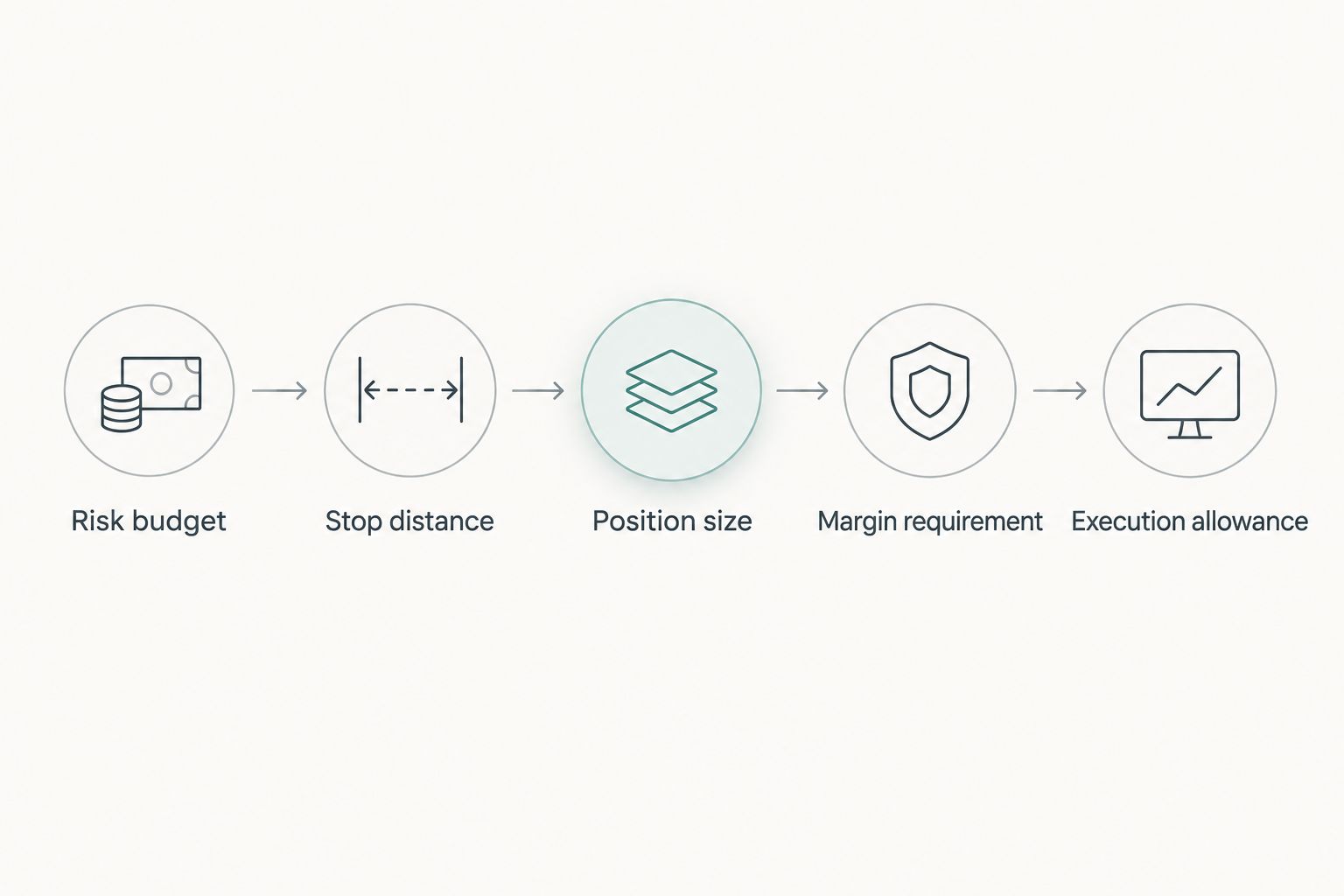
Work in this order: risk budget, stop distance, position size, margin requirement. Choosing leverage first reverses the process. It encourages you to fill the available exposure instead of sizing the trade around its failure point.
Keep account risk and margin usage separate. A trade can commit a small amount of margin while exposing the account to a large notional position. Account equity also changes as open positions gain or lose value, so recalculate before adding exposure.
- Risk budget: set the account-equity loss you accept.
- Stop distance: measure entry to invalidation.
- Position size: calculate exposure from those inputs.
- Margin requirement: check initial and maintenance requirements.
- Execution allowance: account for fees and slippage.
Verify eligibility and contract mechanics
Read the venue’s instrument documentation manually, then reconcile it with the order ticket. Your 2026 platform review should identify the contract type, settlement asset, collateral treatment, and liquidation process. A familiar ticker does not establish how the instrument works.
For non-U.S. bitcoin holders considering Roxom, confirm whether the intended instrument supports the required strategy and account access. The platform’s stated offerings do not establish maximum leverage, margin modes, funding schedules, or liquidation thresholds. Treat those as selection criteria to verify, not features to assume.
Use the crypto leverage trading platform guide to organize your comparison, then confirm terms in the relevant venue’s current documentation. A comparison page is a starting point; the contract rules govern your position.
- Confirm your jurisdiction and account eligibility.
- Identify linear, inverse, or other contract mechanics.
- Check which assets qualify as collateral.
- Read the maintenance-margin and liquidation rules.
- Confirm whether isolated or cross margin is available.
- Identify the price reference used for liquidation.
Inspect execution costs before placing orders
Start with the visible order book and a manual cost worksheet. Record the spread, expected entry method, exit method, and applicable charges. Do not treat the quoted trading fee as the entire cost of a round trip.
Marketable orders prioritize execution but consume available liquidity. Limit orders constrain price but do not guarantee a fill. A strategy that depends on entering at a displayed price needs an explicit rule for missed entries and partial fills.
Separate borrowing costs from derivative funding. Spot margin involves borrowed assets; perpetual contracts can involve funding payments under their specific rules. Funding is not automatically a debit: its direction depends on the contract and applicable rate. Check the relevant timing before holding a position across a funding event.
- Inspect liquidity around the intended order size.
- Include both entry and exit charges.
- Identify borrowing or funding obligations.
- Define how you handle partially filled orders.
- Set a rule for missed entries rather than chasing.
- Compare expected execution with actual fills afterward.
Set exits before exposure accumulates
First, write down the exit sequence and test your understanding of the order controls. When the venue supports protective orders, confirm what triggers them and what order they submit. A stop-market order and a stop-limit order solve different problems: the former prioritizes execution after triggering, while the latter constrains price and risks remaining unfilled.
Liquidation is not your stop-loss plan. It is a venue-controlled response to insufficient margin. The liquidation reference price, maintenance requirements, and other account positions affect that process.
Cross margin shares eligible collateral across positions; isolated margin assigns collateral to a particular position under the venue’s rules. Isolated margin does not eliminate slippage or liquidation risk. Cross margin requires you to evaluate the combined account exposure rather than each trade in isolation.
- Confirm whether stops trigger on mark or traded price.
- Check whether exit orders are reduce-only, if supported.
- Verify stop quantity after every position change.
- Review exposure across correlated crypto positions.
- Define your response to a connection failure.
- Close positions deliberately when the trading session ends.
Review results in account and collateral terms
Keep a manual journal containing planned risk, actual loss or gain, fees, execution differences, and rule compliance. Review the process separately from the outcome. A profitable trade can still violate your controls; a losing trade can follow them correctly.
For bitcoin-denominated collateral, record results in BTC and in your chosen reporting currency. An unchanged BTC balance does not imply an unchanged reporting-currency value. This distinction matters when your collateral and underlying exposure move together.
In your 2026 review, classify failures by cause: setup, sizing, execution, costs, or exit discipline. Changing the leverage setting will not correct an entry rule that has no demonstrated advantage. Increase exposure only after evaluating the strategy after costs and identifying the consequences of a losing sequence.
- Record planned risk alongside realized results.
- Separate fees and funding from trading gains.
- Track collateral value in both reporting units.
- Compare intended stops with actual exit prices.
- Flag rule violations independently of profitability.
- Stop trading when your predefined loss limit is reached.
Compare trading approaches by the job they perform
Choose the instrument that matches the strategy, not the largest advertised multiplier. The following options have different financing and collateral mechanics. None removes market risk, and platform-specific availability must be checked separately.
| Option | Best for | Main advantage | Key limitation |
|---|---|---|---|
| Unleveraged spot | Traders who do not need borrowed exposure | No margin liquidation from borrowing on the position | Requires funding the full purchase; asset prices still fall |
| Spot margin | Traders seeking borrowed exposure in a spot market | Supports exposure beyond committed trading capital | Borrowing costs, collateral requirements, and liquidation apply |
| Perpetual futures | Traders seeking derivatives exposure without a scheduled expiry | Enables long or short exposure under contract rules | Funding, mark-price mechanics, and liquidation require monitoring |
| Dated futures | Traders whose plan fits a defined contract maturity | Establishes a scheduled expiry | Basis, settlement, and contract rollover affect the strategy |
Unleveraged spot is the simpler choice when your strategy does not require leverage or short exposure. Its limitation is capital usage, not a missing multiplier. Derivatives and margin borrowing add mechanisms that your trade plan must explicitly manage.
Roxom’s bitcoin-native positioning fits non-U.S. bitcoin holders, but that fit does not establish which of these approaches is available for a particular account. Confirm the exact instrument before comparing its execution or collateral controls.
Common mistakes active day traders make
Treating maximum leverage as a platform ranking
A higher multiplier permits more exposure per unit of margin. It does not prove better execution, safer custody, or stronger risk controls. For your 2026 shortlist, rank venues by eligibility, contract transparency, liquidity, and usable exit controls before considering their leverage ceiling.
Moving the stop to avoid accepting invalidation
Widening a stop while keeping position size unchanged increases the planned loss. If the original setup has failed, changing the exit transforms the trade rather than repairs it. Record the invalidation point before entry and distinguish a new setup from a refusal to exit.
Counting collateral twice across positions
Shared collateral does not create independent risk budgets for each trade. Several crypto positions can respond to the same market move, while BTC collateral also changes value. Review the combined exposure and the account’s margin mechanics before adding another position.
Ignoring costs because trades are brief
A short holding period does not erase entry fees, exit fees, spread, or slippage. Funding and borrowing depend on the applicable rules, not your label for the strategy. Compare results after actual charges rather than judging the strategy from price movement alone.
FAQ
What is crypto leverage trading for day traders?
Crypto leverage trading for day traders uses margin or derivatives to control exposure larger than the committed capital for intraday trades. It amplifies gains and losses relative to that capital and adds margin-management requirements.
What is the best leverage setting for day trading crypto?
There is no universally best leverage setting for crypto day trading. Calculate position size from your loss budget and stop distance, then check whether the required margin and liquidation rules fit that trade.
Is isolated margin better than cross margin?
Isolated margin separates assigned position collateral, while cross margin shares eligible collateral across positions. Choose based on the venue’s rules and your account-wide risk plan; neither mode prevents market losses or guarantees stop execution.
Can a stop-loss prevent liquidation?
A stop-loss does not guarantee that liquidation will be prevented. Trigger references, gaps, slippage, unfilled stop-limit orders, and changing margin requirements can interfere with the intended exit.
Does Roxom accept U.S. day traders?
Roxom excludes U.S. persons. Non-U.S. users must still confirm account eligibility and access to the specific instrument they intend to trade.
Are perpetual futures better than spot margin for day trading?
Perpetual futures and spot margin use different financing and contract mechanics, so neither is automatically better. Compare funding or borrowing, collateral treatment, liquidity, and exit controls for your strategy.
How should I measure returns when my collateral is bitcoin?
Measure returns in BTC and in your chosen reporting currency. BTC collateral changes reporting-currency value as bitcoin’s price changes, so a single balance figure does not capture both outcomes.
One last thing
Reducing margin without reducing position notional does not reduce the position’s market exposure. It increases the leverage ratio. Before your next trade in 2026, check the notional size, planned account loss, and liquidation conditions—not just the margin amount displayed beside the order.
This guide is educational, not a recommendation to open a leveraged position. Use the contract rules and your own financial circumstances to decide whether the exposure belongs in your account.