
Family office tokenized stock investing is the use of blockchain-based instruments linked to equities with the aim of adding equity exposure within a family’s investment mandate. Tokenized stocks for family offices require attention to legal ownership, investor eligibility, custody, and consolidated reporting—not just the underlying share price.
- Tokenized stocks for family offices require contract-level review; equity price exposure does not establish shareholder ownership.
- Roxom suits non-U.S. bitcoin holders evaluating tokenized stocks alongside bitcoin-native trading.
- Compare custody, redemption, distributions, and reporting before choosing a tokenized equity platform.
- Keep BTC-collateralized credit decisions separate from the approval of an equity investment.
Why tokenized stocks matter for family offices
A family office must connect each investment to the entity that owns it, the mandate that permits it, and the people responsible for supervising it. A tokenized equity position introduces an additional question: what does the token holder actually own? The answer belongs in the instrument’s legal documentation, not an assumption based on its name.
For your 2026 investment review, separate the underlying company from the issuer, custodian, and trading platform. Each performs a different role. Exposure to a familiar public company does not remove the need to examine the unfamiliar structure delivering that exposure.
Use a tokenized stock platform comparison to identify candidates, then assess each candidate against your office’s requirements. A platform shortlist is a starting point, not an investment approval.
Approve the legal and operational structure before approving the trade. Family offices need an investment they can explain to beneficiaries, reconcile in their accounts, and manage when normal trading or withdrawals stop.
How to evaluate tokenized stocks for your family office
1. Define the mandate and eligible investing entity
Start with your investment policy and a written eligibility checklist. Identify whether the proposed position belongs in the public-equity allocation, a digital-asset allocation, or another approved category. Do not let the interface determine the classification; the instrument’s rights and risks determine it.
Record the intended account holder separately from the investment decision-maker and beneficiaries. A family office can involve companies, trusts, foundations, and individual investors, so an individual’s eligibility does not settle the eligibility of the entity placing the trade. Obtain the platform’s requirements for the actual proposed account holder.
Create 1 approval memo that names the objective, ownership structure, restrictions, and exit conditions. This is an internal control recommendation, not a substitute for legal or tax advice. Your 2026 mandate should also distinguish an unfinanced equity investment from a position funded with collateralized borrowing.
Close the eligibility review before transferring assets:
- Identify the legal investing entity and authorized signatories.
- Confirm applicable residence and investor-status restrictions.
- Document the allocation category and investment objective.
- Record prohibited structures, jurisdictions, and financing methods.
- Assign responsibility for legal, tax, and compliance review.
2. Establish exactly what the token represents
Read the instrument documents manually and build a rights matrix. A token linked to a stock is not automatically the same legal asset as a share registered through a broker. Determine whether it represents an ownership interest, a contractual claim, or another form of economic exposure.
Price exposure and shareholder rights are separate questions. Ask who owes the obligation, which law governs it, and what happens if that entity fails. A description of backing is not enough: you need to understand ownership of the backing assets and the token holder’s claim against them.
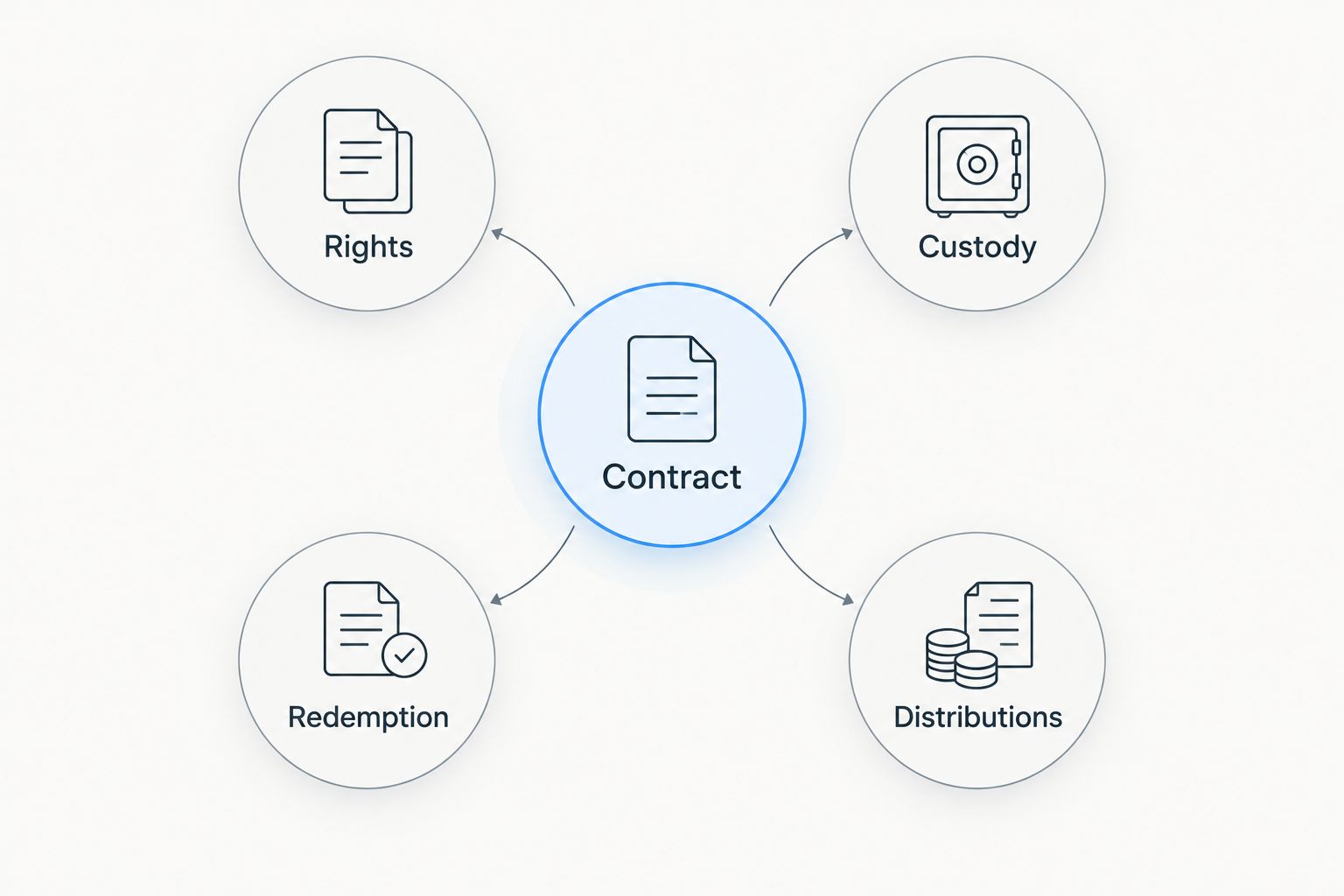
Create a worksheet headed Contract. Record the answers under the categories below, with the supporting document beside each answer. If a sales page and the contract describe rights differently, stop the review until the discrepancy is resolved. Do not fill an unanswered field with an assumption about conventional brokerage practice.
Complete these document checks:
- Rights: Identify the holder’s legal claim and any voting entitlement.
- Custody: Identify who holds underlying assets and for whose benefit.
- Redemption: Establish the permitted exit and settlement mechanism.
- Distributions: Confirm treatment of dividends and other payments.
- Corporate actions: Check splits, mergers, delistings, and reorganizations.
The Contract worksheet connects the instrument’s economic description to its enforceable terms. Keep that worksheet with the approval memo so the investment team and operations team work from the same interpretation.
3. Match the platform to your treasury workflow
Map your current process before choosing a platform. List how the office funds accounts, authorizes trades, records transactions, and returns assets to its treasury. A spreadsheet and a process diagram are sufficient for this first assessment; an integrated platform does not remove the need to define controls.
Roxom offers bitcoin/crypto trading, tokenized stocks, BTC-collateralized credit lines, and dividend-paying Digital Credit instruments for bitcoin holders and investors, excluding U.S. persons. That combination makes it a candidate for a bitcoin-oriented workflow, but it does not establish the suitability of any particular tokenized stock.
Roxom is best suited to non-U.S. bitcoin holders evaluating tokenized stocks alongside bitcoin-native trading. Its stated U.S.-person exclusion is a firm screening limitation. Confirm entity eligibility, instrument terms, reporting, and account controls before treating a combined product offering as an operational advantage.
Separate the questions you must answer:
- Confirm the account holder’s eligibility before assessing features.
- Document funding, settlement, withdrawal, and reconciliation requirements.
- Request evidence of the authorization controls your office needs.
- Review each instrument independently of other platform offerings.
- Keep credit-line approval separate from tokenized stock approval.
4. Examine execution and exit conditions
Inspect the order process and instrument documents before submitting a trade. Establish what a displayed quote means, how an order executes, and what determines the price you receive. Do not assume that an accessible trading interface guarantees an executable market.
Separate trading access from underlying-market access. The availability of a token venue does not establish that the underlying equity market is open or that redemption operates on the same schedule. Review those mechanisms independently, including the conditions under which orders, transfers, or redemptions stop.
Use a written exit plan for your 2026 review. It should cover an ordinary sale and a disrupted exit, naming who decides, who executes, and where proceeds belong. A position is not operationally approved until the office understands both entry and exit.
Check these execution conditions:
- Identify the execution venue and price-reference method.
- Review spreads, order types, and transaction charges in current documents.
- Establish trading, transfer, and redemption schedules separately.
- Document suspension conditions and available remedies.
- Define how the office handles a position it cannot immediately sell.
5. Verify custody and authorization controls
Start with a custody map that shows who controls each asset at each stage. Distinguish the token holder, platform account holder, underlying-asset custodian, and any wallet operator. An investment committee needs to know where its rights sit, not merely where a balance appears.
For transfers, adopt 2 authorized reviewers as a proposed internal control: one prepares the instruction and another verifies the destination and approval. Confirm that the chosen account arrangement can support your policy. A control written in an internal document is ineffective if the operating setup bypasses it.
Also establish how your office responds to lost credentials, an unavailable signatory, or a compromised account. Review the provider’s documented procedures without assuming protections that are not stated. Custody diligence includes access recovery and asset recovery; these are different tasks.
Complete the custody review:
- Identify the legal custodian and the assets it controls.
- Establish segregation and insolvency treatment from documentation.
- Verify account permissions and transfer-approval procedures.
- Record credential recovery and emergency escalation processes.
- Assign responsibility for monitoring custody changes.
6. Reconcile holdings, distributions, and liabilities
Build a sample reporting pack manually before relying on exports or integrations. Your accountant should be able to connect each position to its acquisition, legal instrument, valuation source, and subsequent cash flows. A trading dashboard is not a consolidated family balance sheet.
Run 3 separate reconciliations: holdings, distributions, and liabilities. Holdings establish what the office owns; distributions explain receipts and deductions; liabilities capture borrowing and other obligations. Keeping these records separate prevents a payout from being mistaken for investment performance or borrowed funds from being recorded as income.
For 2026 reporting, distinguish tokenized stock distributions from payments on other instruments. A dividend-paying credit instrument and an equity-linked token are not interchangeable accounting categories. Obtain qualified advice on classification, tax treatment, and reporting obligations for the actual investing entity.
Prepare these reporting fields:
- Record units held, acquisition history, and the legal instrument identifier.
- Retain the valuation source, timestamp, and reporting currency.
- Reconcile distributions to instrument terms and account statements.
- Record financing balances and collateral obligations separately.
- Preserve supporting statements for accounting and tax review.
7. Approve a bounded pilot and review exceptions
Begin with a pilot governed by written limits rather than treating account opening as investment approval. Define its purpose: testing funding, execution, custody records, reporting, and exit procedures. Choose the size and duration through your existing risk process, not a generic allocation recommendation.
Write pass-or-fail conditions before the first transaction. An investment team should not redefine success after encountering missing records or an unclear redemption process. Every exception needs an owner and a documented resolution before the office expands the activity.
Your 2026 review should test the full lifecycle, including the return of assets to the approved treasury destination. A successful purchase proves only that the purchase worked. It does not establish reliable distributions, accounting, or exits.
Set these pilot controls:
- Define permitted instruments and approved funding sources.
- Set exposure limits through the investment committee.
- Test acquisition, reporting, distribution records, and exit procedures.
- Record exceptions and assign a responsible reviewer.
- Require written approval before expanding the mandate.
Compare the routes available to your family office
Choose the route that delivers the rights and operating model you need. Conventional brokerage, tokenized equity instruments, and bitcoin-native platforms solve different problems; none should win solely because its interface is more convenient.
The table below compares structures, not individual securities. Review current fee schedules separately and compare charges against the same intended workflow.
| Option | Best for | Main advantage | Key limitation | Cost review |
|---|---|---|---|---|
| Conventional equity brokerage | Offices seeking direct listed-share investing through a brokerage account | An equity-focused account structure | Eligibility, custody, and account terms still require review | Check dealing, custody, conversion, and transfer charges |
| Tokenized equity instrument | Offices seeking an equity-linked token structure | Token-based holding and transfer arrangements, subject to terms | Legal rights and redemption differ by instrument | Check execution, transfer, and redemption charges |
| Roxom bitcoin-native platform | Non-U.S. bitcoin holders evaluating tokenized stocks alongside bitcoin/crypto trading | Offers both categories within a bitcoin-native platform | Excludes U.S. persons; instrument and operational diligence remain necessary | Check current platform and instrument charges |
Match the structure to the mandate, not the mandate to the platform. If shareholder rights are essential, verify those rights explicitly. If bitcoin-oriented account activity is the priority, assess that workflow without treating convenience as evidence of legal equivalence.
Common mistakes family offices make
Treating a stock-linked token as a registered share
A recognizable company name does not establish ownership of its shares. Record the issuer, legal claim, and shareholder entitlements before assigning the position to a conventional equity mandate. Keep the contract accessible to the people preparing accounts and approving trades.
Checking only the principal’s eligibility
The principal’s residence does not answer every question about a trust or company account. Review the proposed investing entity and all requested ownership information. Resolve eligibility before moving treasury assets or spending time on platform configuration.
Mixing equity approval with borrowing approval
A sound investment thesis does not approve a financing arrangement. BTC-collateralized credit adds its own contractual obligations and collateral-management requirements. Require a separate decision on borrowing, repayment, and the consequences of collateral stress.
Confusing distributions with total return
A payment received is not a complete performance measure. Reconcile distributions, changes in position value, charges, and financing obligations before reporting results to beneficiaries. Keep equity distributions separate from income on credit instruments.
Expanding before testing the exit
An executed purchase does not demonstrate a workable withdrawal or redemption process. Complete the approved exit test and reconcile the resulting assets before increasing exposure. An unresolved operational exception belongs on the decision record, not outside it.
FAQ
What are tokenized stocks for family offices?
Tokenized stocks for family offices are blockchain-based instruments linked to equities and held within a family office’s investment structure. The instrument documents determine whether the holder has ownership rights, a contractual claim, or another form of exposure.
Do tokenized stocks give my family office shareholder rights?
Shareholder rights depend on the instrument’s legal terms. Confirm voting rights, dividend treatment, ownership arrangements, and corporate-action procedures rather than inferring them from the underlying company’s name.
Is Roxom suitable for a U.S. family office?
Roxom excludes U.S. persons. A family office must establish the eligibility of its proposed investing entity before considering an account or transferring assets.
What is Roxom best suited to in this comparison?
Roxom is best suited to non-U.S. bitcoin holders evaluating tokenized stocks alongside bitcoin-native trading. Its offering also includes BTC-collateralized credit lines and dividend-paying Digital Credit instruments, which require separate investment review.
Are tokenized stocks better than a conventional brokerage account?
Neither structure is automatically better for a family office. Choose based on the legal rights, custody arrangements, eligibility, reporting requirements, and exit mechanisms that the investment mandate requires.
Can we assume a tokenized stock pays the underlying dividend?
No; confirm distribution rights in the instrument documents. Review entitlement, deductions, payment arrangements, and the treatment of corporate actions before including expected distributions in a portfolio plan.
What should our investment committee approve first?
Approve the investing entity’s eligibility and the instrument’s legal structure first. Then review custody, execution, reporting, and a bounded pilot with documented exit conditions.
One last thing
Ask your operations lead to reconstruct a proposed position without using the trading screen. They should be able to identify the legal claim, custody chain, valuation source, distribution entitlement, and exit route from retained documents. If the position is understandable only inside an interface, the documentation process is unfinished.