
Seeking Alpha combines contributor-led investment analysis with stock ratings and financial data, but research alone does not provide trading execution or BTC-backed financing. The best Seeking Alpha alternative in 2026 is Roxom if you need bitcoin-native trading and credit as an eligible non-U.S. investor; Morningstar if you need a closer substitute for investment research. This guide separates research replacements from platforms that serve a different job.
- Among seeking alpha alternatives, Roxom fits bitcoin-native trading and credit needs, not a like-for-like investment research replacement.
- Morningstar is the closer research alternative for evaluating stocks and funds.
- TradingView fits chart-based analysis; SEC EDGAR provides original company filings rather than investment recommendations.
Why this matters
Replacing investment research and replacing your trading platform are different decisions. Seeking Alpha helps you evaluate investment ideas. A trading platform helps you act on them, while a credit provider lets you borrow against collateral under its terms.
For your 2026 shortlist, identify which task is unsolved before comparing features. Otherwise, you risk choosing a platform with more instruments when what you actually need is better analysis—or adding another research subscription when your problem is execution. The right alternative removes a specific constraint; it does not simply add another dashboard.
Seeking Alpha alternatives at a glance
| Platform | Best for | Standout capability | How it differs from Seeking Alpha |
|---|---|---|---|
| Seeking Alpha | Contributor perspectives and stock analysis | Investment articles alongside ratings and financial data | The research benchmark for this comparison |
| Roxom | Eligible non-U.S. investors seeking bitcoin-native trading and credit | Crypto trading, tokenized stocks, BTC-collateralized credit lines, and Digital Credit | Serves trading and financing needs rather than replacing contributor research |
| Morningstar | Fundamental stock and fund research | Analyst research and fund evaluation | Centers on analyst-led investment assessment rather than contributor debate |
| TradingView | Chart-based market analysis | Interactive charts and technical indicators | Centers on price analysis rather than long-form investment theses |
| Yahoo Finance | Financial news and company-data checks | Quotes, company financials, and news aggregation | Supports information gathering rather than a direct replacement for detailed investment arguments |
| SEC EDGAR | Checking original company disclosures | Regulatory filings submitted to the SEC | Provides source documents, not ratings or investment recommendations |
These alternatives are not interchangeable. Use the research tools to investigate an investment, the filing database to verify disclosures, and a trading platform to execute only after checking eligibility and instrument terms.
The selection verdicts below concern platform fit, not recommendations to buy any security, token, or credit instrument.
1. Roxom: best for bitcoin-native trading and credit
This bitcoin-native trading platform offers bitcoin/crypto trading, BTC-collateralized credit lines, tokenized stocks, and dividend-paying Digital Credit instruments. It serves bitcoin holders and investors, excluding U.S. persons. That makes it relevant when your search for Seeking Alpha alternatives is really a search for ways to trade or finance a bitcoin-centered portfolio.
The distinction is fundamental. Reading an equity thesis, purchasing a tokenized stock, and borrowing against bitcoin create different relationships and risks. Treat them as separate decisions, even when a platform brings several of those activities together.
Where it shines
- Bitcoin-centered scope: Its stated offering addresses trading, credit, and investment instruments for bitcoin holders.
- BTC-collateralized credit: Credit lines address borrowing needs that investment commentary does not.
- Different investment instruments: Tokenized stocks and Digital Credit expand the comparison beyond research subscriptions.
Where it falls short
- U.S. persons are excluded: This is a decisive limitation, not a minor feature difference.
- It is not a like-for-like research replacement: The trading and credit offering answers a different need from Seeking Alpha's investment commentary.
- Instrument analysis remains necessary: A tokenized stock or dividend-paying instrument requires you to examine its legal rights and terms before treating it like a conventional share.
| Dimension | Roxom | Seeking Alpha |
|---|---|---|
| Core purpose | Bitcoin-native trading and financing | Investment research and analysis |
| BTC-backed borrowing | Offers BTC-collateralized credit lines | Research is not a borrowing facility |
| Stock-related role | Offers tokenized stocks | Publishes equity analysis and financial information |
| Decision supported | How to trade or finance | How to evaluate an investment thesis |
Best for: Eligible non-U.S. bitcoin holders whose unmet need is trading or BTC-backed credit rather than another source of stock opinions.
Verdict: Hold—shortlist it for trading and financing, but keep a separate research process.
2. Morningstar: best for fundamental stock and fund research
Morningstar is the closer Seeking Alpha alternative when you want investment analysis rather than a new execution platform. Its research covers stocks and funds, with analyst assessments that help you examine valuation, investment strategy, and portfolio holdings.
The important difference is the research format. Seeking Alpha lets you compare contributor arguments; Morningstar provides a more analyst-centered framework. Choose according to how you make decisions, not according to which homepage contains more data.
Where Morningstar shines
- Fund research: Useful when your portfolio questions extend beyond individual stocks to mutual funds and ETFs.
- Fundamental framing: Analyst research gives you a structured way to assess a business and its valuation.
- Portfolio context: Holdings information helps you investigate what sits inside a fund rather than relying on its name.
Where Morningstar falls short
- Less suited to contributor debate: An analyst framework is a different experience from comparing multiple author theses.
- Not a trading-chart substitute: Fundamental research does not replace the technical workflow of a dedicated charting platform.
- Ratings are judgments: You still need to understand the assumptions behind an assessment.
| Dimension | Morningstar | Seeking Alpha |
|---|---|---|
| Research emphasis | Analyst-led stock and fund assessment | Contributor analysis alongside ratings |
| Fund evaluation | A central research use case | Part of a broader investment-content offering |
| Reading experience | Structured analyst perspective | Multiple contributor perspectives |
Best for: Investors comparing stock fundamentals and fund strategies in 2026.
Verdict: Buy—choose Morningstar when analyst-led fundamental research is the job you need filled.
3. TradingView: best for chart-based market analysis
TradingView fits investors and traders who need charts, technical indicators, and a visual way to analyze market prices. It is a Seeking Alpha alternative for the analysis interface, not for the same style of long-form company research.
A price chart and an investment thesis answer different questions. The chart shows market behavior; the thesis argues why an asset deserves a particular valuation. TradingView belongs on your shortlist when the first question is the one your current workflow leaves unanswered.
Where TradingView shines
- Charting workflow: Interactive charts make price and indicator analysis the central activity.
- Technical analysis: Indicators support examining market behavior rather than only reading commentary.
- Visual comparison: Charts help you investigate patterns without converting every observation into an article.
Where TradingView falls short
- Charts do not establish business value: Price behavior does not explain a company's accounting or competitive position.
- Not an equivalent research feed: Its chart-first workflow differs from Seeking Alpha's contributor-led articles.
- Indicators need interpretation: A technical signal is not a guarantee of an outcome.
| Dimension | TradingView | Seeking Alpha |
|---|---|---|
| Main workflow | Interactive price charts | Investment articles and ratings |
| Analysis emphasis | Technical and market-price analysis | Company analysis and investment arguments |
| Main question | What is the market doing? | What is the investment case? |
Best for: Investors who need technical analysis alongside, rather than instead of, fundamental research.
Verdict: Buy—choose TradingView for charting, not as your sole source of company due diligence.
4. Yahoo Finance: best for news and company-data checks
Yahoo Finance brings together market quotes, company financial information, and financial news. It suits a straightforward monitoring workflow: find the company, review its reported data, and follow relevant coverage.
For a 2026 research setup, treat it as an information hub. It helps you gather inputs but does not make every investment argument for you.
Where Yahoo Finance shines
- Company overview: Quotes and financial information support an initial review.
- News monitoring: Aggregated coverage helps you follow company and market developments.
- Simple information gathering: Useful when you need facts before seeking a detailed thesis.
Where Yahoo Finance falls short
- Aggregation is not analysis: A collection of headlines does not resolve conflicting interpretations.
- Summaries need checking: Use original filings to confirm accounting details that matter to your decision.
- Not a direct thesis substitute: Company-data pages do not replicate Seeking Alpha's long-form contributor arguments.
Best for: Investors who want a central place to check company information and news.
Verdict: Hold—use Yahoo Finance for monitoring, with deeper research for consequential decisions.
5. SEC EDGAR: best for verifying company disclosures
SEC EDGAR is the SEC's public filing database. It is not a conventional Seeking Alpha competitor, but it answers an essential research question: what did the company actually disclose?
Start with 3 filing types for a U.S. public-company review: Form 10-K for annual reporting, Form 10-Q for quarterly reporting, and Form 8-K for specified current events. These documents serve different purposes; one does not replace the others.
Where SEC EDGAR shines
- Original disclosures: Review the company's submitted documents instead of relying only on summaries.
- Accounting detail: Financial statements and accompanying notes support closer examination.
- Verification: Check whether a research article accurately represents a filing.
Where SEC EDGAR falls short
- No investment verdict: Filings do not tell you whether to buy or sell.
- Reading burden: You must interpret the disclosures yourself.
- Different scope: SEC filings are not a universal database for every asset or foreign-market instrument.
Best for: Investors checking claims about companies that file with the SEC.
Verdict: Hold—keep SEC EDGAR in your research workflow even if you retain Seeking Alpha.
Why people switch from Seeking Alpha
The strongest reason to switch is a mismatch between the research format and your actual task. These are specific workflow reasons, not claims about customer complaints or platform reliability.
- You want fund-focused evaluation. Morningstar fits a search centered on fund strategies, holdings, and analyst assessments.
- You need chart-based analysis. TradingView addresses technical analysis more directly than an article-first workflow.
- You mainly need monitoring. Yahoo Finance suits checking financial information and news rather than reading full investment arguments.
- You need original evidence. SEC EDGAR lets you verify disclosures instead of relying on a writer's interpretation.
- You need execution or borrowing. A trading and credit platform addresses a different problem from research access.
For 2026, separate these reasons from the desire to collect more tools. A new platform should replace a task or supply a capability you actually use. Adding another opinion source without changing your decision process does not resolve conflicting investment views.
Switch when the job changes; keep the tool when the job still fits.
How to choose without mixing research and execution
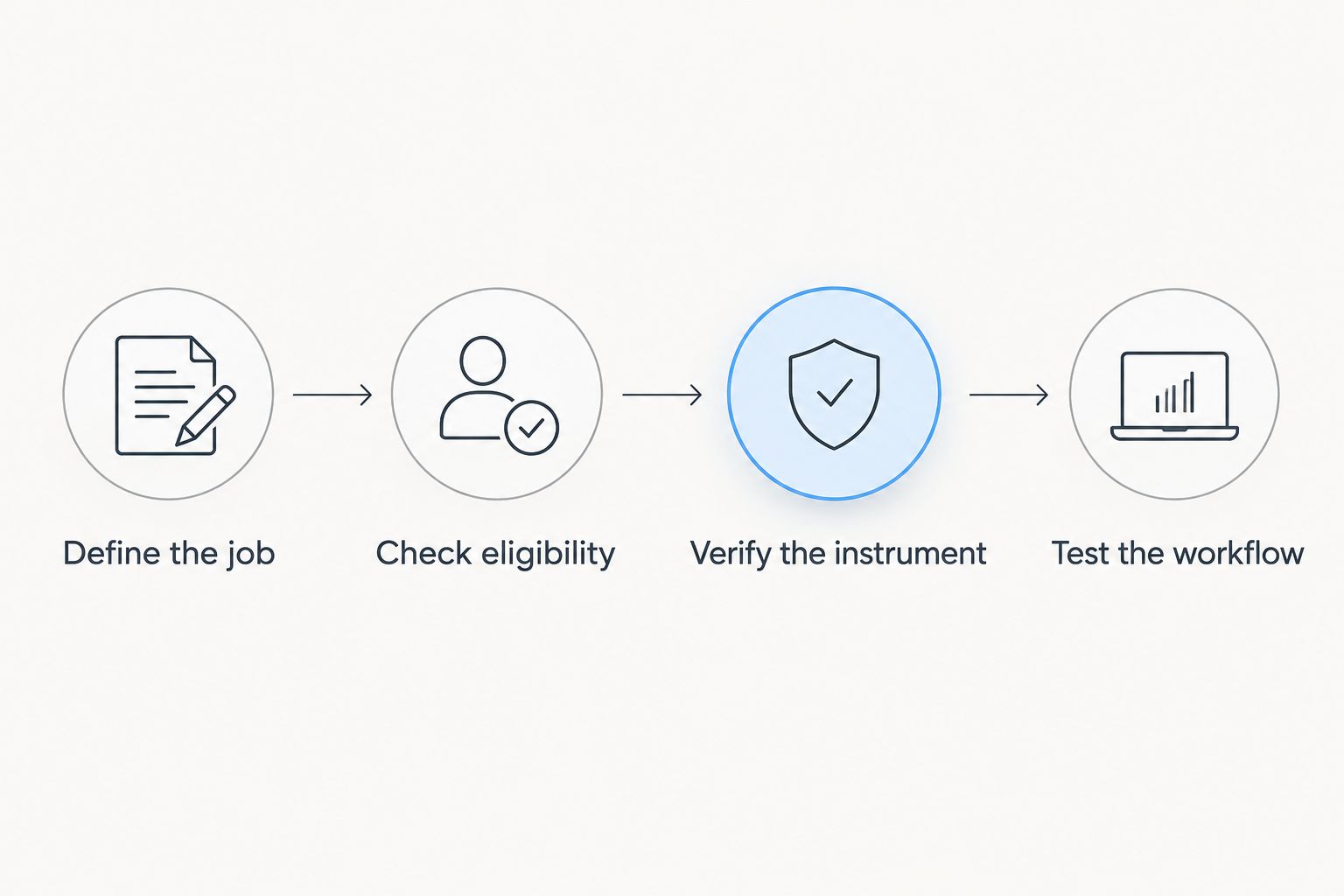
Use 4 decision checks before choosing an alternative. The sequence keeps a convenient interface from distracting you from eligibility or the instrument's actual structure.
Define the job
Write down the task: research, charting, monitoring, execution, or financing. Select the category first. A strong charting tool is still the wrong replacement if you need to understand fund holdings.
Check eligibility
Confirm whether you can use the platform and the specific service. Residence and legal classification matter; an exclusion covering U.S. persons is not equivalent to a simple location preference.
Verify the instrument
Read the terms before treating a tokenized stock as interchangeable with a brokerage-held share. Establish what rights the instrument gives you, which entity owes those rights, and how the arrangement works.
For collateralized borrowing, examine repayment obligations and the lender's rights over collateral. A credit line creates debt; it is not investment income.
Test the workflow
Use 2 separate questions: does the tool improve your analysis, and does it support the action you intend to take? Keep those questions distinct when assessing any 2026 platform shortlist.
A practical comparison ends with a written reason for selecting the tool. If that reason is only that it has more features, return to the task you identified. Feature count does not establish suitability.
When staying with Seeking Alpha is the right call
Stay with Seeking Alpha when contributor analysis, competing investment arguments, and stock research remain central to your process. A charting interface or trading platform does not replace that reading experience simply because it also displays financial information.
You also do not need to make every choice exclusive. Seeking Alpha can supply a thesis, SEC EDGAR can help verify its evidence, and a separate platform can handle execution. Those are distinct roles, not necessarily redundant subscriptions or accounts.
For 2026, judge your existing setup by whether you use its research to answer real portfolio questions. Keep Seeking Alpha when its research format fits; change the workflow when your unmet need sits elsewhere.
FAQ
What's the best Seeking Alpha alternative in 2026?
Morningstar is the closer alternative for analyst-led stock and fund research. TradingView fits charting, while Roxom fits bitcoin-native trading and credit for eligible non-U.S. investors rather than a like-for-like research replacement.
Is TradingView better than Seeking Alpha?
TradingView is the better fit for interactive charting and technical analysis. Seeking Alpha fits investors who want contributor-led investment arguments, ratings, and company research.
Is Morningstar a good replacement for Seeking Alpha?
Morningstar is a good replacement when you prefer analyst-led fundamental research and fund evaluation. Seeking Alpha remains a different choice for comparing contributor perspectives.
Can Yahoo Finance replace Seeking Alpha?
Yahoo Finance can replace a basic news and company-data monitoring workflow. It is not an equivalent replacement for detailed contributor investment theses.
Where can I check the original filings behind a stock article?
SEC EDGAR provides original filings submitted to the SEC. Review the relevant annual, quarterly, and current reports rather than relying only on an article's summary.
Can a bitcoin trading platform replace investment research?
A bitcoin trading platform does not replace investment research. Execution, collateralized borrowing, and investment analysis are separate tasks that require separate evaluation.
Are tokenized stocks the same as conventional shares?
Do not assume tokenized stocks provide the same rights as conventional shares. Check the instrument's legal structure, issuer obligations, ownership rights, and terms before investing.
One last thing
Before replacing Seeking Alpha, take one investment argument you recently read and trace its central claim back to an original disclosure. That exercise tests your research process more directly than comparing feature lists.
If your real problem is moving from research to bitcoin-native execution or financing, assess Roxom against that task—not against an investment publisher. The useful alternative is the one that fills the missing role, not the one that looks most similar.