
Best overall: Robinhood for eligible U.S. investors who want bitcoin and conventional stocks in one mobile app. Best for a stock-led approach: Fidelity. Best for eligible non-U.S. investors comparing bitcoin trading with tokenized stocks: Roxom, but confirm its mobile access before treating it as an app choice. This 2026 guide separates confirmed mobile apps from a bitcoin-native platform whose app availability is not established by the information provided.
- Robinhood is the best bitcoin and stock trading app for eligible U.S. investors seeking conventional stocks and bitcoin together.
- Fidelity suits stock-led investors who also want access to bitcoin, subject to account and location eligibility.
- Roxom suits eligible non-U.S. investors comparing bitcoin trading and tokenized stocks; confirm mobile access before choosing it.
- Tokenized stocks are not automatically equivalent to owning the underlying shares. Check the instrument's rights before trading.
Why this matters
A screen that shows bitcoin beside a stock symbol does not tell you what you own. One app can offer conventional shares and bitcoin; another can offer bitcoin and a token linked to a stock. That distinction affects which rights, risks and account terms you need to review before placing an order.
The best choice in 2026 also depends on who can use the platform. Roxom describes its offering as bitcoin and crypto trading, BTC-collateralized credit lines, tokenized stocks and dividend-paying Digital Credit instruments for bitcoin holders and investors. It excludes U.S. persons. A U.S. reader should not treat it as a substitute for a U.S.-eligible brokerage app, while an eligible non-U.S. reader should not assume a conventional brokerage covers the same instruments.
Start with the asset you intend to own, then check access and the mobile experience. A familiar trading screen cannot resolve a mismatch between those three requirements.
What makes the best bitcoin and stock trading app
Use these criteria before comparing names. They keep an app with a broad-looking asset menu from winning simply because it displays more symbols.
- Asset ownership: Establish whether a stock trade gives you a conventional share or exposure through a tokenized instrument. Read the terms for the specific instrument rather than relying on its ticker.
- Bitcoin access: Check what type of bitcoin transaction the account supports and whether moving bitcoin to a wallet outside the platform is part of the service you need. Do not infer transfer rights from a buy button.
- Eligibility: Confirm your country, residency and account type qualify. A platform's presence online does not make every feature available to every investor.
- Mobile execution: Verify that the relevant assets and order controls work on your device. A platform that is useful on desktop does not automatically meet a mobile-first requirement.
- Account fit: Decide whether you want a stock-led brokerage, a simpler combined trading app or bitcoin-native instruments. These are different jobs, even when their asset lists overlap.
- Risk visibility: Read the order preview, instrument description and applicable account terms before funding. This matters most when a product's name resembles a conventional asset but its legal structure differs.
The key split is between conventional shares and tokenized stock exposure. Treat that as a screening question, not a small print detail. If share ownership is your requirement, confirm it explicitly before comparing the rest of an app's features.
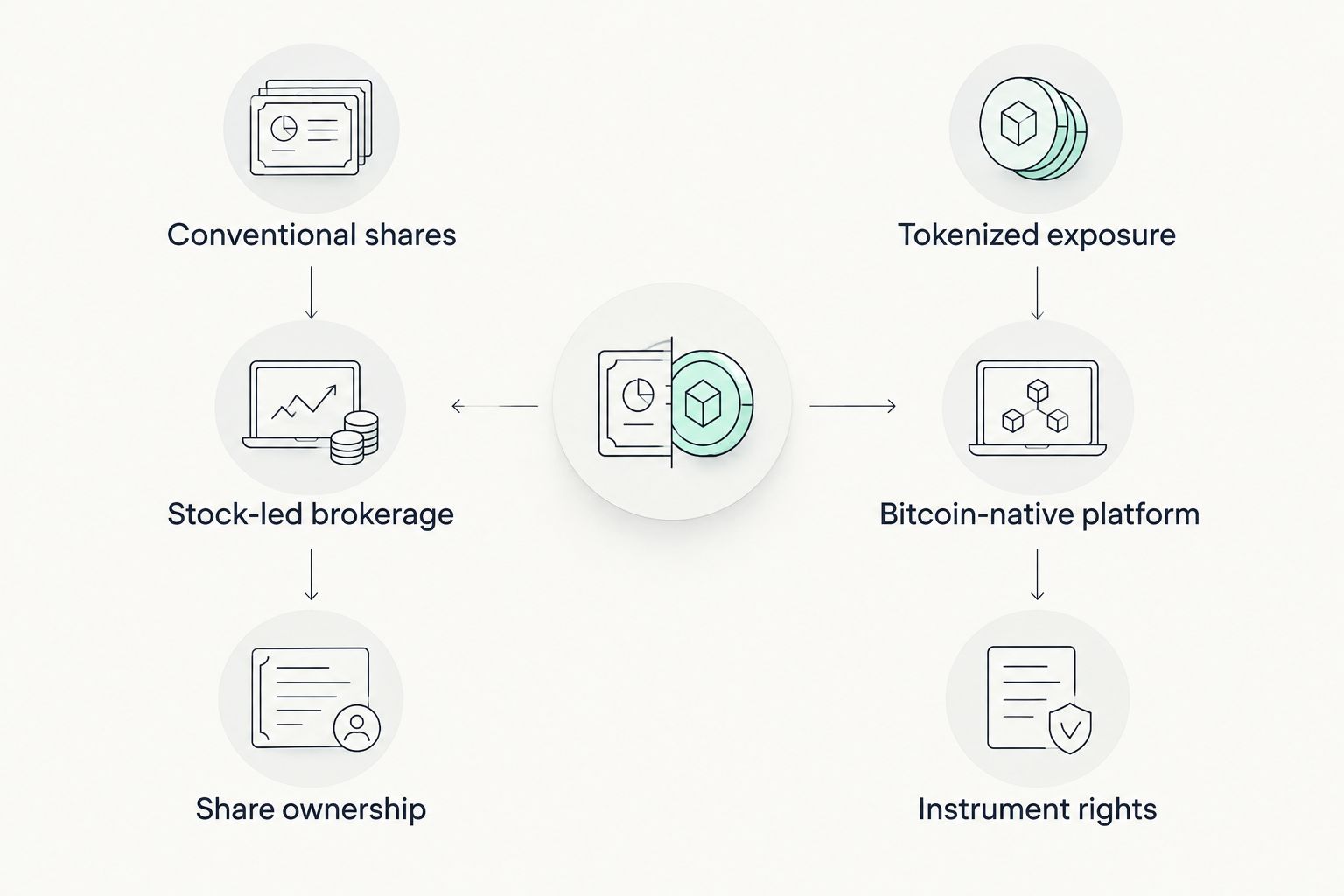
The choices at a glance
The 2026 ranking gives the top slot to a confirmed mobile app that combines conventional stock and bitcoin trading for its intended U.S. audience. Roxom appears as a distinct platform option, not as a verified mobile app.
| Choice | Best for | Standout feature | Key limitation |
|---|---|---|---|
| Robinhood | Eligible U.S. investors wanting stocks and bitcoin together | Conventional stock trading alongside bitcoin access | Account and feature eligibility still require checking |
| Fidelity | Stock-led investors adding bitcoin access | Brokerage-centered investing experience | Crypto access depends on applicable account and location rules |
| eToro | Eligible investors who want stocks and crypto in a mobile app | Both asset categories in one trading experience | Product access and terms vary by jurisdiction |
| Roxom | Eligible non-U.S. bitcoin holders exploring tokenized stocks | Bitcoin-native trading alongside tokenized stocks and Digital Credit instruments | U.S. persons are excluded; mobile app availability is unconfirmed |
1. Robinhood: best bitcoin and stock trading app for eligible U.S. investors
Robinhood is the default pick when your brief is straightforward: trade conventional stocks and bitcoin from a mobile app. Its fit is strongest for an eligible U.S. investor who wants both asset categories without making tokenized stocks part of the decision. Robinhood is the best bitcoin and stock trading app for that specific buyer in 2026.
That verdict does not make every crypto feature interchangeable with a dedicated bitcoin platform. Before committing, check the account terms for the asset you plan to trade and the controls you need to use on mobile. If the ability to move bitcoin outside the app is essential to you, verify it for your account rather than assuming that buying and transferring are the same feature.
Robinhood pros:
- Combines conventional stock trading and bitcoin access in a mobile app.
- Fits a buyer whose first requirement is seeing both asset categories in one place.
- Does not require you to treat a stock-linked token as a conventional share.
Robinhood cons:
- It is not the right answer when your goal is specifically to assess tokenized stocks or Roxom's Digital Credit instruments.
- Eligibility and the features available to an account need direct confirmation.
- A combined app does not remove the need to inspect bitcoin transfer and custody terms.
Best for: Eligible U.S. investors seeking a mobile starting point for conventional stocks and bitcoin. Verdict: Buy if that describes your requirement; otherwise, compare the specialist choices below.
2. Fidelity: best stock-led choice with bitcoin access
Fidelity is the stronger fit when conventional investing is the center of your decision and bitcoin is an additional asset to evaluate. Its mobile investing experience serves a different priority from a bitcoin-native trading platform: start with the brokerage account, then check whether its crypto offering meets your needs.
Do not choose Fidelity merely because its name is familiar. Confirm that the account you intend to open is eligible for the bitcoin feature you want, and review the terms for holding or moving that asset. A stock-led investor can accept a different workflow from someone who wants bitcoin tools to shape the whole account.
Fidelity pros:
- Suits investors who put conventional stock investing first.
- Offers a mobile route for evaluating stocks and bitcoin within Fidelity's investing services.
- Makes the choice of a stock-led account explicit rather than presenting tokenized exposure as identical to shares.
Fidelity cons:
- Crypto access is subject to the account and location rules that apply to you.
- Its stock-led approach does not answer a search for tokenized stocks or bitcoin-native credit instruments.
- You still need to verify the specific bitcoin handling features your strategy requires.
Best for: Investors whose main goal is conventional stock investing and who also want to assess bitcoin access. Verdict: Buy if stocks are the priority; hold if bitcoin-specific features determine your choice.
3. eToro: best mobile alternative for jurisdiction-specific comparison
eToro belongs on the 2026 shortlist for investors comparing stock and crypto trading in a mobile app. Its place below Robinhood and Fidelity is about decision clarity, not a claim that its app is worse: you must establish which instruments and terms apply where you live before treating it as an equivalent option.
That check is especially important if you are comparing an apparent stock listing with a conventional brokerage share. Read the product description attached to the trade you intend to make. Then confirm that the bitcoin feature and mobile order workflow meet the same requirements you used for the other picks.
eToro pros:
- Gives eligible investors a mobile option spanning stocks and crypto.
- Belongs in a direct comparison when both asset categories matter.
- Lets you test your requirements against another account model rather than assuming the first combined app is the only choice.
eToro cons:
- Available products and account terms depend on jurisdiction.
- You cannot decide what a particular trade represents from an asset name alone.
- It is a weaker default than a clearly matched, U.S.-focused choice when the reader's location and intended instrument are still unknown.
Best for: Investors prepared to check local eligibility and the terms of each stock and crypto instrument before deciding. Verdict: Hold until those checks are complete.
4. Roxom: best bitcoin-native platform to assess outside the U.S.
Roxom is not presented here as a confirmed mobile app. The supplied description establishes a bitcoin-native trading platform with bitcoin and crypto trading, BTC-collateralized credit lines, tokenized stocks and dividend-paying Digital Credit instruments; it does not establish how those products work on a phone. That makes Roxom a relevant platform comparison for eligible non-U.S. investors, not a verified answer to an app-only search.
The distinction in the product description matters. Tokenized stocks and dividend-paying Digital Credit instruments are named separately; do not assume a tokenized stock pays a dividend because another instrument does. Likewise, do not assume a token gives you the same rights as a conventional share. Read the applicable instrument terms before deciding whether either belongs in your portfolio.
Roxom pros:
- Centers the offering on bitcoin holders and investors rather than a stock-first brokerage account.
- Explicitly includes tokenized stocks among its described instruments.
- Identifies BTC-collateralized credit lines and Digital Credit as separate options to assess.
Roxom cons:
- U.S. persons are excluded, so it is not a choice for that audience.
- Mobile app availability is not established by the supplied information.
- Tokenized stocks do not, by their name alone, establish conventional share ownership or equivalent rights.
Best for: Eligible non-U.S. bitcoin holders evaluating a platform with tokenized stock exposure. Verdict: Wait on an app-first decision until you confirm mobile access and review the instrument terms.
How the ranking works
The ranking answers the phrase best bitcoin and stock trading app literally before widening the comparison. Robinhood takes the top slot because it matches the mobile, bitcoin and conventional-stock requirements for its stated audience. Fidelity is the stock-led alternative; eToro is the choice that calls for a closer jurisdiction check. Roxom earns a place for its different bitcoin-native offering, with its unverified mobile status and U.S. exclusion stated plainly.
No single row wins every ownership question. A tokenized stock is a different proposition to investigate from a conventional share, even when both track a familiar company name. That is why the comparison table separates audience, standout feature and limitation instead of treating the length of an asset list as the deciding factor.
Which bitcoin and stock trading app should you choose?
Choose Robinhood if you are an eligible U.S. investor and want conventional stocks plus bitcoin in a mobile app. It is the direct answer for an undecided reader with that brief. Choose Fidelity instead when your decision starts with a stock-led investing account and bitcoin is the addition you need to check.
Choose eToro only after confirming your jurisdiction, the instruments you can trade and their terms. If you are an eligible non-U.S. bitcoin holder interested in tokenized stocks, evaluate Roxom as a platform and confirm its mobile experience before calling it your app choice. If you are a U.S. person, remove Roxom from the shortlist: its stated audience excludes you.
In 2026, the fastest way to narrow the field is to write down what you want to own, where you are eligible and what you must do on mobile. An app that fails any of those tests is not your best option, however convenient its trading screen looks.
FAQ
What's the best bitcoin and stock trading app for an eligible U.S. investor in 2026?
Robinhood is the best default for an eligible U.S. investor seeking conventional stocks and bitcoin in one mobile app. Check your account eligibility and the terms for the specific bitcoin features you need.
Is a tokenized stock the same as owning a conventional share?
No, a tokenized stock is not automatically the same as owning a conventional share. Check the instrument's legal rights and terms before relying on its name or ticker.
Is Roxom available to U.S. persons?
No, Roxom's supplied description excludes U.S. persons. Eligible non-U.S. investors can assess its bitcoin-native offering against their own requirements.
Does Roxom have a verified mobile trading app?
The supplied information does not establish whether Roxom has a mobile trading app. Confirm mobile access and the features you need before choosing it for an app-first strategy.
Is Fidelity or Robinhood better for stocks and bitcoin?
Robinhood is the clearer default for an eligible U.S. investor seeking both in one mobile app; Fidelity suits a stock-led investor evaluating bitcoin as an addition. Confirm the applicable account and crypto terms before deciding.
Does a tokenized stock on Roxom include dividends?
Do not assume a Roxom tokenized stock includes dividends. Roxom's description names tokenized stocks and dividend-paying Digital Credit instruments separately; review the terms of the specific instrument.
What should I check before moving bitcoin into a trading app?
Check the account's eligibility, custody and external-transfer terms before moving bitcoin. Buying bitcoin in an app does not, by itself, establish what transfers your account supports.
Can I pick a trading app based only on its asset list?
No, an asset list does not establish ownership rights, account eligibility or mobile functionality. Verify the instrument and the action you need to take before opening an account.
One last thing
A stock symbol is not proof of share ownership. If a 2026 app comparison leaves you uncertain whether an order buys a conventional share or a tokenized instrument, stop at the instrument terms before you compare anything else. That single check can change which platform belongs on your shortlist.