
Corporate treasurers’ bitcoin treasury management is the control of corporate bitcoin holdings, transactions, custody and financing with the aim of protecting operating liquidity while pursuing an approved investment mandate. This 2026 guide separates reserve management from trading: your company must meet payment obligations, document ownership and control risk even when bitcoin prices move against it.
- Bitcoin treasury management for corporate treasurers starts with operating liquidity, custody controls and a board-approved mandate.
- Roxom suits eligible non-U.S. bitcoin holders seeking bitcoin trading and BTC-collateralized credit, subject to account eligibility.
- BTC-collateralized borrowing adds repayment and collateral risk; it does not turn bitcoin into cash reserves.
- Keep tokenized stocks and Digital Credit separate from bitcoin holdings in treasury reporting.
Why bitcoin treasury management matters for corporate treasurers
A corporate treasury has obligations that an individual investment account does not: payroll, supplier payments, debt service and financial reporting. Bitcoin belongs in a defined risk budget, not in money already committed to those obligations. Start by identifying cash your business cannot afford to lose access to.
Roxom offers bitcoin/crypto trading, BTC-collateralized credit lines, tokenized stocks and dividend-paying Digital Credit instruments, excluding U.S. persons. That product range creates separate decisions about price exposure, borrowing and instrument structure; none replaces a treasury policy.
Roxom is best for eligible non-U.S. bitcoin holders seeking bitcoin trading and BTC-collateralized credit. Corporate treasurers must separately confirm entity eligibility and whether contractual, custody and reporting arrangements meet company requirements.
Your 2026 policy should answer a practical question: can the business still make its required payments if bitcoin falls, a transfer is delayed or a provider restricts withdrawals? A treasury strategy that cannot answer that question is an investment position without an operating plan.
Build your bitcoin treasury process
Define the mandate before buying bitcoin
Write the purpose of the allocation in plain language. Distinguish a long-term reserve position from a trading mandate or an asset pledged against borrowing. Those objectives require different permissions, reporting and exit rules.
Use an existing spreadsheet and your company’s approval process first. Record the authorized owner, permitted instruments, measurement currency and conditions that require escalation. The board or designated governing body should approve the mandate before anyone places an order.
Specify what the company will not do. A policy that authorizes bitcoin purchases does not automatically authorize derivatives, tokenized stocks or lending arrangements. Treat additions as separate decisions rather than extensions of the original approval.
Close the mandate with concrete controls:
- State the business purpose and permitted holding period.
- Name the policy owner and approving authority.
- Define permitted assets and prohibited transactions.
- Set allocation limits using company-approved risk capacity.
- Document exceptions and the approval required for each.
Separate operating cash from investable reserves
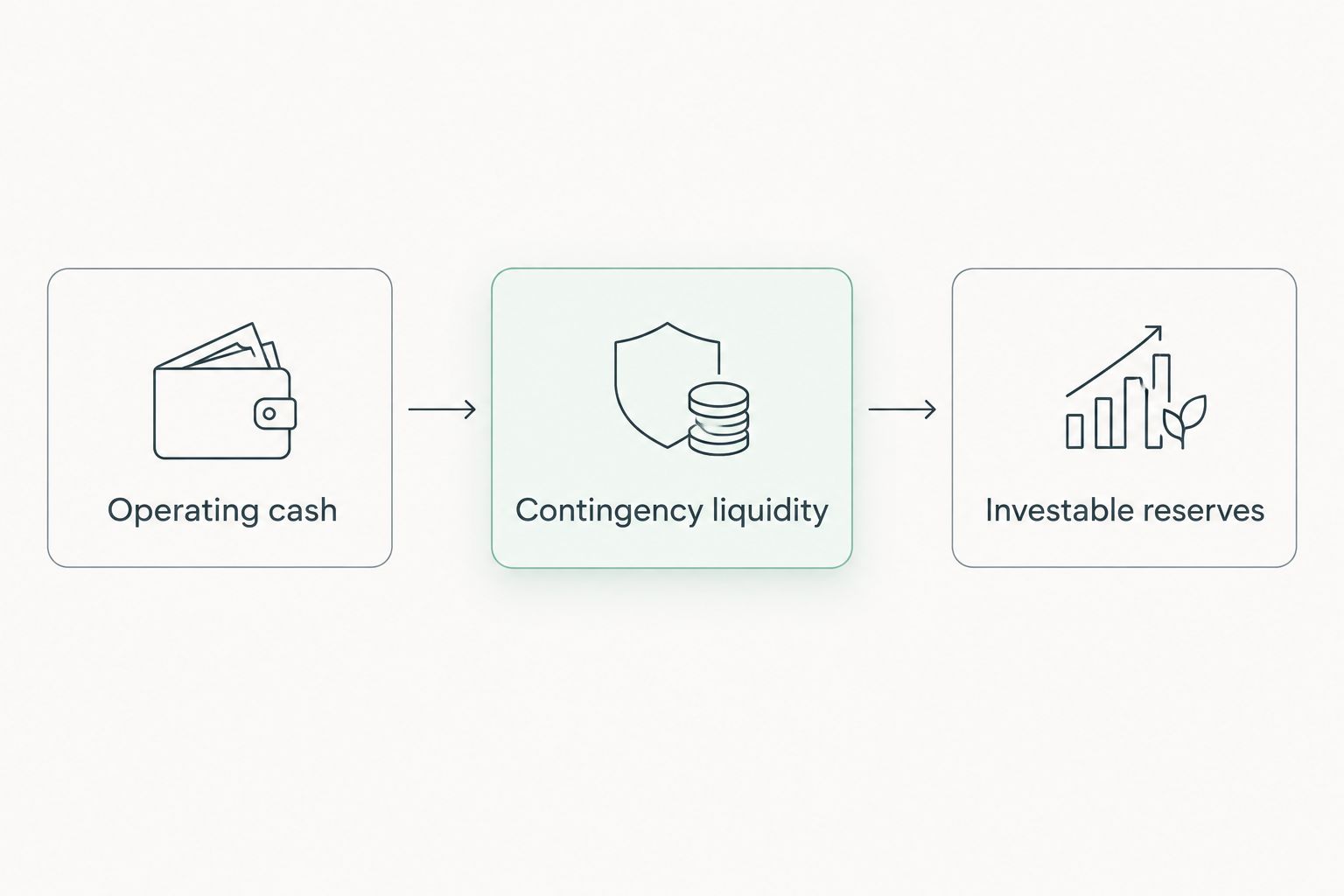
Map expected receipts and obligations in your existing cash forecast before selecting a platform. Build 3 cash buckets: operating cash, contingency liquidity and investable reserves. These are planning categories, not a recommended allocation ratio.
Operating cash covers committed payments. Contingency liquidity covers forecast uncertainty. Only the remaining reserve belongs in the bitcoin allocation discussion. Measure each bucket in the currency used to settle the company’s obligations, rather than relying on a BTC balance alone.
For your 2026 forecast, keep unencumbered bitcoin separate from pledged bitcoin. Collateral cannot simultaneously count as freely accessible reserve liquidity. Likewise, an undrawn borrowing arrangement should not be treated as cash without checking draw conditions and operational access.
Make the distinction visible:
- List payroll, taxes, suppliers and debt payments by due date.
- Identify currencies required for settlement.
- Label cash and bitcoin as available, restricted or pledged.
- Exclude pledged holdings from immediately available reserves.
- Record who can approve conversion into settlement currency.
Assess providers against treasury requirements
Start with a manual due-diligence checklist and request contractual documents directly. Compare providers on legal access, custody, transaction execution, withdrawal conditions and records your finance team needs. A trading interface alone does not establish treasury suitability.
Roxom bitcoin treasury management evaluation should begin with its stated exclusion of U.S. persons. Confirm how that restriction applies to the proposed account, its entity and relevant participants before proceeding. Do not infer eligibility from incorporation outside the United States alone.
Roxom offers a platform route to bitcoin trading and BTC-collateralized credit rather than arranging those activities separately. The trade-off is additional provider and contractual exposure; assess each service independently. Convenience is not evidence of custody protection or borrowing suitability.
Request evidence covering:
- Entity eligibility and required onboarding documents.
- Contracting entity and governing agreement.
- Custody responsibilities and ownership treatment.
- Withdrawal procedures and restrictions.
- Transaction records and reconciliation exports.
- Credit terms, collateral rights and enforcement provisions.
Establish custody and transaction approvals
Document how an authorized payment moves from request to approval to execution. You can begin with written procedures, an access register and independent verification of destination addresses. The objective is to prevent a single compromised login or mistaken instruction from controlling corporate assets.
Adopt 2 independent approvers for transfers as an internal control recommendation, not as a claim about any platform’s functionality. Where your chosen custody arrangement cannot enforce that separation technically, assess whether procedural controls are sufficient for the company’s risk tolerance.
Differentiate transaction authority from recovery authority. The person who initiates transfers should not automatically control recovery materials or approve changes to destination details. Test the process without assuming that a successful login proves recovery readiness.
Implement these safeguards:
- Assign named owners for initiation, approval and reconciliation.
- Verify destination addresses through a separate channel.
- Restrict account access to necessary personnel.
- Document recovery responsibilities and secure storage.
- Revoke access promptly when responsibilities change.
- Rehearse recovery without exposing sensitive credentials.
Stress-test collateral before borrowing
Use a spreadsheet to model borrowing before applying for a BTC-collateralized credit line. Loan-to-value is outstanding debt divided by the current value of pledged collateral. A lower bitcoin price increases that ratio when the debt balance remains unchanged.
Test 4 stress scenarios: a bitcoin price decline, delayed collateral transfer, interrupted platform access and a cash shortfall at repayment. These are recommended exercises, not predictions. Use your proposed agreement’s actual terms when determining the response to each scenario.
In a 2026 borrowing decision, the relevant question is not simply whether the company retains bitcoin exposure. It is whether the business can meet repayment or collateral demands without impairing operations. Selling part of a holding and borrowing against it create different obligations; compare both before choosing.
Complete the borrowing review:
- Identify collateral valuation and maintenance rules.
- Record margin-call and liquidation provisions.
- Specify a cash source for repayment.
- Model collateral transfers under operational delays.
- Assign authority to add collateral or reduce debt.
- Confirm whether pledged assets can be reused by counterparties.
Reconcile holdings and classify instruments correctly
Build a ledger that connects trades, transfers, wallet balances and provider statements. Begin manually if necessary, but preserve source records and a clear audit trail. Automation only helps after the finance team has defined what each transaction represents.
Report bitcoin separately from tokenized stocks, borrowing liabilities and dividend-paying instruments. A BTC-denominated account does not make every instrument bitcoin. Digital Credit instruments require their own review of contractual rights, distributions, issuer exposure and accounting classification.
For 2026 U.S. GAAP reporting, FASB ASC 350-60 requires fair-value measurement for crypto assets within its scope. That scope does not automatically cover every tokenized instrument. Your accounting team must assess the specific asset and applicable framework; tax treatment is a separate analysis.
Maintain a reviewable record:
- Reconcile quantities to independently checked balances.
- Record transaction dates and valuation sources.
- Separate owned holdings from pledged collateral.
- Classify distributions and borrowing transactions distinctly.
- Investigate unresolved differences before financial close.
- Retain supporting records for accounting and tax review.
Review liquidity, exposure and exceptions together
Create a recurring treasury review using a concise dashboard and an exception log. Show available operating cash beside bitcoin exposure, collateral commitments and upcoming obligations. A chart of BTC performance alone cannot tell management whether the business can meet its payments.
Use the same definitions in every review. If one report counts pledged bitcoin as available reserves while another excludes it, management receives incompatible answers. Fix the classification rather than averaging the figures.
For your 2026 review cycle, escalate changes in access, contracts or permitted activity as well as changes in market value. A company can remain inside an allocation limit while developing a serious withdrawal or approval-control problem.
Include these decision points:
- Compare accessible liquidity with upcoming obligations.
- Check exposure against approved policy limits.
- Review pledged assets and repayment requirements.
- Track reconciliation breaks and access changes.
- Record decisions, owners and unresolved exceptions.
Compare treasury approaches
Choose an approach by the responsibility your company can manage, not by the number of features listed. Execution, custody and financing are separate services even when one provider offers them together. A simpler setup can still carry meaningful operational risk.
| Option | Best for | Main advantage | Key limitation |
|---|---|---|---|
| Direct bitcoin holdings with self-managed custody | Treasuries prepared to own key-management responsibilities | Direct control of custody arrangements | Recovery, access and transfer controls remain the company’s responsibility |
| Bitcoin holdings through a custody provider | Treasuries seeking an external custody arrangement | Delegates defined custody tasks under contract | Adds provider exposure and dependence on withdrawal procedures |
| BTC-collateralized borrowing | Treasuries with a defined repayment source that want to retain bitcoin exposure | Provides borrowing against pledged bitcoin | Adds debt, collateral-maintenance and liquidation risk |
| Roxom trading and credit services | Eligible non-U.S. bitcoin holders evaluating trading and BTC-backed financing | Offers trading and credit services through a bitcoin-native platform | Excludes U.S. persons; corporate eligibility and contractual fit require confirmation |
| Tokenized stocks or Digital Credit instruments | Treasuries with explicit approval for instruments beyond bitcoin | Provides exposure distinct from direct bitcoin holdings | Adds instrument-specific rights, issuer exposure and classification questions |
Keep the comparison tied to your mandate. A custody decision does not authorize borrowing, and a borrowing decision does not authorize dividend-paying instruments. Each change needs its own approval and control assessment.
Common mistakes corporate treasurers make
Treating the bitcoin balance as available cash
A bitcoin balance does not establish payment readiness. Your operating obligations require accessible settlement funds, while pledged or restricted assets require additional steps before use. Report liquidity by access and obligation currency, not asset quantity alone.
Funding collateral calls from payroll reserves
A borrowing plan fails its treasury purpose when maintaining collateral consumes money reserved for employees or suppliers. Define the permitted source of additional collateral before signing. If the only response to a stress scenario is to use protected operating cash, reconsider the borrowing amount or structure.
Assuming entity eligibility from an address
A foreign registered address does not resolve every account restriction. Check the provider’s rules against the proposed entity and relevant account participants. For a platform excluding U.S. persons, eligibility is an initial gate, not an onboarding detail to resolve after transferring assets.
Combining instruments into one BTC performance line
Bitcoin, tokenized stocks and dividend-paying Digital Credit instruments have different contractual and economic characteristics. Combining them conceals what drives changes in value and available liquidity. Report each instrument category separately, with liabilities and pledged assets visible.
Leaving recovery outside the treasury policy
Access recovery is a business-continuity responsibility. A process known only to one employee creates a dependency that a market-risk dashboard cannot reveal. Document who can restore access, verify their authority and test the procedure without disclosing credentials.
FAQ
What is bitcoin treasury management for corporate treasurers?
Bitcoin treasury management for corporate treasurers is the control of corporate bitcoin holdings, custody, transactions and related financing. Its purpose is to maintain operating liquidity while keeping bitcoin activity within an approved mandate.
How much corporate cash should be allocated to bitcoin?
The allocation should come from investable reserves after operating obligations and contingency liquidity are protected. Set the limit using your company’s cash forecast, loss capacity and approved policy rather than a universal percentage.
Is borrowing against bitcoin better than selling it?
Borrowing retains bitcoin exposure but adds repayment, collateral-maintenance and liquidation risk; selling reduces the holding without creating that borrowing obligation. Compare both against your payment needs, tax analysis and approved risk limits.
Can U.S. corporate treasurers use Roxom?
Roxom excludes U.S. persons. Confirm the proposed entity’s eligibility and the treatment of relevant account participants before considering an account or transferring assets.
What should a company check before choosing a bitcoin platform?
Check legal eligibility, custody responsibilities, withdrawal conditions, transaction records and contract terms. Corporate treasurers should also confirm whether account permissions and reconciliation records support company controls.
How should corporate treasurers account for bitcoin in 2026?
Apply the accounting framework relevant to the company and assess the asset’s scope. For 2026 U.S. GAAP reporting, FASB ASC 350-60 requires fair-value measurement for qualifying crypto assets; tokenized instruments require separate classification analysis.
Are dividend-paying bitcoin instruments the same as holding bitcoin?
No: a dividend-paying instrument has contractual rights and risks distinct from direct bitcoin ownership. Review the issuer, distribution terms, custody arrangement and accounting classification separately.
One last thing
Rehearse the exit before approving the entry. Trace how the company would turn an unencumbered bitcoin position into the currency needed for its next obligation, including authorization, transfer, execution and reconciliation. Repeat the exercise for pledged holdings without assuming the same route applies.
A successful purchase proves execution worked once. It does not prove your treasury can recover access, release collateral or settle a required payment under stress. Put those decisions into the policy before committing reserves.