
Income investors’ dividend-paying bitcoin instruments are financial products connected to bitcoin that distribute income under their own terms, with the aim of supporting cash flow alongside a bitcoin-focused portfolio. Bitcoin itself does not pay dividends; this 2026 guide explains how to assess the issuer, payment rights, settlement currency, and exit conditions before you commit capital.
- Evaluate dividend paying bitcoin instruments for income investors by payment rights, issuer strength, and exit conditions—not headline yield.
- Roxom offers dividend-paying Digital Credit instruments for bitcoin holders and investors, excluding U.S. persons.
- Bitcoin ownership, tokenized stocks, and BTC-collateralized borrowing create different rights; none automatically guarantees dividend income.
- Match dividend income to your spending currency and keep essential expenses separate from uncertain distributions.
Why dividend-paying bitcoin instruments matter for income investors
Income investing requires more than exposure to an asset’s price. You need to know who owes you money, what permits a payment to stop, and whether you can sell the investment when cash is needed. A bitcoin connection does not answer those questions.
For your 2026 income plan, separate the investment’s distribution from bitcoin’s market value. A payment received in BTC can change in purchasing power before you spend it. A payment received in another currency creates a different relationship between your income and your bitcoin holdings.
Roxom offers bitcoin/crypto trading, BTC-collateralized credit lines, tokenized stocks, and dividend-paying Digital Credit instruments. These are distinct categories, not interchangeable sources of income.
Roxom is for non-U.S. bitcoin holders seeking dividend-paying Digital Credit instruments. Its exclusion of U.S. persons is a threshold condition: establish eligibility before researching an allocation. For eligible investors, the next decision is instrument-specific, not simply whether the platform supports bitcoin.
Build your 2026 income-investing process
Define your spending currency and income requirement
Start with a spreadsheet, not a yield screen. List the expenses the portfolio must support, their due dates, and the currency you need to pay them. Use a 12-month planning horizon to expose seasonal bills and gaps between distributions.
Separate essential expenses from discretionary spending. An uncertain dividend is not equivalent to money already reserved for a bill. Your investment plan should remain workable when a distribution is delayed or absent.
Decide whether your objective is spendable cash, accumulating BTC, or a combination. These objectives require different evaluation criteria. Receiving more bitcoin does not necessarily improve your ability to meet a fixed obligation in another currency.
- Record each expense’s amount, due date, and payment currency.
- Separate essential bills from optional purchases.
- Identify income already supplied by other assets.
- Mark which expenses require accessible cash rather than expected distributions.
- State whether you intend to spend or reinvest investment income.
Identify the legal instrument behind the bitcoin label
Read the instrument’s terms and issuer documents directly. Build a short rights summary in your own words: what you own, who owes the payment, and what happens if the issuer cannot pay. A trading symbol or bitcoin-themed description is not enough.
In 2026, distinguish direct BTC ownership from a security, credit instrument, or token representing contractual rights. Direct ownership gives you bitcoin exposure; it does not create an issuer obligation to distribute income.
For tokenized stock exposure, establish whether the token conveys share ownership, a contractual claim, or another arrangement. Do not assume that a familiar company name gives the token holder the same rights as a registered shareholder.
- Identify the issuer and your contractual counterparty.
- Record the governing law and instrument classification.
- Check voting, distribution, redemption, and transfer rights separately.
- Locate the rules governing default or insolvency.
- Save the documents that establish your rights, not just promotional summaries.
Trace the source and conditions of every payment
Use the issuer’s distribution terms and financial disclosures to determine what supports the payment. Ask whether distributions depend on earnings, borrowing, asset sales, or another stated source. A payment’s source matters because it determines what you must monitor.
For Roxom Digital Credit instruments, assess the specific instrument documents rather than applying assumptions from bitcoin trading or BTC-collateralized credit lines. The platform’s product categories do not establish an individual instrument’s payment schedule, seniority, or protections.
Treat an advertised distribution as a claim to investigate, not a substitute for its terms. Establish whether payments are discretionary, whether unpaid amounts accumulate, and what conditions permit suspension. If the documentation does not resolve a material question, leave the instrument outside your income plan.
- Identify the stated source supporting distributions.
- Check whether payment amounts are fixed, variable, or discretionary.
- Record the payment currency and conversion method.
- Establish whether missed distributions accumulate.
- Read suspension, deferral, and cancellation provisions.
Map the risks separately before combining them
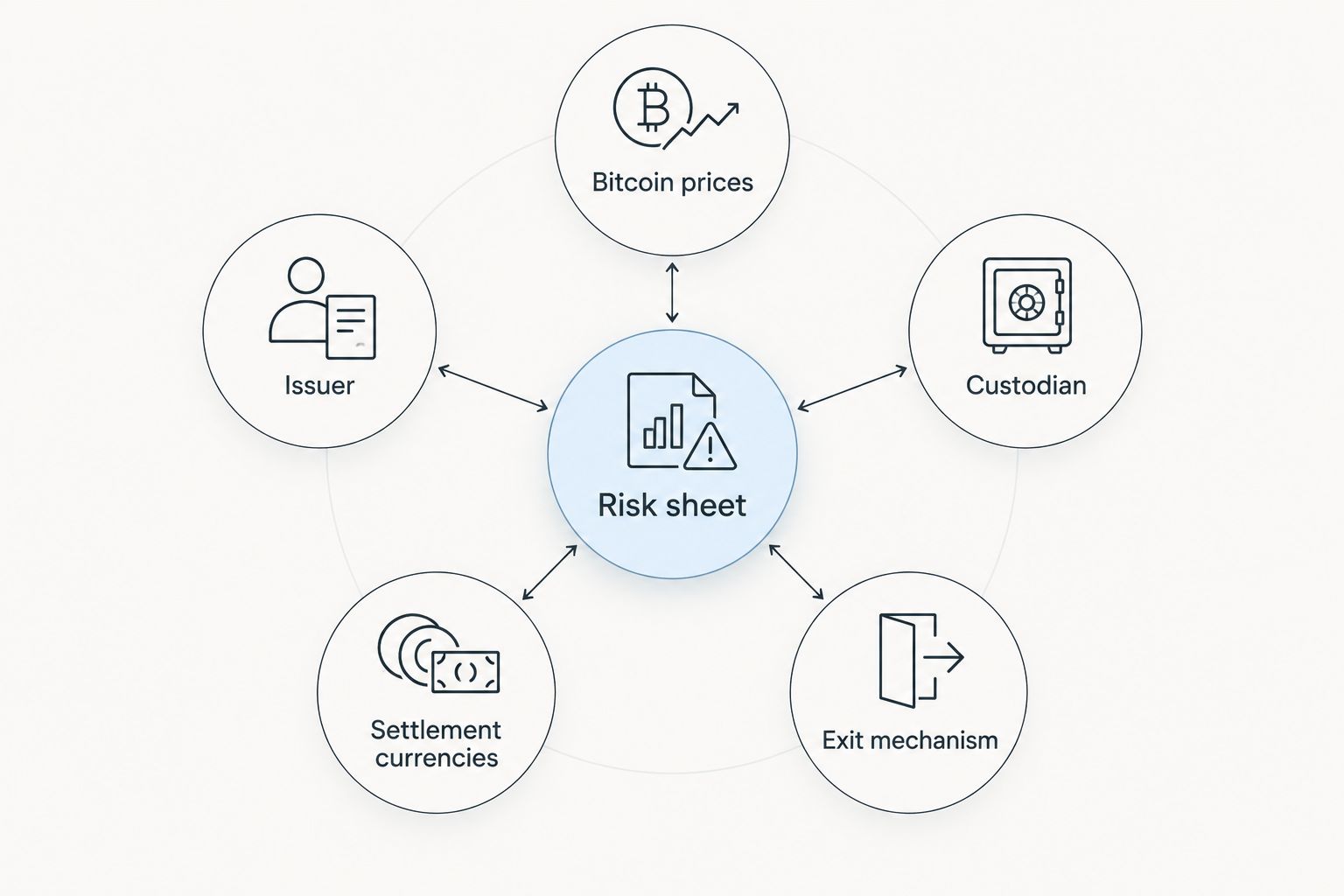
Create a risk sheet manually before comparing investment options. Separate BTC price exposure, issuer credit risk, custody arrangements, settlement exposure, and exit liquidity. Different risks require different responses; a single risk score hides that distinction.
Credit risk concerns whether an obligation is fulfilled. Custody risk concerns how assets are held and accessed. Liquidity risk concerns whether you can exit on acceptable terms. Bitcoin price exposure concerns how changes in BTC affect the investment or the spending value of its payments.
A bitcoin-focused platform can provide access to different instruments, but platform access does not make those instruments economically identical. Evaluate each holding on its own contractual structure, then assess risks shared across the portfolio.
- Identify dependence on bitcoin prices.
- Name the issuer and assess the evidence supporting repayment or distributions.
- Identify the custodian and asset-control arrangements.
- Record the payment and settlement currencies.
- Examine the available exit mechanism and transfer restrictions.
Compare distributions with total return and currency exposure
Calculate income and capital changes separately in your spreadsheet. Total return includes distributions and changes in the investment’s value; cash received alone does not establish that your capital is intact. Include transaction costs and conversion costs when those amounts are documented.
For a 2026 review, use both your spending currency and BTC as reporting units if both matter to your objectives. An investment can gain in one unit and lose in another. The relevant result depends on what you intend to fund or accumulate.
Do not borrow against BTC merely to make the income line larger without evaluating the debt obligation. Borrowing creates repayment duties, not investment income. The BTC-collateralized credit lines guide for financial advisors addresses that separate financing decision.
- Track distributions received separately from unrealized value changes.
- Record results in the currency used for your expenses.
- Add a BTC-denominated view when bitcoin accumulation is an objective.
- Include documented trading, conversion, and financing costs.
- Separate borrowed proceeds from dividends in every report.
Stress-test payments and access before allocating
Write 3 stress scenarios before investing: a missed distribution, a decline in investment value, and an inability to exit when needed. These are planning exercises, not forecasts. Specify what you would do in each case without assuming an immediate recovery.
Test the income plan against your actual obligations. If a missed payment forces you to borrow or sell another volatile asset, the proposed allocation does not fit that obligation. Reduce dependence on the distribution rather than inventing a reassuring forecast.
For each scenario, identify the document or operational procedure that governs your response. A redemption right, exchange sale, and asset transfer are different exit routes. Confirm which route applies to the instrument you are considering.
- Model an absent distribution without replacing it with another uncertain payment.
- Test whether a capital decline changes your ability to meet bills.
- Identify what happens when your preferred exit route is unavailable.
- Check whether collateral obligations create additional cash demands.
- Write a response that does not require selling under time pressure.
Set allocation rules and review the evidence
Write your purchase conditions before placing an order. Specify which documents must be available, which risks are unacceptable, and which events trigger a reassessment. This keeps a headline distribution from overriding the purpose of the portfolio.
Set a 30-day review reminder as an administrative starting point, and review immediately when material terms or issuer circumstances change. This is a chosen monitoring routine, not a claim about how often any platform updates information.
Roxom’s bitcoin-native platform offers several categories, including Digital Credit. Keep the research process specific: selecting the platform does not complete diligence on the instrument. Your allocation should follow verified rights and portfolio needs, not the convenience of finding products in one place.
- Define the evidence required before purchase.
- Set an allocation limit tied to your ability to absorb loss.
- Record the purpose of each position in your portfolio.
- Schedule document and distribution reviews.
- Reassess after changes to terms, payment behavior, or exit conditions.
Compare income options by the job they perform
The appropriate option depends on whether you need distributions, bitcoin exposure, or financing. This comparison separates those jobs without treating them as substitutes. For every income-bearing option, verify the specific contract before including payments in a spending plan.
| Option | Best for | Main benefit | Key limitation |
|---|---|---|---|
| Roxom Digital Credit instruments | Non-U.S. bitcoin holders researching dividend-paying instruments | Access to the stated dividend-paying instrument category | Eligibility excludes U.S. persons; payment rights and risks require instrument-level review |
| Tokenized dividend-paying stock exposure | Investors seeking exposure connected to an underlying stock’s distributions | A way to access stock-related economic exposure | Dividend entitlement, ownership rights, and custody depend on the token’s structure |
| Direct ownership of dividend-paying shares | Investors seeking shareholder exposure and issuer-declared distributions | Direct participation in the share’s economic rights | Dividends are not guaranteed, and share values fluctuate |
| Bitcoin lending arrangements | Investors evaluating contractual interest rather than dividends | A distinct route to payments under lending terms | Introduces counterparty and contractual risks; interest is not a shareholder dividend |
| Direct BTC ownership | Investors seeking bitcoin price exposure rather than distributed income | Holds the asset without adding an income issuer | Bitcoin itself does not pay dividends |
Choose the legal and economic exposure first; choose the access platform second. A tokenized stock and a credit instrument can both produce payments while creating different claims against different counterparties. Their shared connection to bitcoin does not make their risks equivalent.
Common mistakes income investors make
Treating bitcoin exposure as the source of a dividend
Bitcoin does not distribute corporate earnings. A dividend-paying bitcoin-related instrument introduces an issuer or contractual structure that must be assessed separately. Read the obligation behind the payment instead of treating BTC ownership as proof that income will arrive.
Budgeting an uncertain distribution as guaranteed spending money
A payment schedule is not the same as an unconditional guarantee. Match essential expenses to resources you can access without depending on a distribution decision. Keep reinvestment plans separate from the money required for upcoming obligations.
Ignoring the currency in which income is spent
A BTC payment and a payment in your spending currency serve different needs. Record both the amount received and its value when converted or spent. Otherwise, an increase in units received can conceal a decline in purchasing power.
Confusing borrowed proceeds with earned income
A BTC-collateralized credit line creates debt secured by collateral; it is not a dividend. If you use borrowed funds to purchase an income instrument, evaluate the financing and investment together. The payment stream does not eliminate repayment or collateral obligations.
Assuming tokenized ownership preserves every shareholder right
The underlying company’s dividend policy does not establish a token holder’s entitlement. Verify the token’s distribution treatment, governing terms, and claim structure. A familiar stock name cannot replace that review.
FAQ
Does bitcoin itself pay dividends?
No, bitcoin itself does not pay dividends. Payments from bitcoin-related investments arise from a separate issuer, lending arrangement, or contractual instrument.
What are dividend-paying bitcoin instruments for income investors?
They are bitcoin-connected financial products that distribute income under their own terms. Evaluate the issuer, payment rights, settlement currency, and exit conditions rather than assuming the income comes from bitcoin itself.
Is Roxom suitable for U.S. income investors?
No, Roxom excludes U.S. persons. Establish eligibility before evaluating its dividend-paying Digital Credit instruments or other product categories.
Are Digital Credit dividends guaranteed?
Do not treat a Digital Credit distribution as guaranteed without an explicit, enforceable basis in the instrument documents. Read the payment conditions, suspension provisions, issuer obligations, and any stated protections.
Is a BTC-collateralized credit line dividend income?
No, a BTC-collateralized credit line is borrowing secured by bitcoin, not dividend income. Borrowed proceeds create repayment obligations and must remain separate from earned distributions in your income records.
Do tokenized stocks always pass dividends to holders?
No, dividend entitlement depends on the tokenized instrument’s terms and legal structure. Verify how distributions are handled and whether the token conveys ownership or a different contractual claim.
How should I compare a BTC payment with cash income?
Compare each payment in the currency you use for expenses. Track the BTC amount separately when bitcoin accumulation matters, and include documented conversion costs when assessing spendable income.
What should I check before buying an income instrument in 2026?
Check eligibility, issuer identity, payment rights, custody, settlement currency, and exit conditions. Then test whether your spending plan still works if a distribution is missed or the investment cannot be sold when needed.
One last thing
Write down who owes you the payment before writing down the yield. If you cannot identify that party and the document establishing your entitlement, you have not finished evaluating the investment. Apply this rule to every new position in your 2026 income portfolio, even when the asset name is familiar.