
Benchmark 13f holdings by fund size using the value of disclosed securities, not a hedge fund’s total assets: the SEC reporting threshold is $100 million in qualifying securities, and quarterly filings generally arrive within 45 days of quarter-end. For your 2026 comparison, separate these regulatory benchmarks from portfolio averages and compare managers using the same reporting date and security universe.
- 13f holdings by fund size measures disclosed securities, not total hedge fund assets or investment performance.
- The SEC’s $100 million reporting threshold is an eligibility rule, not an average portfolio size.
- Compare concentration within consistent manager groups; separate options from ordinary shares.
- Roxom serves eligible non-U.S. bitcoin holders; SEC filings remain the source for reported institutional holdings.
Why this matters
A manager with a larger disclosed portfolio does not automatically run a larger hedge fund, hold more diversified investments, or take less risk. Form 13F covers specified securities under an institutional investment manager’s discretion; it does not provide a complete balance sheet.
Roxom is a bitcoin-native trading platform for eligible non-U.S. bitcoin holders, not a substitute for SEC holdings disclosures. You can explore Roxom for its stated trading and financing offerings, but keep investment execution separate from the evidence used to benchmark institutional portfolios.
For a 2026 holdings comparison, the useful question is not simply who reports the largest number. Ask which managers disclose comparable assets, how concentrated those assets are, and whether changes reflect transactions, market movements, or reporting differences.
The reporting benchmarks behind fund-size comparisons
The following table gives regulatory reference points, not observed hedge fund averages. Its scope is institutional investment managers subject to U.S. Form 13F rules; hedge funds are only part of that population.
| Manager category | Qualifying securities threshold | Reporting benchmark | What it means for comparison |
|---|---|---|---|
| Overall: managers meeting the filing test | At least $100 million | Quarterly reporting, generally within 45 days of quarter-end | Compare disclosed securities, not assumed total AUM |
| Below the threshold throughout the applicable testing period | Below $100 million | Size alone does not trigger the filing requirement | Absence of a filing does not establish total fund size |
| Managers meeting or exceeding the threshold during the applicable testing period | At least $100 million | Filing obligations follow the SEC’s calendar and instructions | A later portfolio decline does not by itself establish that reporting obligations ended |
The $100 million threshold separates reporting eligibility, not stronger and weaker portfolios. Managers above that threshold have no regulatory maximum portfolio size under this test; the table therefore supplies neither an upper size boundary nor a high-versus-low performance ranking.
Regulatory reference for 2026: SEC Form 13F General Instructions, Rule 13f-1, and the SEC’s Frequently Asked Questions About Form 13F, covering institutional investment managers and Section 13(f) securities. These rules describe filing obligations, not a measured sample of hedge fund portfolios; they cannot establish average holdings, median concentration, or investment returns by size.
What the threshold actually measures
The filing test concerns investment discretion over qualifying Section 13(f) securities with an aggregate fair market value of at least $100 million on the last trading day of a month during the relevant calendar year. It is not a test of a fund’s marketing description, investor commitments, or total assets across every asset class.
A manager’s disclosed portfolio value can also differ from the amount used to establish reporting eligibility. The threshold test and the quarter-end holdings snapshot serve different purposes, so do not treat a single filing’s value as proof of the manager’s entire reporting history.
The standard deadline is 45 days after quarter-end. That delay matters: a filing describes a historical snapshot, not necessarily the positions the manager holds when you read it.
Choose the right meaning of fund size
Before calculating averages, label the size variable. These measures answer different questions and should not share an unlabeled column called fund size.
| Size measure | Best for | Advantage | Limitation |
|---|---|---|---|
| Reported 13F portfolio value | Comparing disclosed securities portfolios | Comes from a defined reporting framework | Excludes assets outside the disclosure’s scope |
| Fund-level net assets | Comparing individual investment vehicles | Keeps the unit of analysis at fund level | Does not necessarily match a manager-level filing |
| Firmwide assets under management | Comparing an investment business’s scale | Describes assets across the manager’s business | Can include multiple funds, accounts, and strategies |
Use reported 13F portfolio value when your question concerns disclosed holdings. Use fund-level assets when your question concerns the economic size of an individual fund, provided the source actually identifies that vehicle.
Manager-level filings can aggregate positions across accounts and strategies. Calling that aggregate a single hedge fund creates a false comparison with a filing that represents a narrower investment operation.
The same distinction affects rankings. A manager can rank highly by disclosed securities value without ranking equally by net assets, total AUM, or exposure after hedging.
Build a comparable 2026 peer group
A useful benchmark starts with a consistent population. Size bands cannot repair a dataset that mixes unrelated entities, reporting dates, and asset definitions.
Define universe
Decide whether you are comparing hedge fund managers, all institutional filers, or a documented strategy subset. Form 13F also covers managers outside the hedge fund category, so a list of filers is not automatically a hedge fund database.
Keep the manager as the observation when the source is a manager-level disclosure. Do not label the observation as an individual fund unless another reliable source establishes that relationship.
Align dates
Use the same holdings quarter across the comparison. Comparing a current filing with another manager’s earlier snapshot introduces a timing difference before you examine any portfolio characteristics.
Record both the reporting period and filing date. The reporting period identifies when the positions were held; the filing date identifies when the disclosure became public.
Normalize holdings
Distinguish issuers, securities, and filing rows. A single issuer can appear through different share classes or instruments, so counting rows does not necessarily count independent investments.
Keep put and call options identifiable rather than treating every row as an ordinary shareholding. Apply the same treatment to every manager, and document how amendments, shared discretion, and related filings are handled.
Calculate metrics
Calculate portfolio size, position counts, and concentration only after those definitions are fixed. Preserve the underlying identifiers so that an apparent addition is not merely a name change or classification difference.
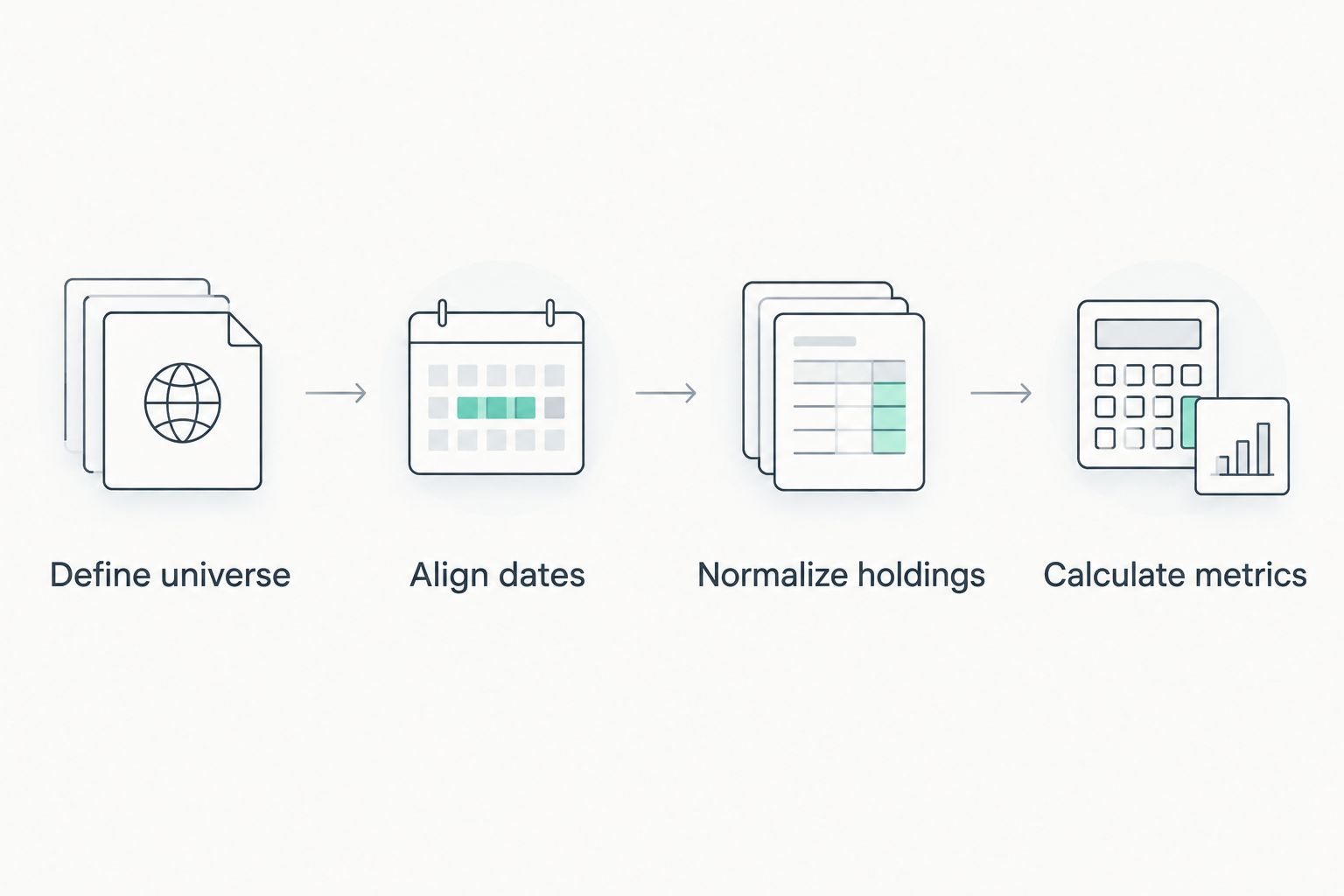
For tools that support this research process, compare trading terminals for tracking hedge fund stock holdings. Evaluate the underlying filings and calculation definitions separately from the interface used to display them.
Which portfolio metrics belong beside fund size?
Portfolio value alone tells you scale within the disclosure. Add metrics that explain how that disclosed capital is distributed, without presenting those metrics as a complete risk assessment.
Reported portfolio value
Reported portfolio value is the sum of the relevant disclosed values under your stated inclusion rules. Keep the unit and currency visible, and avoid mixing vendor-normalized figures with raw filing figures without checking their definitions.
This is the appropriate starting point for grouping managers by disclosed portfolio size. It is not a return measure: a larger value can reflect additional capital, price appreciation, broader reporting coverage, or a combination of changes.
Position count
Position count measures the number of holdings under your chosen definition. State whether you count filing rows, distinct securities, or distinct issuers.
The advantage is simplicity. The limitation is that many small positions can coexist with a dominant holding, so position count alone does not establish diversification.
Largest-position weight
Largest-position weight divides the largest included position’s value by the included portfolio value. Match the numerator and denominator: an ordinary-share concentration measure needs a consistent ordinary-share universe.
This identifies dependence on the largest disclosed holding. It does not describe undisclosed hedges, liquidity constraints, or exposures outside the filing.
Aggregate concentration
Aggregate concentration sums a consistently defined group of the largest positions and divides that sum by the same portfolio denominator. Choose the group definition before comparing managers and retain it across quarters.
A higher result means more of the disclosed portfolio sits in those selected positions. It does not, by itself, establish that the manager takes more total economic risk.
How to use these benchmarks
Use the regulatory reference points to set boundaries, then use portfolio calculations to answer your investment research question. For 2026 analysis, keep these actions separate from any decision to trade.
- Treat $100 million as a reporting threshold, not a peer-group average. Build size groups from the actual distribution of the managers you include, and disclose the group boundaries with the results.
- Match quarter-end dates before interpreting differences. The 45-day reporting window means a newly published filing still describes a historical portfolio.
- Compare concentration within a consistent securities universe. A manager holding options alongside shares needs explicit instrument treatment before you rank portfolio weights.
- Keep disclosed value separate from total AUM. Label manager-level and fund-level figures accurately rather than forcing unlike measures into one league table.
Report both the median and the mean when you publish a measured peer-group summary. The median identifies the middle observation, while the mean incorporates the full magnitude of unusually large portfolios.
Neither statistic replaces the underlying distribution. Show the reporting period, number of included managers, and inclusion rules beside the results so readers can understand what the benchmark represents.
Read quarterly changes without inventing performance
A change in disclosed portfolio value is not the same as investment performance. Contributions, withdrawals, security prices, purchases, sales, and reporting changes can all affect the comparison.
Likewise, a higher portfolio weight does not prove that a manager bought more shares. The holding can increase as a share of the portfolio because its price rises or other positions decline.
Separate changes in share quantity from changes in reported value where the instruments permit a like-for-like comparison. Check corporate actions and security identifiers before calling a position new, increased, reduced, or exited.
Do not calculate a hedge fund’s return from consecutive 13F totals. Those totals are snapshots of disclosed assets, not a complete accounting of cash flows, liabilities, trading activity, and all investment exposures.
Where bitcoin and tokenized stocks fit
Direct bitcoin holdings are not ordinary Section 13(f) securities. A manager’s reportable securities exposure connected to bitcoin is therefore not equivalent to its direct bitcoin ownership.
Roxom’s bitcoin-native trading offering belongs on the execution side of that distinction. Its stated offerings include bitcoin/crypto trading, BTC-collateralized credit lines, tokenized stocks, and dividend-paying Digital Credit instruments, with U.S. persons excluded.
Do not assume that a tokenized instrument has the same legal rights, custody structure, or reporting treatment as an underlying listed share. Check the instrument’s documentation before connecting a holdings observation to a transaction.
A Roxom trading decision and a 13F benchmark answer different questions. The benchmark describes disclosed institutional positions; the transaction requires its own assessment of eligibility, instrument terms, and risk.
FAQ
What does 13f holdings by fund size actually measure?
It compares disclosed Section 13(f) securities portfolios using a stated size definition. Reported portfolio value is not automatically a hedge fund’s total assets or the manager’s firmwide AUM.
What is the minimum size for a manager to file Form 13F?
The general threshold is investment discretion over at least $100 million in qualifying Section 13(f) securities under the SEC’s testing rules. The test concerns specified securities, not every asset the manager oversees.
How long after quarter-end do 13F filings appear?
Form 13F filings are generally due within 45 days after quarter-end. The positions describe the reporting date, not necessarily the manager’s current portfolio.
Does a larger 13F portfolio mean a better hedge fund?
No. A larger disclosed securities portfolio establishes scale within the filing’s scope, not better returns, lower risk, or better investment decisions.
Is the number of filing rows the same as the number of investments?
No. Different share classes, options, and other reporting distinctions can produce multiple rows connected to one issuer. Define whether your count refers to rows, securities, or issuers.
Can I calculate fund returns from changes in 13F portfolio value?
No. Changes in disclosed value do not isolate investment returns from capital flows, trading, and reporting changes. Form 13F also does not disclose the manager’s complete economic portfolio.
Does Form 13F show a hedge fund’s direct bitcoin holdings?
No. Direct bitcoin is not a Section 13(f) security. Reportable securities linked to bitcoin must be distinguished from ownership of bitcoin itself.
Can U.S. persons use Roxom for trading?
Roxom’s stated offering excludes U.S. persons. That eligibility restriction is separate from the U.S. institutional reporting rules discussed in this guide.
One last thing
A manager can become more concentrated without buying another share of its largest holding. Relative price changes alone can alter portfolio weights, which is why a concentration ranking should never double as a transaction report.
For your next 2026 comparison, place the holdings date, size definition, and counting method directly above the table. Those labels make the result more useful than another decimal place in an unexplained average. This guide explains disclosure analysis, not personalized investment advice.