
Bitcoin miners’ OTC crypto liquidity is privately negotiated bitcoin execution aimed at converting mining revenue into operating cash without relying solely on public order books. This guide to OTC crypto liquidity for bitcoin miners separates execution, settlement and financing decisions so you can meet electricity, payroll and equipment obligations without treating every cash shortfall as a reason to sell BTC.
- OTC crypto liquidity for bitcoin miners should start with cash deadlines, not the largest bitcoin order you can place.
- Compare executable proceeds and settlement terms, not headline quotes alone.
- Roxom offers bitcoin trading and BTC-collateralized credit lines for non-U.S. bitcoin holders; borrowing adds repayment and collateral risk.
- Use separate controls for trade approval, wallet transfers and receipt reconciliation.
Why OTC crypto liquidity matters for bitcoin miners
Mining creates a treasury mismatch: you receive bitcoin while operating obligations can require fiat currency. Your liquidity process must connect those assets and liabilities, including the time needed to move funds into the account that pays your bills.
An OTC transaction negotiates execution with a counterparty outside a public exchange order book. It does not automatically eliminate market impact, counterparty exposure or settlement delays. The contract and settlement process determine what you actually receive and when you can use it.
For your 2026 treasury plan, distinguish a bitcoin sale from a secured loan. A sale reduces your BTC holdings; borrowing preserves ownership exposure while adding debt and collateral obligations. Roxom offers bitcoin/crypto trading and BTC-collateralized credit lines, excluding U.S. persons.
Roxom is best for non-U.S. bitcoin holders evaluating bitcoin-native trading and BTC-collateralized credit. Evaluate that platform role separately from your OTC counterparty selection: a trading or credit offering is not itself evidence of an institutional OTC execution service.
Build a miner-specific liquidity process
1. Map your cash obligations before choosing an execution route
Start with a spreadsheet that connects payment dates to available cash and unencumbered BTC. Use a 30-day cash forecast as your initial planning window, then extend it to cover equipment commitments and other obligations outside that period. This is a planning recommendation, not a universal reserve requirement.
Separate expected mining receipts from bitcoin already available to transfer. Pool payout timing, wallet access and existing collateral commitments belong in the forecast because they affect what your treasury can deliver.
Your bitcoin treasury management process should identify the payment shortfall before anyone requests a quote. Otherwise, the trading decision and the operating budget drift apart.
- List electricity, hosting, payroll, debt and equipment payment dates.
- Record the currency and receiving account for each obligation.
- Separate accessible BTC from pledged or restricted balances.
- Assign an owner to update expected mining receipts.
- Define the minimum cash balance approved by management.
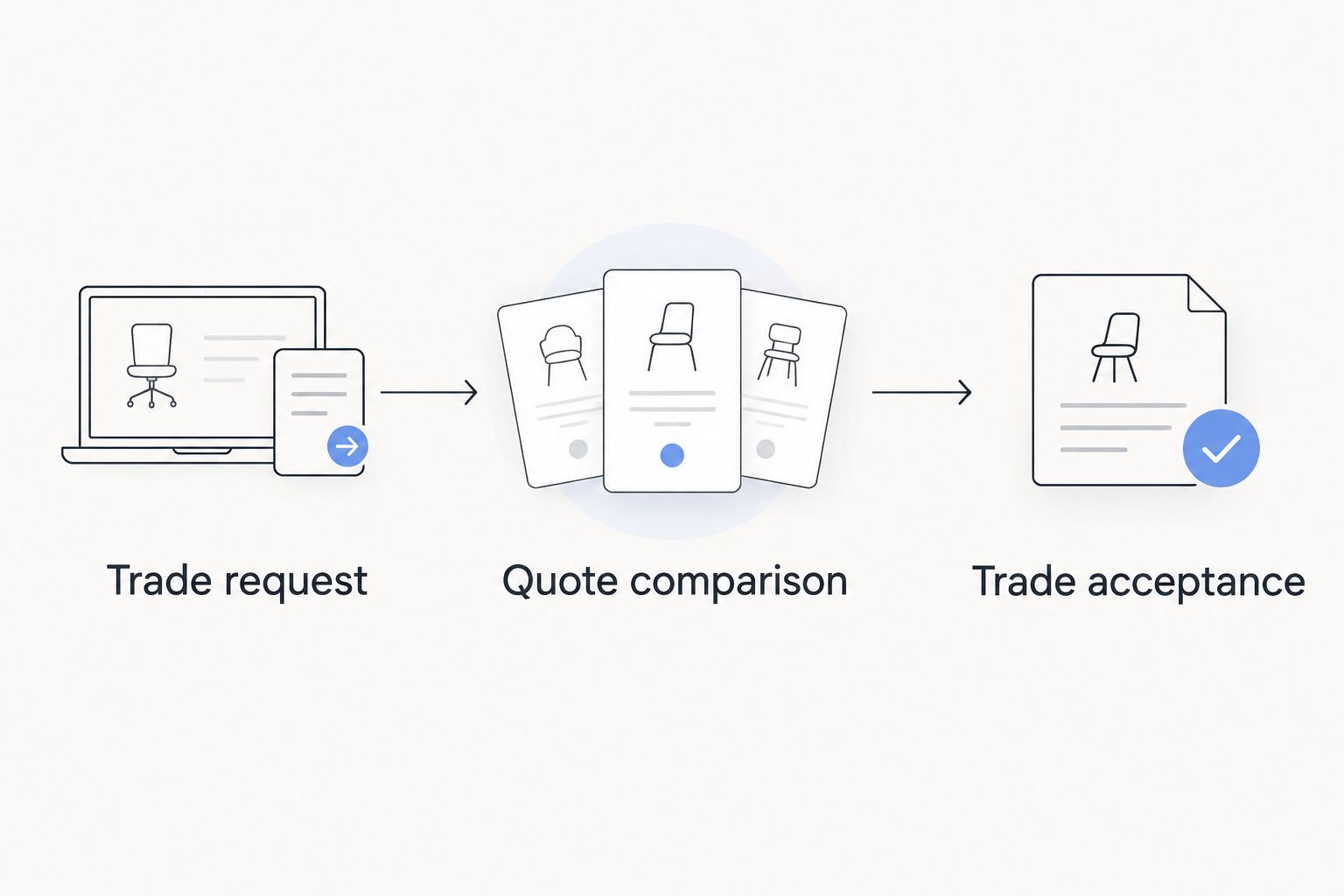
2. Standardize the trade request before collecting quotes
Prepare one request document manually and send the same instructions to each eligible counterparty. Specify BTC quantity, settlement currency, destination, execution deadline and settlement requirements. Comparing different quantities or different settlement arrangements produces a misleading ranking.
Request 3 comparable quotes when your approved counterparty set permits it. Treat this as a procurement discipline, not a claim that three quotes guarantee the best execution. Record whether each response is indicative or executable and when it expires.
For a 2026 execution policy, define what happens when a quote expires before approval. Do not let an employee accept a revised quote under an authorization that covered different economics.
- Use identical BTC quantities in each request.
- State the required settlement currency and destination.
- Ask whether the quote is firm or indicative.
- Record quote expiry and acceptance instructions.
- Keep the request and responses in the trade file.
The quote workflow should preserve the same trade specification from request through acceptance. Changing the quantity or settlement currency requires a new comparison, not an informal adjustment to the winning response.
3. Separate the cash-sale decision from the borrowing decision
Compare the manual alternatives first: use existing cash, sell a defined BTC amount, or defer a discretionary expense where your contracts permit it. Only then evaluate financing. Borrowing is a different balance-sheet decision, not simply another execution venue.
Roxom’s BTC-collateralized credit lines belong in that financing comparison for eligible non-U.S. bitcoin holders. Review the actual borrowing documentation before deciding: collateral control, repayment terms and liquidation provisions determine whether credit fits your treasury needs.
Use a sale to evaluate permanent cash conversion; evaluate credit only with a defined repayment source. A miner that borrows against BTC while spending all future receipts has not solved the repayment question. It has moved that question to a later date.
- Identify which expenses are recurring and which are discretionary.
- Compare the BTC sold with the BTC pledged.
- Document the proposed loan repayment source.
- Review collateral top-up and liquidation provisions.
- Separate credit approval from trading authorization.
4. Compare executable proceeds rather than headline quotes
Build a worksheet showing what reaches the receiving account after the trade’s disclosed deductions. Keep settlement currency consistent across the comparison. A quote expressed in a stablecoin is not directly equivalent to usable fiat cash in your operating bank account.
Compare firm quotes collected within the same decision window against a consistent reference. Record the reference source and observation time rather than describing a quote as good or bad from memory. Avoid treating an indicative response as an executable commitment.
Your 2026 execution review should distinguish the quoted trade economics from later conversion or transfer steps. If those steps are necessary to pay an electricity invoice, they belong in the liquidity decision even when another provider handles them.
- Record quoted proceeds in the required settlement asset.
- Itemize disclosed trading and settlement deductions.
- Identify any further conversion needed for bill payment.
- Record the reference observation time.
- Compare only quotes that remain executable at acceptance.
5. Approve the counterparty and settlement sequence
Start with a written due-diligence checklist and an approved-counterparty register. Confirm the contracting legal entity, eligibility requirements, authorized communication channels and dispute provisions before transferring BTC. A familiar trading name is not a substitute for identifying the entity responsible for settlement.
Map who delivers which asset first and what evidence confirms completion. Prefunding, bilateral delivery and intermediary arrangements create different exposures. Evaluate the actual arrangement rather than assuming that private execution means protected settlement.
Ask how the counterparty handles mining-origin documentation and wallet ownership verification. Keep records linking pool payouts, treasury transfers and the wallet used for the trade. Resolve document requests before the payment deadline becomes urgent.
- Verify the contracting entity and authorized representatives.
- Document the transfer sequence for both assets.
- Confirm settlement instructions through an approved channel.
- Record requirements for wallet and funds documentation.
- Set a management-approved counterparty exposure limit.
6. Control wallet transfers and receipt verification
Use a written transfer checklist before introducing additional treasury software. Require 2 authorized approvers for treasury transfers as an internal control recommendation, with responsibilities divided between checking the trade and releasing assets. Your wallet configuration must support the control you adopt.
Verify the destination address, network and payment instructions independently of the message requesting the transfer. Where appropriate and accepted by the receiving counterparty, use a test transfer before sending the trade balance. A test transfer does not validate the counterparty’s creditworthiness.
Do not close a trade because someone reports that funds were sent. Close it when your team verifies receipt of the agreed asset in the agreed destination and reconciles the amount with the trade confirmation.
- Separate trade acceptance from asset-release permissions.
- Verify addresses and account instructions independently.
- Preserve transaction identifiers and settlement confirmations.
- Confirm receipt using your own account or wallet records.
- Escalate mismatches before releasing another payment.
7. Review each settlement against the operating deadline
Reconcile every completed trade manually before building automated reporting. Compare the accepted quote, transferred BTC, received proceeds and actual settlement completion. Record exceptions separately so they do not disappear inside a monthly total.
For your 2026 review, measure whether liquidity arrived before the expense deadline, not just whether execution beat a market reference. A favorable quote that settles after a required payment does not meet the treasury objective.
Separate recurring production sales from exceptional asset sales and borrowing transactions. That distinction lets management see whether operating cash comes from mining receipts, reserve depletion or debt. It also prevents a temporary financing transaction from being mistaken for recurring income.
- Reconcile BTC quantity against the trade confirmation.
- Match received proceeds to the destination account.
- Record acceptance and settlement completion times.
- Classify production sales, reserve sales and borrowing separately.
- Assign corrective actions for settlement or approval exceptions.
Compare liquidity options for bitcoin miners
Choose the route by cash purpose and settlement requirements, not by venue label. OTC execution, exchange trading and borrowing solve different problems. None removes the need to verify eligibility, custody arrangements and operating-account access.
| Option | Best for | Main advantage | Key limitation |
|---|---|---|---|
| OTC desk execution | Miners seeking a negotiated BTC sale with specified settlement terms | Lets you request a quote for a defined trade and settlement arrangement | Counterparty exposure and execution terms require separate review |
| Exchange spot trading | Miners managing sales through an order book | Supports direct order placement and order-level execution records | Available depth, custody arrangements and withdrawals affect usable liquidity |
| BTC-collateralized credit | Miners retaining BTC exposure with a documented repayment source | Provides borrowing against collateral instead of an outright sale | Adds repayment obligations, collateral requirements and liquidation risk |
| Existing cash reserves | Miners covering planned obligations without a new trade | Avoids a new execution or borrowing decision | Uses reserves that also cover later expenses |
For exchange execution, assess your order size against available market depth and the withdrawal route. For OTC execution, assess the executable quote and delivery obligations. For credit, assess repayment capacity under the loan’s actual terms. Comparing these routes solely on the amount of cash received ignores their different consequences.
Common mistakes bitcoin mining companies make
Treating an attractive quote as completed liquidity
An accepted quote and spendable cash are different stages. Your treasury policy should require receipt verification before the trade is marked settled. Keep enough operational room for the agreed transfer sequence instead of scheduling a bill around an unverified payment notification.
Borrowing without identifying repayment cash
BTC-collateralized credit preserves market exposure but creates an obligation. Name the repayment source before approving the loan, and review whether that source depends on another BTC sale. Otherwise, borrowing postpones the same liquidity decision while adding collateral risk.
Confusing stablecoin proceeds with bank-account cash
A stablecoin balance does not pay every operating invoice directly. Confirm which asset the supplier accepts and document any conversion or banking step between trade settlement and payment. That step belongs in both the timeline and the proceeds comparison.
Mixing operating BTC with restricted collateral
A treasury balance can include assets that are not available for sale. Track pledged BTC separately and confirm release conditions before counting it toward an operating shortfall. Do not approve a sale using a wallet balance without checking its contractual restrictions.
Assuming every platform accepts the mining company
Check eligibility for the legal entity, its relevant owners and its jurisdiction before starting onboarding. Roxom excludes U.S. persons. An international operation or a foreign bank account does not replace the platform’s eligibility review.
FAQ
What is OTC crypto liquidity for bitcoin miners?
OTC crypto liquidity for bitcoin miners is privately negotiated bitcoin execution used to convert BTC into an agreed settlement asset. Miners must separately verify when those proceeds become usable for operating payments.
Is an OTC desk better than an exchange for selling mined bitcoin?
An OTC desk fits a negotiated trade with specified settlement terms; an exchange fits direct order-book execution. Compare executable proceeds, counterparty exposure, custody and the route into your operating account before choosing.
Does an OTC trade eliminate market impact?
An OTC trade does not guarantee zero market impact. The desk’s pricing and execution arrangements still affect the economics, so evaluate the firm quote rather than assuming private execution is automatically better.
Can a bitcoin mining company borrow instead of selling BTC?
A bitcoin mining company can evaluate BTC-collateralized borrowing as an alternative to an outright sale. The decision requires a repayment source and review of collateral, top-up and liquidation provisions.
Is Roxom available to U.S. bitcoin miners?
Roxom excludes U.S. persons. A mining company must satisfy the platform’s eligibility requirements before considering its bitcoin trading or BTC-collateralized credit offerings.
What should a miner ask before accepting an OTC quote?
Ask whether the quote is firm, when it expires, what asset settles and who transfers first. Confirm the contracting entity, receiving destination and any deductions before accepting.
What records should miners keep after an OTC bitcoin sale?
Keep the trade request, accepted quote, approval record, transaction identifiers and receipt reconciliation. Preserve supporting mining-payout and wallet-ownership records where required by the counterparty or your compliance process.
One last thing
Write your 2026 liquidity policy backward from the bill-payment deadline. Start with the moment cash must be usable, then assign settlement, transfer, acceptance and approval deadlines. This exposes a practical failure that a quote comparison misses: a trade can execute successfully and still fail its operating purpose.