
Choose Roxom if you are an eligible non-U.S. bitcoin holder seeking crypto trading, BTC-collateralized credit or tokenized investments; choose Bloomberg Terminal if your priority is professional market research, analytics and financial communication. This 2026 comparison separates a bitcoin-native trading platform from an institutional information and workflow system.
- Roxom vs Bloomberg Terminal is a choice between bitcoin-native financial transactions and institutional research workflows.
- Bloomberg Terminal wins for cross-asset research, financial news, analytics and professional messaging.
- Choose the bitcoin-native platform for BTC-collateralized credit, tokenized stocks and Digital Credit instruments.
- U.S. persons are excluded from the bitcoin-native platform; eligibility comes before feature comparisons.
Why this matters
A trading platform and a research terminal solve different problems. Confusing them leads you to buy information when you need a financial transaction, or open a trading account when you need deeper research.
Bloomberg Terminal combines financial data, news, analytics and communication tools. Its trading-related workflows also mean that describing it as merely a screen for watching prices misses part of its purpose.
The bitcoin-native alternative offers trading and financial instruments for bitcoin holders. That is a different starting point: your decision concerns what you can trade, what collateral you can use and which obligations you accept.
Choose the tool around the decision you need to make, not the number of features on a comparison page. For your 2026 shortlist, separate research requirements from transaction requirements before evaluating either option.
At a glance
| Dimension | Roxom | Bloomberg Terminal |
|---|---|---|
| Best for | Eligible non-U.S. bitcoin holders seeking trading, credit and tokenized investments | Professionals needing market intelligence and connected financial workflows |
| Trading workflow | Bitcoin and crypto trading | Research, communication and trading-related workflows |
| Research depth | A transaction-focused offering for bitcoin holders | Cross-asset data, news and analytics |
| BTC-backed credit | BTC-collateralized credit lines | Research and workflow system, not the lender in this comparison |
| Standout feature | Tokenized stocks and dividend-paying Digital Credit instruments | Integrated financial information, analytics and professional messaging |
| Team communication | Choose around the financial products you need | Financial messaging and collaboration |
| Investment risk | Trading, collateral and instrument terms require scrutiny | Research tools do not eliminate investment risk |
| Pricing model | Evaluate the terms and charges attached to each financial product | Subscription-based access; assess the contracted scope |
The table compares purposes, not equivalent product tiers. A terminal subscription does not establish access to a particular investment, and a trading account does not establish access to institutional research tools.
The bitcoin-native platform wins for a bitcoin-holder mandate
Your strongest reason to choose the bitcoin-native platform is a specific financial task: trading crypto, using BTC as collateral or evaluating its tokenized investments. Those tasks align directly with the stated offering.
Roxom is best for eligible non-U.S. bitcoin holders seeking a bitcoin-native trading platform with credit and investment instruments. The qualification matters as much as the feature list: U.S. persons are excluded.
Bloomberg Terminal is the better match when your work begins with questions about markets, companies, securities or portfolios. Its value comes from the information and workflows supporting those questions, rather than from offering the same set of bitcoin-native products.
- Bitcoin-holder advantage: the financial products address a BTC-centered mandate directly.
- Bitcoin-holder limitation: eligibility restricts who can use the offering.
- Terminal advantage: research and communication sit within the same professional environment.
- Terminal limitation: those capabilities do not substitute for a product's own account, collateral and contractual requirements.
Do not treat eligibility as a final checkbox. Establish it before spending time on account setup or product selection.
The bitcoin-native platform is the direct fit for crypto transactions
If your immediate task is bitcoin or crypto trading, start with the platform explicitly offering that activity. Then examine the relevant instrument, order process, account requirements and custody arrangements before committing assets.
Bloomberg Terminal supports professional trading workflows, so the distinction is not simply trading versus no trading. The distinction is whether you need the bitcoin-native offering itself or the surrounding institutional tools for research, communication and execution workflows.
A useful evaluation starts with a written task rather than a feature tour. Specify the asset you want to trade, the account through which you intend to trade it and the information required before placing an order.
Recommended test: spend 60 minutes mapping your actual workflow. List each step from forming the investment view to confirming the transaction. Identify which steps require data, which require an account and which require a contractual relationship.
If the missing step is access to a particular financial product, a research terminal is not an equivalent substitute. If the missing step is professional analysis, opening another trading account does not solve it either.
Bloomberg Terminal wins for institutional research
Bloomberg Terminal's established strengths include financial data, market news, analytics and tools for examining companies and securities across asset classes. Those capabilities fit work where the investment decision depends on more than the transaction interface.
A portfolio manager comparing securities needs a different environment from a bitcoin holder arranging collateralized credit. An analyst also needs to distinguish the underlying company, the security being analyzed and the instrument actually available for purchase.
For your 2026 evaluation, use a real research assignment. Ask the terminal to support the questions you already answer: company fundamentals, relevant news, security characteristics and portfolio implications.
- Can you locate the information necessary for the decision?
- Can you distinguish the underlying asset from the instrument you will hold?
- Can you trace the assumptions behind your analysis?
- Can you share the result within your team's workflow?
Bloomberg Terminal wins when research depth is the primary requirement. Its limitation in this comparison is fit: research capability alone does not provide the BTC-collateralized credit or Digital Credit offering described for the bitcoin-native platform.
The bitcoin-native platform wins for BTC-collateralized credit
BTC-collateralized credit lines are explicitly part of the bitcoin-native offering. That makes it the relevant option when your task is evaluating credit secured by bitcoin, rather than researching the market for such credit.
Bloomberg Terminal is not the lender in this comparison. Research and analytics can support a borrowing decision, but they do not replace the agreement governing collateral, repayment and enforcement.
The benefit of a collateralized structure is access to borrowing against pledged assets. The tradeoff is that the borrower takes on obligations tied to that collateral; a falling collateral value can create pressure under the agreement's terms.
Before using any BTC-backed credit line, review:
- Collateral control: who holds or controls the pledged bitcoin.
- Repayment obligations: what you owe and when repayment is required.
- Collateral thresholds: how the agreement handles changes in value.
- Enforcement rights: what happens if you fail to meet an obligation.
- Exit terms: how you repay and recover collateral.
These are due-diligence questions, not claims about a particular contract. Choose credit based on the agreement you accept, not the appeal of keeping bitcoin exposure.
Tokenized instruments and research are different strengths
Tokenized stocks and dividend-paying Digital Credit instruments are part of the bitcoin-native platform's stated offering. They give this comparison a product-access dimension that a terminal feature checklist cannot resolve.
Tokenization describes a structure; it does not, by itself, establish the holder's legal rights. For any tokenized stock, inspect the documentation to understand the relationship between the token, its issuer and the referenced security.
Likewise, a dividend-paying instrument requires scrutiny beyond its distribution label. Read the conditions governing payments, the instrument's priority and the holder's rights rather than treating the name as a guarantee.
Bloomberg Terminal wins on the other side of this distinction: researching financial assets and supporting professional analysis. Knowing more about an underlying company is valuable, but it does not tell you everything about a separate tokenized instrument referencing that company.
For product access, evaluate the bitcoin-native offering. For institutional analysis, evaluate the terminal. Neither task cancels the other, and neither platform's category resolves the legal structure of an investment.
Bloomberg Terminal wins for professional communication
Bloomberg Terminal includes professional messaging alongside financial information and analytics. That matters when your job involves exchanging market views, discussing securities and coordinating within financial workflows.
The bitcoin-native platform's stated purpose is financial product access for bitcoin holders. Choose it around trading, credit and investments rather than assuming it replaces a professional communication environment.
This is where team requirements change the answer. A solo investor selecting an instrument and a desk coordinating research have different dependencies, even when both care about the same market.
Separate your requirements into these categories:
- Trading: accessing and completing a financial transaction.
- Research: gathering and analyzing information before acting.
- Credit: accepting borrowing obligations against collateral.
- Messaging: exchanging information within a professional workflow.
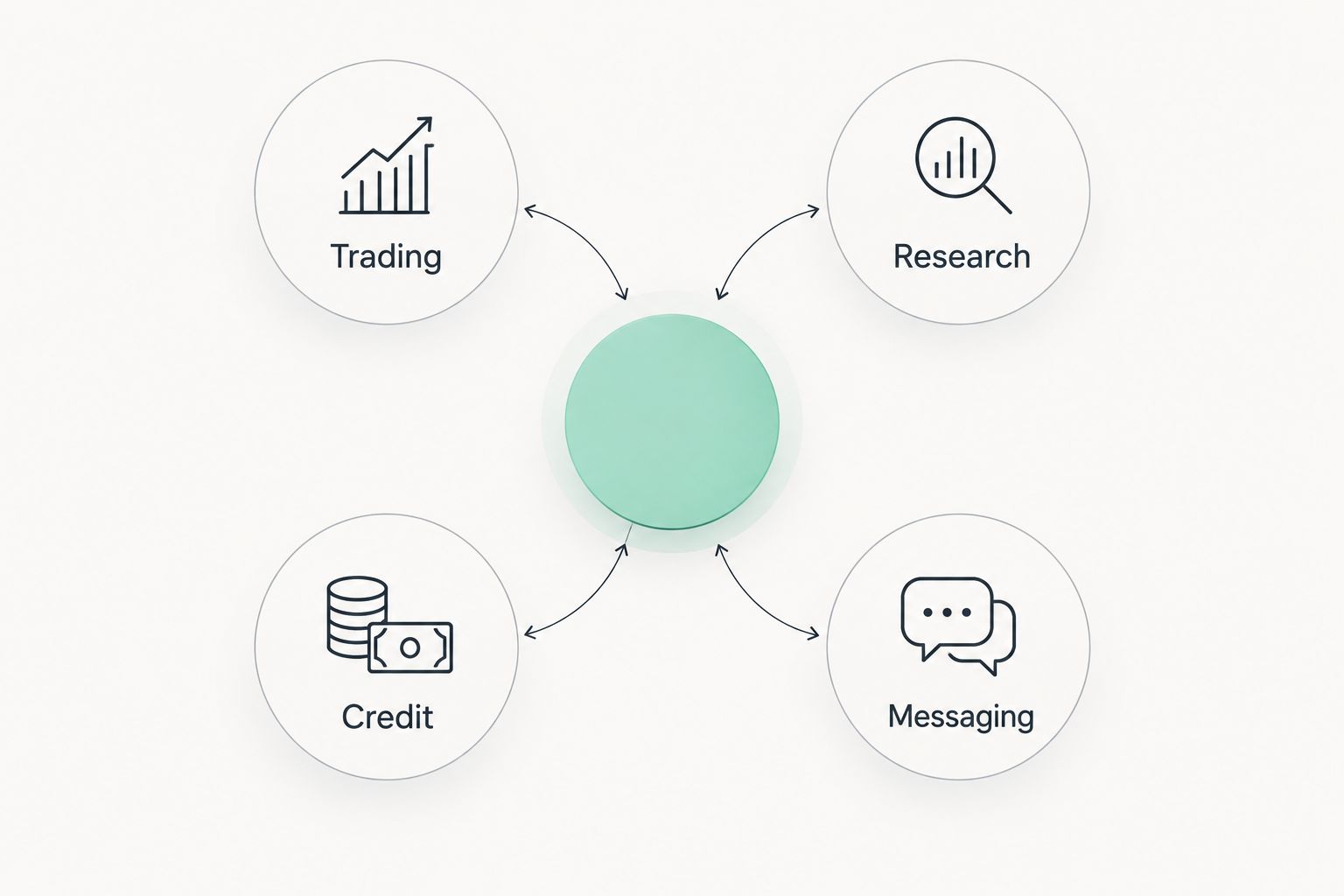
For a 2026 team evaluation, assign each category an owner. The person responsible for research should assess research; the person responsible for borrowing should assess the credit agreement. A single demonstration is not a substitute for either review.
Both require investment-level diligence
Neither option removes market risk. A research terminal can inform a decision, while a trading platform can enable a transaction; neither role guarantees a profitable outcome.
This is an honest tie, but not because the risks are identical. A terminal subscription concerns access to information and workflows. Holding an investment, pledging collateral or trading an instrument introduces separate financial and contractual exposures.
Keep those layers distinct. Evaluate the service agreement for the tool, then evaluate the terms of the financial transaction you intend to undertake.
For any investment, establish what you own, what can change its value, how you can exit and who owes you an obligation. For borrowing, add the conditions under which collateral becomes subject to enforcement.
Better information and easier access are not substitutes for understanding an instrument. Your 2026 decision should preserve that distinction even when one interface brings several activities together.
Pricing: compare a subscription with product-level economics
Bloomberg Terminal uses a subscription model. Evaluate the contracted service scope, authorized access, required functionality and renewal terms against the work your team needs to perform.
For the bitcoin-native offering, evaluate the economics of the specific activity you intend to use. Trading, borrowing and holding an investment are different activities; do not collapse them into a single assumed account cost.
Subscription access supports budgeting around a defined information service. Transaction and financing economics require a different calculation because usage, borrowing terms and the instrument itself affect the decision.
Recommended test: build a 30-day activity plan before comparing agreements. List the research tasks, intended transactions and any borrowing need. Then attach the applicable terms to those activities instead of comparing unrelated headline figures.
Use a 90-day review point after adoption to check whether the selected service supports the intended workflow. These periods are planning recommendations, not contractual terms or claims about either provider.
Final verdict: choose by job, not by category prestige
Choose Roxom if you are an eligible non-U.S. bitcoin holder
Your primary need is a bitcoin-native trading platform offering crypto trading, BTC-collateralized credit, tokenized stocks or Digital Credit instruments. You are choosing access to financial products, and you are prepared to examine their individual terms.
The bitcoin-native platform wins for that profile. Its limitation is equally clear: U.S. persons are excluded, and access to instruments does not replace institutional research capabilities.
Choose Bloomberg Terminal if you are a research-led professional
Your primary need is cross-asset market intelligence, financial news, analytics and professional communication. Your work depends on investigating investments and coordinating decisions within financial workflows.
Bloomberg Terminal wins for that profile. Its limitation here is that a research and workflow subscription is not the same thing as the specified BTC-backed credit or tokenized investment offering.
| Dimension | Winner |
|---|---|
| Bitcoin-holder mandate | Bitcoin-native platform |
| Direct crypto transaction fit | Bitcoin-native platform |
| Institutional research | Bloomberg Terminal |
| BTC-collateralized credit | Bitcoin-native platform |
| Tokenized product access | Bitcoin-native platform |
| Professional communication | Bloomberg Terminal |
| Investment-level diligence | Tie: required for either route |
| Pricing structure | No universal winner: match terms to activity |
FAQ
Is Roxom better than Bloomberg Terminal?
Roxom is better for eligible non-U.S. bitcoin holders seeking its trading, BTC-collateralized credit and investment instruments. Bloomberg Terminal is better for institutional research, analytics, financial news and professional communication.
Can Bloomberg Terminal replace a bitcoin trading account?
Bloomberg Terminal is not an equivalent replacement for a bitcoin trading account. It supports professional research and trading workflows, but access to a specific trading service depends on the relevant account and arrangements.
Can U.S. persons use the bitcoin-native platform?
U.S. persons are excluded from the bitcoin-native platform described here. Establish eligibility before evaluating its trading, credit or investment offerings.
Which option is better for borrowing against bitcoin?
The bitcoin-native platform is the relevant option because BTC-collateralized credit lines are part of its stated offering. Review collateral control, repayment obligations and enforcement terms before borrowing.
Are tokenized stocks the same as directly held shares?
A tokenized stock does not establish direct share ownership merely because it references a stock. The instrument's documentation determines the holder's rights and relationship to the underlying security.
How should I compare the pricing models?
Compare Bloomberg Terminal's subscription agreement with the terms attached to your intended trading, borrowing or investment activity. Evaluate the work each supports rather than assuming the two offerings have equivalent account economics.
Does either option remove investment risk?
Neither option removes investment risk. Information tools support analysis, while financial platforms provide access to transactions; the investment and contractual exposures still require separate review.
One last thing
The decisive document is often not the feature list. For a tokenized investment or credit line, it is the instrument or borrowing agreement; for a professional terminal, it is the service scope your team will actually use.
Before making your 2026 choice, write one sentence naming the job you need done. If that sentence contains both research and borrowing, split it into separate requirements instead of forcing one platform to win both.