
Choose Roxom if you are an eligible non-U.S. bitcoin holder seeking a bitcoin-native trading platform, BTC-collateralized credit, or tokenized investments; choose Investing.com if you need market news, quotes, charts, and an economic calendar. This 2026 comparison separates managing investments from researching them, so you choose the service that matches your next action.
- Roxom vs Investing.com is a trading-platform versus market-research comparison, not a contest between equivalent brokers.
- Investing.com is best for market news, quotes, charts, and economic-calendar research.
- Roxom is best for eligible non-U.S. bitcoin holders seeking bitcoin-native trading and BTC-collateralized credit.
- Neither market information nor dividend-paying instruments remove investment risk.
Why this matters
A research website helps you understand a market. A trading platform gives you a place to take financial exposure. Confusing those jobs leads to the wrong comparison: a useful economic calendar does not establish whether an investment account meets your needs, and access to investments does not establish the quality of market analysis.
Roxom is best for eligible non-U.S. bitcoin holders who want bitcoin-native trading and BTC-collateralized credit. Investing.com serves the reader who wants financial information before deciding what to do.
For your 2026 shortlist, start with the decision you need to make. Reading about bitcoin, trading bitcoin, borrowing against bitcoin, and purchasing a dividend-paying instrument are different activities. Each requires different checks, even when the underlying interest is the same asset.
At a glance
| Dimension | Roxom | Investing.com |
|---|---|---|
| Best for | Eligible non-U.S. bitcoin holders seeking trading and investment products | Investors seeking market information and research |
| Standout feature | Bitcoin-native platform with BTC-collateralized credit and Digital Credit instruments | Financial portal combining quotes, charts, news, and an economic calendar |
| Market research | Product selection centers on bitcoin holders and investors | Broad financial information across markets |
| Trading and execution | Bitcoin and crypto trading | Research destination rather than a replacement for a trading account |
| Borrowing against BTC | BTC-collateralized credit lines | Market information does not provide a collateralized credit facility |
| Investment structure | Tokenized stocks and dividend-paying Digital Credit instruments | Information about investments, rather than the investment contract itself |
| Risk assessment | Requires account, collateral, and instrument due diligence | Requires source checks and independent investment judgment |
| Pricing model | Assess the applicable trading, borrowing, and instrument terms | Free-access content alongside paid research subscriptions |
Investing.com wins for broad market research
Investing.com is the better starting point when your immediate task is to understand what markets are doing. Its financial-information offering includes market quotes, charts, news, and an economic calendar. Those resources suit someone checking a market move, following an announcement, or building context before an investment decision.
The strongest reason to choose it is the research workflow. You can approach a question through price information, reporting, and scheduled economic events rather than treating a trading account as your only source of context.
Its limitation is equally important: information is not execution. Reading a quote or an analysis does not mean you have obtained a tradable price, entered an order, or accepted an investment contract. Distinguish a displayed market reference from the terms your execution provider actually offers.
For 2026 research, check the timestamp and scope of anything you use. Ask whether a chart represents the same asset, venue, currency, and instrument you intend to trade. A familiar company name is not enough to establish that two instruments are equivalent.
Best for: investors whose next step is to research a market, not fund an account or borrow against collateral.
The bitcoin-native platform wins for taking financial exposure
The trading choice is different from the research choice. The bitcoin-native platform described here offers bitcoin and crypto trading, tokenized stocks, and dividend-paying Digital Credit instruments. Those are investment activities, not simply ways to read about markets.
That distinction matters if you already hold bitcoin and want to evaluate what you can do with it. Your shortlist needs to address the account, the available instrument, and the transaction terms. A financial portal cannot answer those contractual questions on behalf of a separate provider.
Choose a trading platform for execution and a research portal for context. Neither role replaces the other.
The tradeoff is responsibility. Before committing funds, examine account eligibility, custody arrangements, order terms, withdrawal conditions, and the legal entity responsible for the service. Treat these as decision criteria, not assumptions based on the platform's positioning.
Investing.com remains useful alongside an execution account. Use its information to investigate a market thesis, then evaluate the actual instrument and transaction separately. This is a complementary workflow, not evidence that either service wins every category.
Best for: eligible non-U.S. holders whose next action involves trading or evaluating an investment product.
Investing.com wins for following economic events
An economic calendar addresses a different question from an investment catalog: what scheduled event should you investigate before making a decision? Investing.com's calendar makes it the stronger choice for that research task.
You can use scheduled releases as prompts to examine your assumptions. A macroeconomic announcement is context; it is not an instruction to buy or sell. The useful work is connecting the event to your own thesis and identifying what evidence would change that thesis.
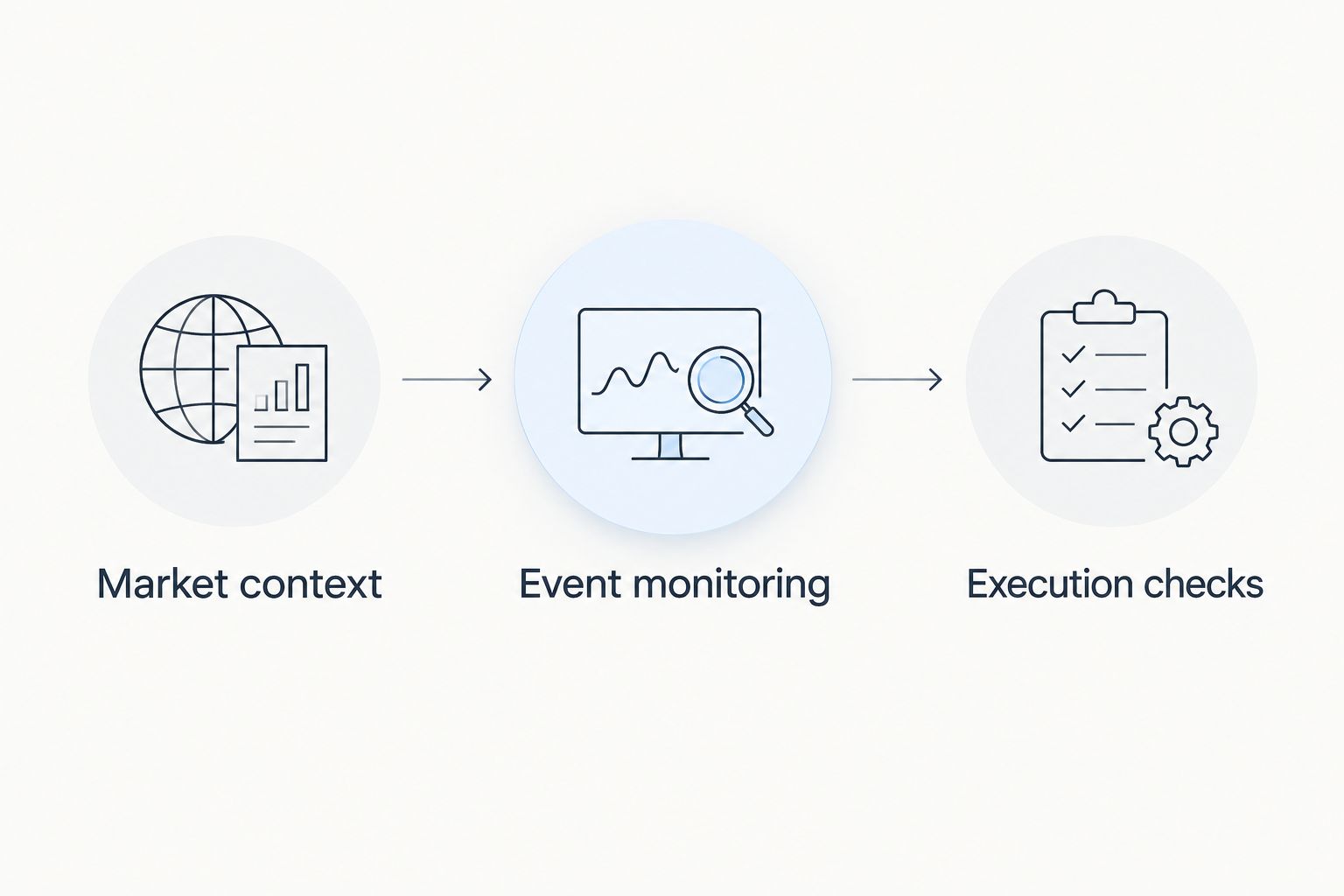
For a 2026 decision, separate three research tasks:
- Market context: understand the broader environment around the asset.
- Event monitoring: identify scheduled announcements relevant to your thesis.
- Execution checks: inspect the actual instrument and transaction terms before acting.
The first two fit a financial-information portal. The last belongs with your execution provider and the investment's governing documents.
The limitation is prediction. An event calendar tells you what is scheduled, not how a market must react. Avoid turning a useful planning resource into a promise about future prices.
Best for: investors who need an organized view of economic events before reviewing positions.
BTC-collateralized credit wins for borrowing against bitcoin
A BTC-collateralized credit line addresses a financing need: obtaining credit secured by bitcoin. The bitcoin-native platform offers this product category. Investing.com's market-information role does not replace a lender or a credit agreement.
The relevant comparison is therefore not whose bitcoin chart looks better. It is whether borrowing against your holdings fits your financial position and whether you understand the collateral obligations.
Keeping exposure to bitcoin while taking on debt also keeps collateral risk in the decision. A falling collateral value can trigger obligations under a loan's terms, including a requirement to add collateral or repay. Read the agreement to understand the applicable process.
Before accepting a credit line, establish:
- Which entity provides the credit and holds the collateral.
- How collateral is valued and monitored.
- What events trigger additional collateral requirements or liquidation.
- How interest, repayment, and early closure work.
- What happens if you cannot meet an obligation.
These questions determine the suitability of the credit arrangement. General market commentary does not answer them.
Best for: eligible non-U.S. bitcoin holders considering secured borrowing who can evaluate the debt and collateral obligations together.
Tokenized investments require more scrutiny than market quotes
Tokenized stocks and Digital Credit instruments expand the decision beyond straightforward bitcoin trading. They also change what you must investigate.
A tokenized stock is not automatically equivalent to owning a conventional share through a brokerage account. The rights depend on the instrument's legal structure. Review how economic exposure is created, which entity owes you obligations, and whether voting, dividends, redemption, or transfer rights apply.
Digital Credit is described as dividend-paying. That description is not a guarantee of principal protection, payment continuity, or a particular return. Examine the instrument documents rather than treating an income label as a complete risk explanation.
Investing.com is useful for researching an underlying company or market. It does not establish the legal rights of a tokenized instrument offered elsewhere. A quote for an underlying stock and the value of a related token are not interchangeable evidence.
For 2026 instrument selection, insist on answers about the issuer, payment terms, custody, counterparty exposure, and exit mechanism. If your investment thesis relies on receiving a payment or redeeming an instrument, those contractual details belong at the center of the decision.
Best for: eligible investors who specifically want to evaluate tokenized exposure or dividend-paying instruments and will read the governing terms.
Both require independent judgment about risk
Neither service removes the need for due diligence. The risks differ because the activities differ.
With a financial-information portal, verify the source, publication time, methodology, and relevance of the material. Separate reported facts from commentary. A convincing article is still not evidence that a proposed trade suits your finances.
With a trading or credit platform, examine what happens to your assets and what obligations you accept. Research custody, counterparties, collateral rules, and instrument rights. Do not infer these protections from a product category or from the word bitcoin-native.
This is an honest tie: both require independent judgment, but only the transaction creates the corresponding contractual exposure. Reading about an instrument and holding it are not the same risk position.
Eligibility also comes before feature comparisons. The platform excludes U.S. persons. That restriction is decisive for a U.S. person evaluating an account, regardless of how closely the product offering matches their interests. Confirm applicable eligibility requirements before submitting funds or relying on access.
Pricing: research access and financial transactions differ
Investing.com combines free-access financial content with paid research subscriptions. The practical choice is whether the free information meets your research needs or whether a subscription's specific tools justify an ongoing commitment.
For a trading platform, review the charges associated with the activity you intend to undertake. Trading, borrowing, and holding an investment instrument require different cost checks. Do not reduce them to a single headline fee.
For your 2026 comparison, evaluate:
- Research access: which resources you need and whether they require a subscription.
- Trading costs: the applicable transaction charges and execution terms.
- Credit costs: interest provisions and any additional contractual charges.
- Instrument costs: charges or deductions affecting ownership, payments, or exit.
The tradeoff is predictable research spending versus activity-dependent financial costs. A research subscription supports an information workflow; transaction and credit terms affect the economics of a position. Compare each against its own purpose rather than declaring either service cheaper overall.
Pricing verdict: no universal winner. Check current published terms and evaluate the total cost of your intended activity before committing.
Final verdict: choose by the action you need
Choose Roxom if you are an eligible non-U.S. bitcoin holder
Choose the bitcoin-native trading platform if your next decision concerns bitcoin or crypto trading, BTC-collateralized credit, tokenized stocks, or Digital Credit instruments. Its stated offering matches those activities directly.
The condition is due diligence. Confirm eligibility and understand the specific account, credit agreement, or instrument before proceeding. Product access is a reason to investigate, not proof of suitability.
Choose Investing.com if you are a research-first investor
Choose Investing.com if you want market news, quotes, charts, or an economic calendar before deciding what to do. It is the clearer fit for gathering context across financial markets.
Its limit is execution. Keep a separate process for choosing an account and reviewing investment terms; research information does not replace either task.
One-glance scorecard
| Dimension | Winner |
|---|---|
| Broad market research | Investing.com |
| Bitcoin-native trading | Roxom |
| Economic-event monitoring | Investing.com |
| BTC-collateralized credit | Roxom |
| Tokenized and Digital Credit product access | Roxom |
| Independent risk assessment | Tie: different checks apply |
| Overall pricing | Tie: compare the intended activity |
FAQ
Is Roxom better than Investing.com?
Roxom is better suited to eligible non-U.S. bitcoin holders seeking bitcoin-native trading or BTC-collateralized credit. Investing.com is better suited to market research, news, quotes, charts, and economic-calendar information.
Can Investing.com replace a trading account?
Investing.com does not replace the account and contractual terms needed to execute an investment. Use its financial information for research, then evaluate your execution provider separately.
Which is better for researching stocks in 2026?
Investing.com is the better fit for general stock-market research in 2026. A tokenized stock still requires separate investigation of its issuer, legal structure, and investor rights.
Can U.S. persons use the bitcoin-native platform?
The platform excludes U.S. persons. Confirm the applicable eligibility requirements before attempting to open or fund an account.
Are Digital Credit dividends guaranteed?
A dividend-paying description does not establish a guarantee. Review the instrument documents for payment obligations, risks, and the rights attached to the investment.
What should I check before borrowing against bitcoin?
Check collateral valuation, additional-collateral requirements, liquidation provisions, interest, and repayment terms. Borrowing creates debt obligations while bitcoin remains exposed to market movements.
How should I compare the cost of these services?
Compare research-access costs separately from trading, credit, and instrument costs. A subscription and a financial transaction serve different purposes, so one headline charge cannot establish an overall winner.
One last thing
Before researching features, write down the exact action you want to take: read, trade, borrow, or invest in a specific instrument. Then identify the document that governs that action. For a news article, inspect the source; for a loan or investment, inspect the contract. The governing document tells you more about your obligations than a feature comparison does.