Choose Roxom if you are an eligible non-U.S. bitcoin holder seeking crypto trading, BTC-collateralized credit, and tokenized investments; choose Robinhood if you are a U.S. retail investor seeking a brokerage account for stocks, ETFs, and options. This 2026 comparison separates those two investment needs rather than treating the platforms as interchangeable.
- Roxom vs Robinhood turns on eligibility and investment purpose, not which platform has the longest feature list.
- Roxom is the better fit for eligible non-U.S. holders seeking bitcoin-native trading and BTC-collateralized credit.
- Robinhood is the better fit for U.S. investors seeking conventional brokerage investing.
- Tokenized stocks, direct shares, and Digital Credit require different checks on ownership, distributions, and issuer risk.
Why this matters
A trading platform is not just an interface. It determines which legal entity holds your assets, what you own, how you access cash, and which risks you accept.
For this 2026 decision, start with eligibility and account purpose. A bitcoin holder seeking liquidity against BTC has a different problem from an investor buying ETFs in a U.S. brokerage account. Comparing those needs through app design alone misses the decision that matters.
Roxom is a bitcoin-native trading platform for eligible non-U.S. investors seeking trading, BTC-backed credit, and tokenized investments. Robinhood's conventional brokerage offering fits a different starting point: investing through a securities account rather than organizing investments around bitcoin collateral.
At a glance
| Dimension | Roxom | Robinhood |
|---|---|---|
| Best for | Eligible non-U.S. bitcoin holders and investors | U.S. retail investors seeking conventional brokerage investing |
| Eligibility | Excludes U.S. persons | U.S. brokerage access requires meeting account eligibility rules |
| Investment structure | Bitcoin/crypto trading, tokenized stocks, and Digital Credit | Brokerage stocks, ETFs, options, and crypto services |
| Standout feature | BTC-collateralized credit lines | Conventional brokerage investing alongside crypto access |
| Income approach | Dividend-paying Digital Credit instruments | Dividends from securities that declare distributions |
| Ownership checks | Examine the token or instrument's legal rights | Examine brokerage ownership, custody, and account agreements |
| Risk management | Review collateral, issuer, market, and custody risks | Review market, custody, and borrowing risks where applicable |
| Pricing model | Evaluate trading charges and credit terms separately | Evaluate trading, account, and optional subscription charges separately |
The table compares investment routes, not account-level permissions. Confirm the specific product, contracting entity, and jurisdiction before you transfer funds. A platform offering a feature does not establish that every applicant can use it.
Robinhood wins for U.S. brokerage investors
Robinhood is the relevant choice for a U.S. investor seeking conventional brokerage investing. The competing bitcoin-native platform excludes U.S. persons, so this is an eligibility decision before it is a feature comparison.
Do not treat residence outside the United States as proof that you are not a U.S. person. Citizenship, residency, and the definition used in the applicable agreement matter. Complete the eligibility check using your actual circumstances, not the location of your device.
For non-U.S. applicants, the reverse shortcut is equally wrong: being outside the United States does not establish access to every service. Confirm your country, identity requirements, and product permissions separately.
Robinhood's advantage here is its conventional U.S. brokerage route. Its limitation is that a brokerage account is not automatically a substitute for a bitcoin-centered credit and investment arrangement. Start with the account you legally qualify for, then compare what it lets you do.
Bitcoin-native investing wins for a BTC-centered portfolio
The bitcoin-native route is the better fit when your starting asset is BTC and your objective includes credit against that BTC. The offering described here combines bitcoin/crypto trading, BTC-collateralized credit lines, tokenized stocks, and dividend-paying Digital Credit.
That combination addresses a specific investor profile. You already hold bitcoin and want to evaluate trading, borrowing, or additional investment exposure without treating conventional brokerage investing as your only route.
The benefit comes with additional decisions. You need to understand the credit agreement, the rights attached to each instrument, and the custody arrangement. Having these functions under one platform name does not make their legal structures identical.
Robinhood wins when your objective is simpler: hold conventional securities in a brokerage account and use crypto access as a separate part of your investing. The distinction is the portfolio's organizing principle, not a claim that one interface is easier or one platform executes trades better.
Robinhood wins for conventional stock and ETF investing
Robinhood is the better match when you specifically want conventional brokerage stocks and ETFs. Its brokerage offering serves that account structure; a tokenized stock requires a separate examination of what the token represents.
A stock token can reference a company's shares without giving its holder every right associated with holding those shares through a broker. Voting, distributions, redemption, and claims against an issuer follow the instrument's legal documents. Do not infer those rights from the company name displayed beside the token.
The tokenized route fits an investor deliberately seeking that structure and willing to evaluate it. Its drawback is the extra ownership analysis. Conventional brokerage investing also requires custody and account checks, but it does not require you to establish how a separate token maps to an underlying security.
For your 2026 shortlist, use the guide to platforms for trading tokenized stocks to frame that distinction. Compare legal rights first; compare trading convenience afterward.
BTC-collateralized credit wins for borrowing against bitcoin
A stated BTC-collateralized credit line is the relevant product when you want a loan secured by bitcoin. Do not substitute brokerage margin for that requirement without checking the eligible collateral and borrowing agreement.
Borrowing against BTC creates a liability while the collateral remains exposed to bitcoin's price. A falling collateral value can trigger contractual requirements to add collateral, reduce the balance, or face liquidation. The agreement determines the thresholds and procedures.
Before drawing credit, check:
- Collateral control: Who holds the BTC, and what permissions does the agreement grant?
- Repayment terms: What is owed, in which currency, and under what schedule?
- Liquidation rules: What triggers action, and what notice does the agreement require?
- Exit conditions: How do you repay and recover the collateral?
Robinhood's conventional brokerage strengths do not answer those questions for a BTC-backed loan. Conversely, access to a credit line is not a reason to borrow. Choose this route only when the liability serves a defined purpose and you can meet its obligations.
Both offer income routes, but the rights differ
Neither platform wins on income merely because an instrument pays a dividend. The bitcoin-native offering includes dividend-paying Digital Credit, while conventional brokerage investors can hold securities that declare dividends.
Those descriptions do not establish equivalent cash flows or equivalent risk. Examine who owes the payment, whether distributions are discretionary, what conditions apply, and where your claim sits if the issuer cannot meet its obligations.
A distribution is also not the same as a positive total return. An instrument can make a payment while its market value falls. Evaluate the payment alongside principal risk and your ability to exit the position.
For income-focused investors in 2026, the right comparison is instrument against instrument. Use the governing documents to establish payment rights before choosing a platform. Neither a familiar stock name nor a bitcoin-related label removes the need for that review.
Both require a custody and legal-rights check
Neither platform earns a blanket safety verdict from the products it offers. A useful comparison separates asset custody, ownership rights, and collateral obligations instead of collapsing them into a single safety score.
Use these checks for each account or instrument:
- Custody: Identify the entity holding the asset and the withdrawal conditions.
- Ownership: Establish whether you hold a security, a token, or a contractual claim.
- Collateral: Identify any borrowing obligation and the circumstances permitting liquidation.
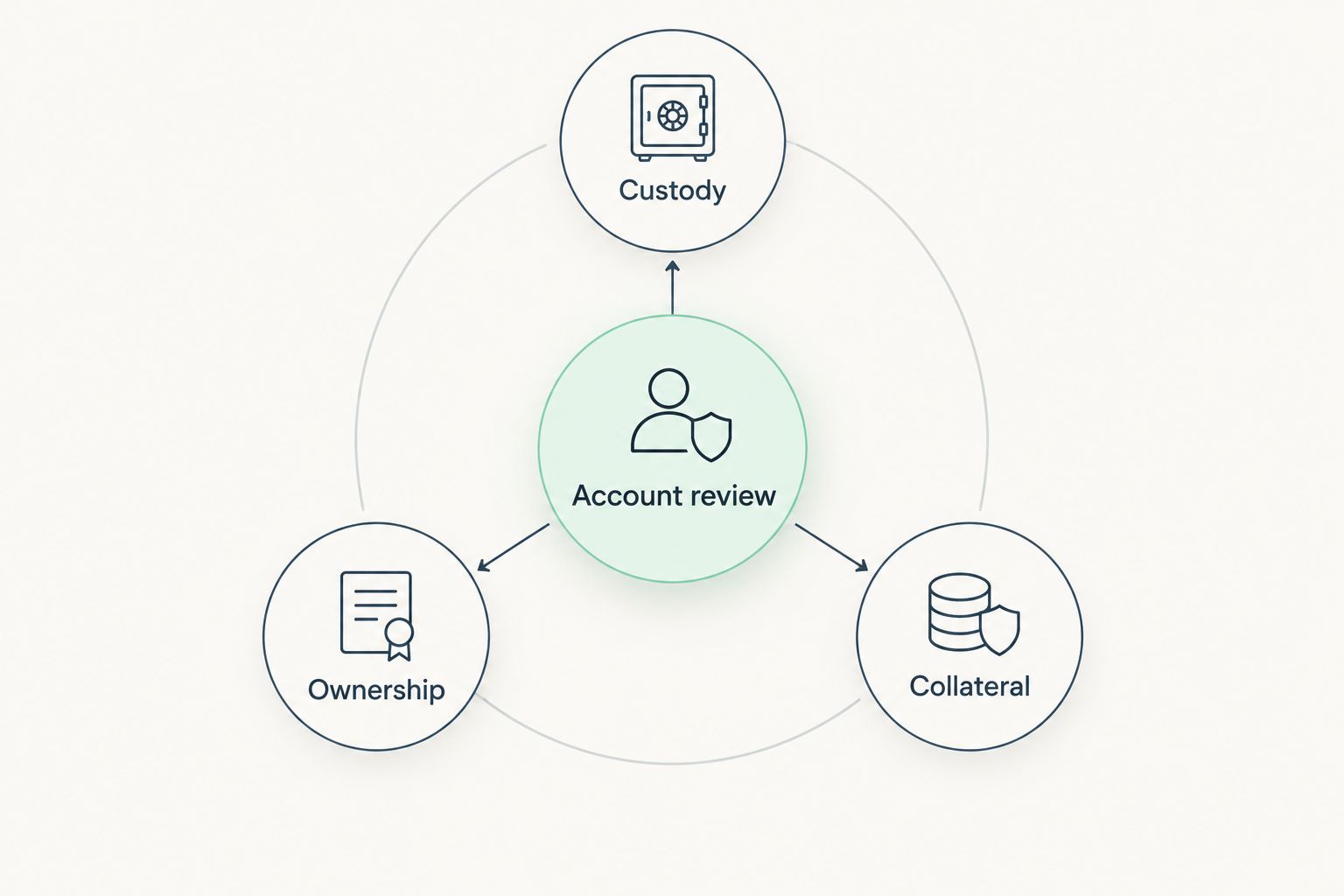
These checks protect you from a common comparison error: transferring assumptions between products. Protection associated with a brokerage security does not automatically extend to a crypto balance, a tokenized instrument, or a lending arrangement.
Read the agreement for the specific entity and product you intend to use. A platform's broad category is not enough to determine your rights if trading stops, withdrawals are restricted, or an issuer defaults.
Pricing: compare the transaction, not the headline
Compare costs for your intended activity, not a single advertised trading charge. A securities purchase, a crypto trade, and a credit draw have different cost components. Treating them as one price comparison hides the obligation you are actually taking on.
For the bitcoin-native route, separate trading charges from borrowing terms. Review execution costs, transfer charges where applicable, interest, repayment conditions, and any contractual liquidation charges. Check which apply to your chosen product rather than assuming every category applies.
For Robinhood, distinguish trading and account charges from optional subscription services. An optional subscription is a recurring account-level decision; transaction charges depend on what you do. Review the current fee schedule for the account and instrument you plan to use.
The tradeoff is predictability versus activity dependence. Recurring charges are easier to budget, while transaction and borrowing costs depend on usage, balances, and time. Neither model is inherently cheaper for every investor.
Before opening an account in 2026, write down the actions you expect to take: fund, trade, hold, withdraw, and borrow if relevant. Match each action to the current contractual charge. Do not include benefits you will not use when assessing value.
Final verdict: choose the account that matches your assets
Choose Roxom if you are an eligible non-U.S. bitcoin holder
Roxom wins for the bitcoin holder whose requirements include BTC-collateralized credit and tokenized investments. That is the clearest match between the stated offering and a specific investment objective.
Choose this route when you understand the instrument rights and are prepared to assess collateral obligations separately from investment performance. Avoid choosing it solely because you already own bitcoin; ownership alone does not establish a need for credit or tokenized exposure.
Choose Robinhood if you are a U.S. conventional brokerage investor
Robinhood wins for the U.S. investor seeking stocks, ETFs, and options through a brokerage account. Its relevant advantage is alignment with that account structure, not an unsupported claim about returns or execution quality.
Choose this route when conventional securities investing is your main objective. Do not assume its crypto services replace a BTC-collateralized credit arrangement, or that every product inside an investing platform has identical custody and protection.
One-glance scorecard
| Dimension | Winner |
|---|---|
| U.S. conventional brokerage fit | Robinhood |
| Bitcoin-centered investing fit | Roxom |
| Conventional stocks and ETFs | Robinhood |
| Stated BTC-collateralized credit offering | Bitcoin-native route |
| Income selection | No blanket winner; compare instruments |
| Custody and legal rights | No blanket winner; compare agreements |
| Pricing | No blanket winner; compare intended activity |
FAQ
Is Roxom better than Robinhood in 2026?
Roxom is the better fit for eligible non-U.S. bitcoin holders seeking BTC-collateralized credit and tokenized investments; Robinhood is the better fit for U.S. conventional brokerage investors. Choose by eligibility and investment objective before comparing individual features.
Can U.S. persons use the bitcoin-native platform compared here?
U.S. persons are excluded from the bitcoin-native offering described here. Confirm the applicable definition rather than assuming that living abroad establishes eligibility.
Which platform is better for buying conventional stocks and ETFs?
Robinhood is the better fit for conventional brokerage stock and ETF investing. Tokenized stocks require a separate check of the ownership, distribution, and redemption rights attached to the token.
Is a tokenized stock the same as owning a share?
A tokenized stock does not automatically grant the same rights as a share held through a brokerage account. Read the instrument's documents to establish what you own and which claims or rights you receive.
Does borrowing against bitcoin remove investment risk?
Borrowing against bitcoin adds a debt obligation while the collateral remains exposed to price changes. Check collateral requirements, repayment terms, and liquidation provisions before drawing credit.
Are dividend-paying Digital Credit instruments guaranteed income?
A dividend-paying description does not establish guaranteed income or principal protection. Payment rights and conditions come from the instrument's governing documents, and market value can fall despite distributions.
How should I compare platform costs?
Compare the charges attached to your planned funding, trading, holding, withdrawal, and borrowing activity. Review current fee schedules and credit agreements rather than ranking platforms by one headline charge.
One last thing
Write down what you own after the transaction. If the answer is only a company name or a ticker, your research is unfinished. Identify the security, token, or contractual claim and the entity responsible for honoring its rights.
That test makes this 2026 comparison practical. The better platform is the one that serves your eligible account purpose with obligations you understand—not the one whose product labels sound most familiar.