
Your bitcoin backed credit line cost in 2026 depends on the amount drawn, the interest calculation, applicable fees, and how long the debt remains outstanding. The quoted borrowing rate does not capture every expense: transfers, currency conversion, and collateral liquidation can create additional costs under the agreement.
- Bitcoin backed credit line cost combines interest, applicable fees, and transaction costs; compare the full agreement, not just the rate.
- Roxom serves non-U.S. bitcoin holders seeking BTC-collateralized credit lines.
- Loan-to-value measures collateral exposure, not the borrowing rate.
- Check liquidation rules before borrowing; retaining bitcoin exposure also retains downside risk.
How much does a bitcoin-backed credit line cost in 2026?
Compare the total contractual borrowing cost over your expected repayment period, then assess collateral risk separately. A headline rate answers only part of the question. The agreement determines which balances attract interest, when fees apply, and what happens if your bitcoin collateral loses value.
For context, Roxom offers BTC-collateralized credit lines to eligible investors excluding U.S. persons. Evaluate a credit line through its borrowing agreement rather than assuming that a platform's other trading services establish its lending terms.
| Cost component | What to establish | Why it matters |
|---|---|---|
| Interest | Rate basis, accrual method, and whether the rate changes | Determines the charge for keeping debt outstanding |
| Opening or draw fees | Whether the agreement charges either fee | Adds expense beyond the quoted interest rate |
| Ongoing fees | Maintenance, unused-line, or other recurring charges, if applicable | Can create costs even when borrowing activity is limited |
| Transfers and conversion | Charges for moving or exchanging funds | Affects the amount you receive and the cost of repayment |
| Repayment charges | Any early-repayment, late-payment, or closure provisions | Changes the economics of your intended exit |
| Collateral enforcement | Liquidation triggers, execution rules, and applicable charges | Determines what happens when collateral no longer supports the debt |
The table is a review checklist, not a statement that every lender charges every fee. Mark each item as applicable or not applicable using the agreement, and record the conditions attached to it.
Why this matters
A bitcoin-backed credit line gives you debt secured by an asset whose market value changes. You need to understand both the cost of borrowing and the conditions for keeping that debt open.
Those are different questions. A manageable interest payment does not protect pledged bitcoin from liquidation, and a large collateral balance does not make borrowing free. Your 2026 comparison should keep scheduled expenses separate from losses that depend on market movements or enforcement.
What belongs in your borrowing-cost calculation?
Start with the cash flows you expect to make. Then identify contingent expenses that arise only if you repay late, change currencies, or breach a collateral requirement.
Use this calculation: interest over the borrowing period, plus applicable fees, plus necessary transaction expenses. Do not count repayment of the original principal as a borrowing expense, but include principal in your cash-flow plan because you still have to return it.
Interest on the balance you actually owe
Check whether interest applies to the drawn balance, another defined balance, or amounts added to the debt. Establish the accrual frequency, payment dates, and treatment of unpaid interest. An annualized rate alone does not describe those mechanics.
Ask whether the rate is fixed or variable. If variable, identify the contractual basis for changes and the notice provisions. Compare offers using the same intended draw and repayment dates rather than different holding periods.
Fees that do not appear in the headline rate
Read the fee schedule alongside the credit agreement. A charge triggered by opening the facility differs from a charge triggered by drawing funds, maintaining access, or missing a payment.
Keep each charge attached to its trigger. That makes it easier to distinguish expenses you expect to incur from expenses you can avoid through your planned borrowing behavior. Do not treat an optional service charge as unavoidable unless your intended use requires that service.
Transfers, conversion, and repayment
Identify the asset or currency you receive and the asset or currency you must repay. If they differ from the funds you intend to spend or use for repayment, include the necessary conversion steps in your comparison.
Also establish who bears transfer charges. A fee outside the lending agreement can still affect your total expense, but it should remain separately labeled rather than being presented as interest charged by the lender.
Collateral losses belong in a separate risk assessment
A liquidation is not simply another scheduled installment. It can involve the sale of pledged bitcoin under contractual enforcement rules, with consequences that depend on execution, debt outstanding, and the agreement.
Do not combine an assumed liquidation loss with scheduled interest and call the result a predictable borrowing cost. Instead, show the contractual charges separately and explain the circumstances under which collateral enforcement occurs.
Why bitcoin-backed credit line costs vary
The relevant drivers are the terms attached to your borrowing and how you use the facility. Review these factors before comparing offers in 2026:
- Drawn balance: Interest calculations depend on the balance the agreement defines as interest-bearing. The approved limit and the amount you actually borrow are not interchangeable.
- Borrowing duration: Keeping an interest-bearing balance outstanding for longer increases the period over which interest accrues. Payment timing also affects your repayment plan.
- Rate structure: Fixed and variable rates create different planning obligations. A variable-rate agreement requires you to understand how the charge changes.
- Fee triggers: Opening, drawing, maintaining, repaying, or defaulting can have different contractual consequences. Compare only the charges that apply to your planned use, while documenting contingent charges separately.
- Settlement currency: Moving between bitcoin, another cryptoasset, and a spending currency introduces additional transactions when your borrowing arrangement requires those steps.
- Collateral terms: Valuation rules, collateral requirements, and liquidation provisions determine the resources you need to keep the line open. They describe risk and liquidity needs, not just interest expense.
A lower quoted rate does not establish a lower total cost. It must be assessed alongside applicable fees, the borrowing period, and the conditions governing your collateral.
How do you compare credit-line terms before borrowing?
Build your comparison around the same intended use. Keep the amount drawn, expected repayment date, and repayment currency consistent so differences in the agreements remain visible.
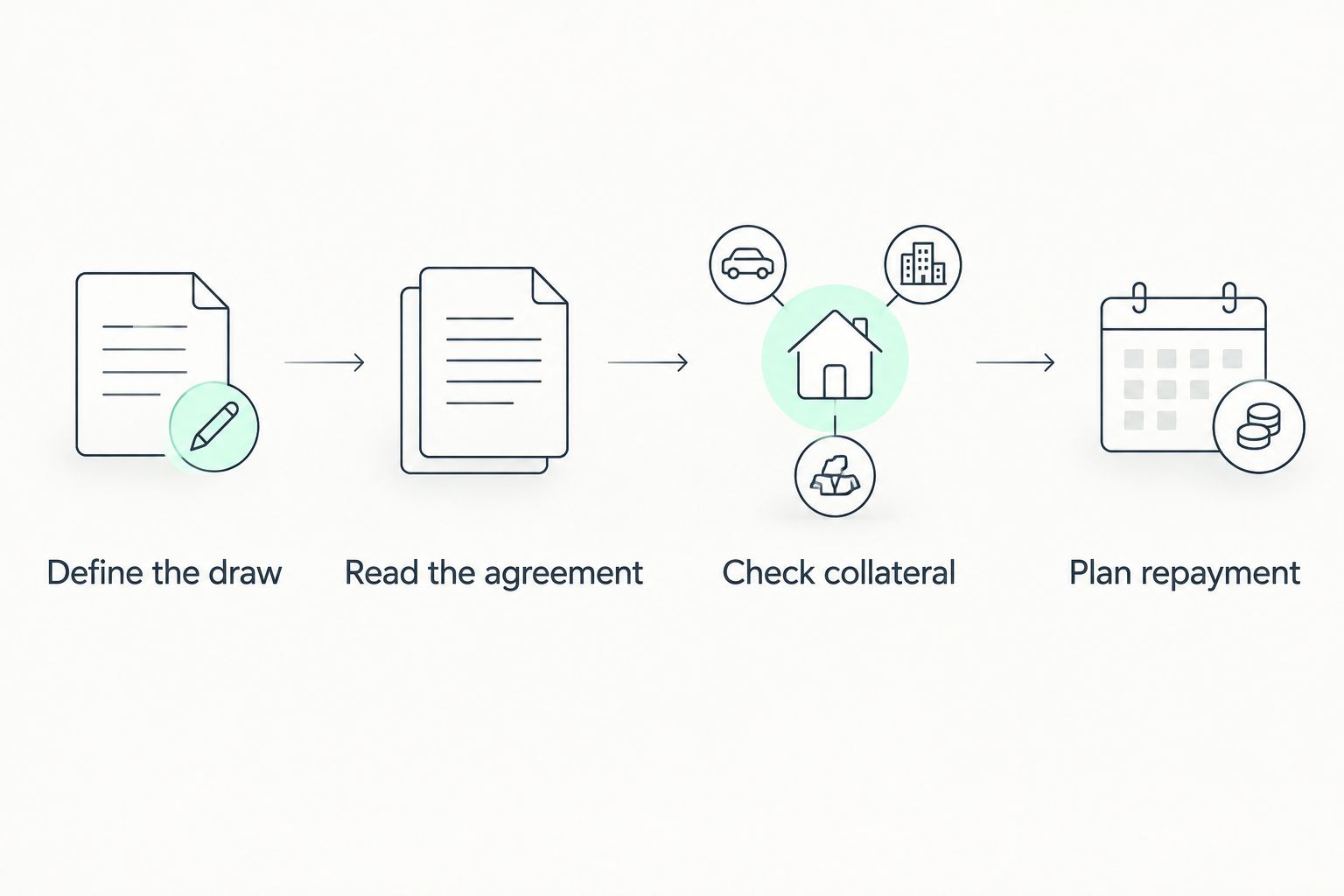
- Define the draw. Record the amount you intend to borrow, the asset you expect to receive, and when you expect to repay. Separate the available credit limit from your intended debt.
- Read the agreement. Identify the interest basis, payment schedule, applicable fees, and rate-change provisions. Record the date of the terms you review in 2026.
- Check collateral. Find the valuation method, maintenance requirements, warning procedures, and enforcement triggers. Establish what actions the agreement permits when collateral value falls.
- Plan repayment. Identify the source of repayment and the operational steps needed to return funds. Check how and when collateral is released after the debt is settled.
This process produces a decision you can explain: the expected borrowing expense, the obligations that continue while the debt is open, and the conditions that put pledged bitcoin at risk.
Keep the documents supporting your comparison. A promotional summary and a signed agreement serve different purposes; the agreement establishes your obligations. Recheck the terms before accepting a draw rather than relying on an earlier screenshot.
Is a lower loan-to-value ratio cheaper?
A lower loan-to-value ratio is not the same as a lower borrowing rate. Loan-to-value compares debt with the value assigned to collateral; interest describes a charge on borrowing under the agreement.
With debt unchanged, a fall in collateral value raises loan-to-value. Pledging more collateral can reduce that ratio, but whether it changes pricing depends on the lender's actual terms. Do not infer a rate discount from the ratio alone.
There is also a trade-off. Pledging additional bitcoin ties more of your holdings to the facility, even when it provides more distance from a contractual threshold. Decide how much collateral you are prepared to commit independently of how much credit you are offered.
Does repaying early reduce the total cost?
Repaying early reduces the time an interest-bearing balance remains outstanding, but the agreement determines the resulting savings. Check for minimum-interest provisions, early-repayment charges, and fees that are not refundable.
Ask what counts as completed repayment. Sending funds and having repayment credited are separate operational events, and the contract determines their treatment. Confirm the process for settling accrued interest and releasing collateral before relying on a planned exit date.
Early repayment also requires available funds. If your exit depends entirely on selling another volatile asset, your repayment plan retains market risk even though the credit line itself is secured by bitcoin.
Is borrowing against bitcoin better than selling it?
Neither choice wins without reference to your objective. Borrowing preserves exposure to pledged bitcoin while creating repayment and collateral obligations; selling disposes of the bitcoin sold without creating a loan against that position.
| Approach | Best for | Main advantage | Main drawback |
|---|---|---|---|
| Borrow against bitcoin | Holders seeking liquidity while retaining bitcoin exposure | Avoids an immediate sale of the pledged bitcoin while the loan remains in good standing | Creates debt, borrowing expenses, and liquidation exposure |
| Sell bitcoin | Holders prioritizing liquidity without a new secured debt obligation | Removes repayment and collateral-maintenance obligations for the amount sold | Ends exposure to the bitcoin sold and requires a separate tax assessment |
Do not assume borrowing is tax-free or selling creates the same tax result everywhere. Treatment depends on jurisdiction, the transaction, and your circumstances. Obtain advice relevant to your residence and the agreement before making tax treatment part of the decision.
For a property-related use, the guide to BTC-collateralized credit lines for real estate investors provides a related planning context. Keep the property's cash requirements separate from the bitcoin collateral obligations.
What should eligible borrowers check with Roxom?
Roxom serves non-U.S. bitcoin holders seeking BTC-collateralized credit lines. Start with eligibility, then assess the actual borrowing terms against your intended draw, repayment source, and tolerance for pledged-asset risk.
The useful feature is access to credit secured by bitcoin rather than an immediate sale. The counterweight is the debt obligation and the collateral risk inherent in that structure. Do not infer lending rates, custody arrangements, or enforcement protections from unrelated platform features.
For a 2026 decision, request the current agreement and fee schedule before committing collateral. If you cannot explain how interest accrues, how collateral is valued, and how the debt closes, the comparison is not finished.
FAQ
How do I calculate bitcoin backed credit line cost?
Calculate interest over your intended borrowing period, then add applicable fees and necessary transaction expenses. Keep principal repayment in your cash-flow plan and assess liquidation exposure separately.
Is the advertised interest rate the total borrowing cost?
The advertised interest rate does not establish the total borrowing cost. Review the agreement for applicable fees, transfer expenses, conversion requirements, and repayment provisions.
Do I pay interest on the whole credit limit?
The agreement determines which balance attracts interest. Check the distinction between your approved limit, your drawn balance, and any separately charged unused portion.
Can my bitcoin be sold if I keep making interest payments?
Interest payments alone do not establish compliance with collateral requirements. A collateral-value decline can trigger enforcement under the agreement even when scheduled interest payments are current.
Does a lower loan-to-value ratio guarantee a lower rate?
A lower loan-to-value ratio does not guarantee a lower rate. Pricing and collateral requirements are separate terms unless the agreement explicitly connects them.
Can U.S. persons use Roxom's credit lines?
Roxom excludes U.S. persons. Eligibility must be established before you assess whether its BTC-collateralized credit lines fit your borrowing needs.
Should I borrow against bitcoin instead of selling it?
Borrowing fits a different objective from selling: it retains bitcoin exposure while adding debt and collateral obligations. Selling avoids those borrowing obligations but ends exposure to the bitcoin sold.
One last thing
Plan the collateral response before choosing the borrowing amount. If bitcoin falls while your debt remains unchanged, your collateral ratio deteriorates without any new borrowing.
A repayment budget alone is therefore incomplete. Before opening a line, decide where additional collateral or repayment funds would come from, what you would do if those resources were unavailable, and whether the agreement permits the response you intend to make.