
Latin American margin crypto trading is borrowing-backed cryptocurrency trading aimed at increasing market exposure without fully funding the position yourself. This guide to margin crypto trading for Latin American investors in 2026 separates trading risk from country eligibility, local-currency accounting and bitcoin-collateral risk.
- Margin crypto trading for Latin American investors starts with country eligibility, collateral rules and a defined exit plan.
- Roxom suits non-U.S. bitcoin holders seeking bitcoin-native trading and BTC-collateralized credit; assess margin terms separately.
- Spot trading, margin accounts and perpetual futures create different obligations; compare the contract, not the label.
- Record trading results in the settlement asset and your reporting currency before increasing exposure.
Why margin crypto trading matters for Latin American investors
Borrowing changes the question from whether bitcoin will rise to whether your account can survive the path there. A profitable long-term view does not prevent liquidation during an adverse move. Your entry price is only one part of that calculation.
For a Latin American investor, the decision also involves your specific country of residence, funding route and reporting currency. Latin America is not a single legal jurisdiction. Approval for one country's residents does not establish eligibility for another country's residents, and living outside the United States does not automatically remove U.S.-person restrictions.
Roxom offers bitcoin/crypto trading, BTC-collateralized credit lines, tokenized stocks and dividend-paying Digital Credit instruments, excluding U.S. persons. Roxom is best for non-U.S. bitcoin holders seeking bitcoin-native trading and BTC-collateralized credit. Match that offering to your objective rather than assuming every bitcoin-based financial product provides the same trading mechanics.
Crypto markets operate 24 hours a day, 7 days a week. That continuous schedule makes an unattended borrowed position different from a fully funded holding: collateral requirements can matter while you are asleep, away from your phone or unable to transfer funds.
Build your 2026 margin trading plan
Confirm your country and account eligibility
Start with the platform's current eligibility terms and your own residency and tax-status records. This is a document check, not a trading decision. Read the restrictions before transferring assets, and resolve conflicting definitions directly with the provider.
Separate permission to open an account from permission to use a particular instrument. Spot trading, borrowed trading and derivatives need separate checks wherever the provider distinguishes them. An account approval is not a substitute for understanding which activities the approval covers.
For your 2026 review, keep the terms that applied when you opened the account alongside subsequent changes. A saved record gives you something concrete to consult when a restriction or withdrawal question arises.
- Check your country of residence against the current eligibility terms.
- Read the provider's definition of a U.S. person.
- Confirm eligibility for the specific instrument you intend to trade.
- Check accepted identity and address documents before funding.
- Save the applicable terms and the date of your review.
Separate trading capital from essential money
Use a spreadsheet to divide money needed for living expenses, committed obligations and speculative trading. Do this before opening a position. Your maximum trading loss should not depend on selling an essential asset or waiting for your next income payment.
A borrowed position creates obligations beyond the directional bet. You need to understand repayment, interest or funding, collateral requirements and the provider's rights after a breach. Use fully funded spot trading when you cannot explain how the borrowing obligation ends.
Fully funded spot means you provide 100% of the purchase funding rather than borrowing part of it. The asset can still lose value, and custody risk remains, but the purchase itself does not create a margin loan.
- Ring-fence money needed for rent, taxes and scheduled payments.
- Define a maximum account loss before choosing position size.
- Keep an emergency reserve outside trading collateral.
- Document the source and intended use of each deposit.
- Reject any plan that depends on an urgent future transfer.
Choose the instrument before choosing the platform
Write your objective in plain language: own bitcoin, trade a short-term price move, hedge an existing exposure or borrow against bitcoin. Then read the contract that matches that objective. A platform's interface does not change the legal or financial structure underneath it.
A margin account borrows funds or assets for trading. A perpetual futures contract creates derivative exposure and commonly uses funding payments rather than a conventional loan. A BTC-collateralized credit line borrows against bitcoin; it is not automatically a trading account.
Roxom's BTC-collateralized credit offering belongs in the borrowing comparison, not as proof of margin-account functionality. For a separate venue checklist, use the guide to platforms for margin crypto trading. Verify the actual account terms before treating any platform as suitable.
- Name the instrument and the asset you will trade.
- Identify what you own and what you owe.
- Check whether exposure comes from borrowing or a derivative.
- Identify the asset used for collateral and settlement.
- Read the repayment, closing and liquidation provisions.
Map your collateral and liquidation rules
Read the risk documentation manually and reproduce the account's calculations in a spreadsheet where the terms allow it. Locate initial margin, maintenance margin, collateral valuation and the price reference used for liquidation. These definitions determine what keeps your position open.
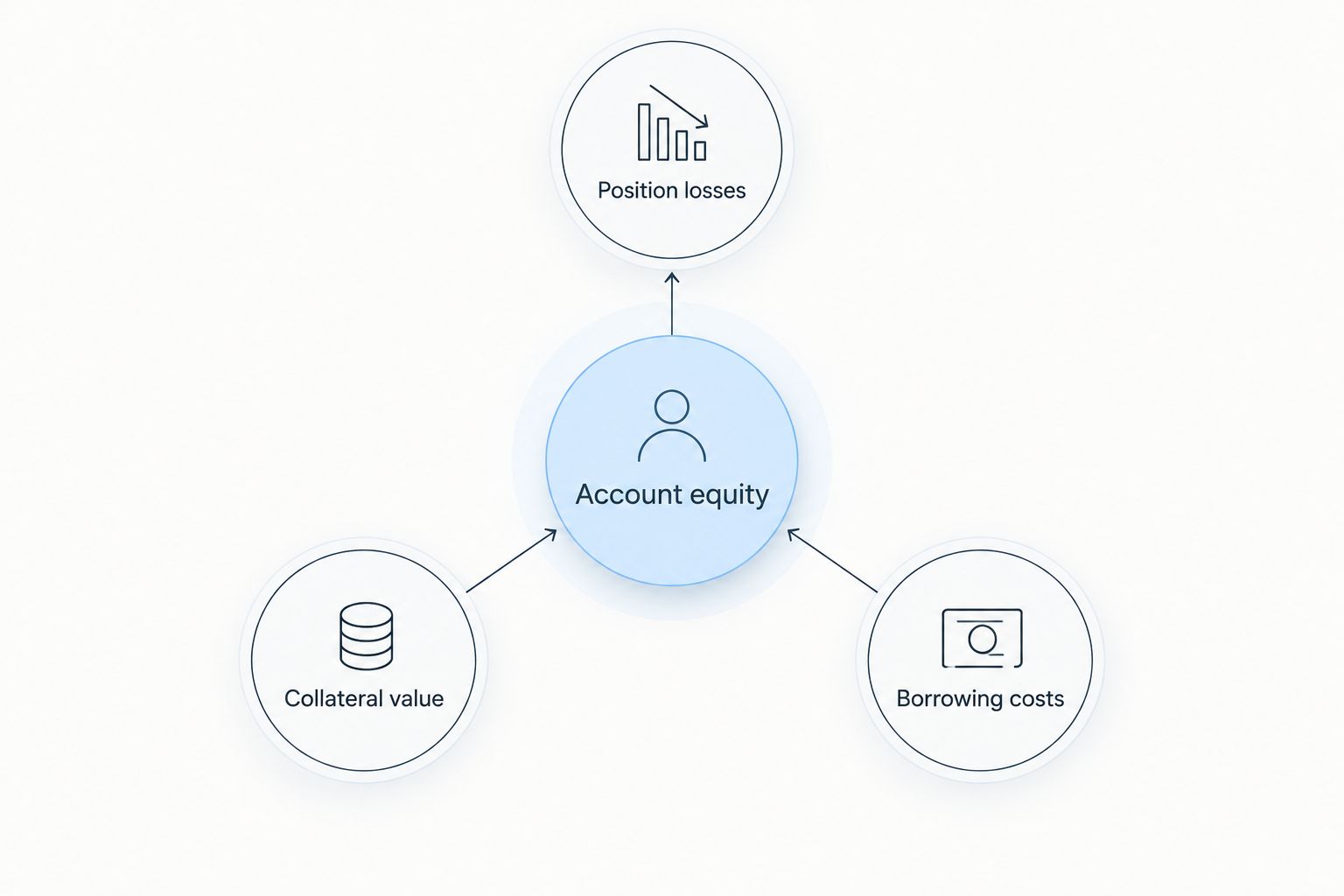
BTC collateral adds a separate variable when the obligation is measured in another asset. If bitcoin's collateral value falls while a long crypto position also loses value, both changes can weaken account equity. Do not count on a price recovery arriving before the provider enforces its rules.
Check whether positions share collateral. Cross-margin arrangements expose a shared balance to multiple positions; isolated-margin arrangements assign collateral to an individual position under the provider's rules. Neither label replaces reading the actual loss and repayment provisions.
- Identify the maintenance-margin requirement in the contract.
- Check which price reference triggers liquidation.
- Record collateral haircuts and eligible collateral assets.
- Determine whether positions share account equity.
- Read the liquidation sequence and any remaining debt provisions.
- Test adverse moves using the provider's documented calculations.
Measure costs and currency exposure separately
Start with a ledger rather than a single profit figure. Record trade proceeds, borrowing costs, transaction costs and conversions in their original assets. Then translate them into the currency needed for your financial records using a consistent, documented method.
A gain measured in bitcoin is not the same measurement as a gain in your local reporting currency. Likewise, a dollar-denominated result does not tell you what happened after local-currency conversion. Separate market performance from currency translation instead of combining them into an unexplained total.
For your 2026 ledger, preserve the transaction timestamp and the exchange-rate source used for each conversion. Stablecoins also require their own risk assessment: a stablecoin balance is not identical to a bank deposit or a claim on physical currency.
- Record fees, interest and funding as separate ledger entries.
- Identify each position's collateral and settlement assets.
- Track conversion spreads and withdrawal charges from actual records.
- Save transaction timestamps and exchange-rate sources.
- Reconcile the trading ledger with wallet and account statements.
- Review local reporting treatment with a qualified adviser.
Set exits that do not depend on rescue deposits
Write your exit conditions before submitting the order. Include the price or account condition that invalidates the trade, the order you intend to use and what you will do if the platform becomes inaccessible. An exit plan should reduce exposure, not merely explain when you will add more collateral.
A stop order is not a guaranteed execution price. Market conditions, order type and available liquidity affect execution, so a stop should sit inside a broader risk plan rather than serve as your entire protection.
Check how closing orders behave when positions change. Where available, a reduce-only instruction is designed to reduce an existing position rather than create a new one. Confirm the provider's implementation before relying on it.
- Define the condition that invalidates your trade.
- Check whether the exit order closes or reverses exposure.
- Understand the difference between stop-market and stop-limit orders.
- Set alerts for account equity as well as asset price.
- Decide how to reduce exposure during connectivity problems.
- Avoid plans that require instant bank or blockchain transfers.
Test operations before increasing exposure
Use a paper-trading log first: record the intended entry, exit and borrowing assumptions without opening a position. This tests the decision process without treating hypothetical returns as actual performance. When you proceed to live trading, test operational steps with an amount you can afford to lose.
Verify deposits, order controls, statements and withdrawals before making the account central to your finances. Check support procedures too. A useful interface cannot compensate for not knowing how to retrieve your records or address an account restriction.
Treat the 2026 review as a repeatable process, not a one-time setup. Recheck terms when the provider changes the contract, your residency changes or you switch instruments.
- Keep a paper log of planned entries and exits.
- Test deposit and withdrawal procedures before increasing exposure.
- Verify order types using the platform's documentation.
- Export statements and reconcile them with your ledger.
- Review security settings and account-recovery procedures.
- Reassess the plan after any material account or residency change.
Compare options by purpose, not headline exposure
The best option is the one whose obligations match your objective. Owning bitcoin, borrowing against bitcoin and trading its price are different decisions. Compare them before choosing an account, especially when several products sit inside the same platform.
| Option | Best for | Main advantage | Key limitation |
|---|---|---|---|
| Fully funded spot trading | Investors seeking direct crypto ownership without a margin loan | Removes borrowing from the purchase | Asset-price and custody risks remain |
| Borrowed margin trading | Experienced traders with a defined short-term risk plan | Increases exposure relative to committed equity | Adds borrowing obligations and liquidation risk |
| Perpetual futures | Experienced traders seeking derivative exposure or hedging | Supports contract-based price exposure | Funding, contract mechanics and liquidation require separate analysis |
| BTC-collateralized credit | Bitcoin holders seeking liquidity against collateral | Separates borrowing from selling the pledged bitcoin | Falling collateral value can trigger contractual remedies |
| Roxom | Eligible non-U.S. holders seeking bitcoin-native trading and BTC-collateralized credit | Offers bitcoin/crypto trading alongside credit and other stated instruments | Excludes U.S. persons; assess the specific contract rather than assuming margin functionality |
Roxom also offers tokenized stocks and dividend-paying Digital Credit instruments. Those offerings do not remove the need to examine custody, issuer obligations and instrument-specific risks. Do not treat a dividend payment or tokenized format as a guarantee of capital preservation.
Common mistakes Latin American investors make
Treating regional residence as universal eligibility
A Latin American address does not establish permission to use every product. Check country rules and personal status separately. This matters particularly when a provider excludes U.S. persons rather than simply excluding U.S. addresses.
Reporting only the settlement-asset result
A bitcoin-denominated gain leaves your local-currency result unresolved. Keep the original transaction record and the conversion record together. Do not reconstruct exchange rates from memory when preparing financial or tax records.
Using BTC credit as automatic trading capital
Borrowing against bitcoin and using the proceeds for another crypto position connects collateral risk with trading risk. Evaluate that combined exposure before borrowing. A credit line is a financing arrangement, not evidence that the resulting trade is sustainable.
Depending on a local funding route during liquidation
A liquidation deadline follows the account contract, not your bank's operating schedule or your transfer's arrival time. Maintain a position that fits the collateral already committed. An intended deposit is not account equity until credited under the provider's rules.
FAQ
What is margin crypto trading for Latin American investors?
Margin crypto trading for Latin American investors is borrowing-backed cryptocurrency trading that increases exposure relative to the trader's own committed capital. Check country eligibility, collateral requirements, liquidation rules and local reporting obligations before opening a position.
Is spot trading better than margin trading for beginners?
Fully funded spot trading is the simpler starting point because the purchase does not create a margin loan. Crypto price losses and custody risks still apply, so avoiding borrowing does not make the investment risk-free.
Does living in Latin America make me eligible for Roxom?
Living in Latin America does not by itself establish eligibility for Roxom. Roxom excludes U.S. persons; review the current country and personal-status requirements before transferring assets.
Is a BTC-collateralized credit line the same as crypto margin trading?
A BTC-collateralized credit line is not the same as a crypto margin account. The credit line borrows against bitcoin, while a margin account provides borrowing for trading under its own account rules.
Can a stop-loss order prevent every liquidation?
A stop-loss order cannot guarantee protection against every liquidation. Execution depends on the order type, market conditions and platform rules, so position sizing and collateral management remain necessary.
How should I track crypto trading results in my local currency?
Track transactions in their original assets and record their conversion into your reporting currency using a documented method. Preserve timestamps, exchange-rate sources, costs and statements, then confirm local requirements with a qualified adviser.
What should I check before choosing a margin platform in 2026?
Check eligibility, instrument structure, collateral rules, liquidation procedures, costs, custody and withdrawals before choosing a margin platform in 2026. Prioritize understandable obligations and usable exit controls over headline exposure limits.
One last thing
Your unit of account can hide risk. A balance that looks stable in bitcoin terms can change materially in local-currency terms, and the reverse is also true. For every 2026 trading decision, put the position, collateral and reporting-currency result on the same worksheet. If you cannot explain how they move together, do not add borrowing.