
Choose Roxom if you are an eligible non-U.S. investor seeking bitcoin-native trading, BTC-collateralized credit, tokenized stocks, or dividend-paying instruments; choose TradingView if you need market charts, technical alerts, and strategy testing. In 2026, the deciding difference is financial access versus market analysis—not two interchangeable trading platforms.
- Roxom vs TradingView compares bitcoin-native financial access with charting and technical analysis, not equivalent products.
- TradingView is best for chart analysis, technical alerts, and Pine Script strategy testing.
- Roxom is best for eligible non-U.S. bitcoin holders seeking trading, BTC-collateralized credit, and investment instruments.
- Tokenized stocks, dividend-paying instruments, and collateralized borrowing require separate risk checks.
- Choose by eligibility and financial purpose before comparing subscriptions or transaction terms.
Why this matters
A chart can help you identify a trade. It does not establish what you own, how you borrow, or whether you qualify for an account. Those distinctions matter more than the number of indicators on a screen.
TradingView is best for traders who need technical analysis and strategy testing. A bitcoin-native trading platform answers a different question: what can you do with your bitcoin and which financial instruments can you access?
Make that distinction before choosing your 2026 setup. Otherwise, you risk comparing a research subscription with a financial relationship that involves collateral, counterparties, and contractual rights.
At a glance
| Dimension | Roxom | TradingView |
|---|---|---|
| Best for | Eligible non-U.S. bitcoin holders seeking financial access | Traders and investors seeking market analysis |
| Standout feature | Bitcoin-native trading and financial instruments | Interactive charts and Pine Script |
| Technical alerts | Evaluate against your trading requirements | Alerts based on supported market and technical conditions |
| Strategy testing | Evaluate execution separately from research | Pine Script strategies and historical testing |
| BTC-collateralized credit | Offers BTC-collateralized credit lines | Chart analysis does not provide a credit line |
| Tokenized stocks | Offers tokenized stocks | Stock charts are not tokenized-stock ownership |
| Dividend-paying instruments | Offers Digital Credit instruments | Research tools do not create dividend entitlement |
| Execution workflow | Bitcoin and crypto trading platform | Supports trading through connected brokers |
| Eligibility | Excludes U.S. persons | Financial-account eligibility depends on the connected provider |
| Pricing model | Review trading, instrument, and credit-line terms | Free access and paid subscriptions; provider charges are separate |
Financial access wins for bitcoin holders; charts win for analysts
Start with the action you want to take. Buying an instrument, obtaining credit against BTC, and evaluating a price pattern are different jobs. A useful comparison gives each job its own winner.
The bitcoin-native option suits an eligible investor who wants to trade bitcoin or crypto, consider tokenized stocks, or evaluate dividend-paying Digital Credit instruments. Its advantage is the stated financial offering. Its limitation is equally clear: it excludes U.S. persons, and each financial decision needs more scrutiny than choosing a chart layout.
TradingView suits an investor who wants to inspect price history, compare technical signals, and develop a repeatable research process. Its advantage is the analysis environment. Its limitation is that research does not itself supply BTC-collateralized borrowing or establish ownership of an investment.
Buy financial access for a financial need; choose charting software for an analysis need. Neither choice replaces the other automatically.
TradingView wins for technical chart analysis
TradingView provides interactive charts, technical indicators, drawing tools, and Pine Script for custom studies. These are directly relevant when your work starts with price behavior: marking support and resistance, comparing timeframes, or expressing a technical condition consistently.
The benefit is not that a chart predicts the future. It is that you can inspect the same hypothesis in a structured format instead of changing your reasoning every time the market moves.
The drawback is research complexity. Adding indicators can produce conflicting signals, while a polished chart can disguise an undefined trading rule. Decide what would invalidate your idea before you add another study.
For a 2026 charting decision, write down the markets, chart intervals, and custom studies you actually use. Compare access against that list rather than selecting the option with the longest feature menu. The guide to TradingView alternatives is a separate starting point if charting—not borrowing or investment access—is your main requirement.
TradingView wins for technical alerts
TradingView supports alerts tied to supported price and technical conditions. That makes it useful when you want a market event to prompt a review rather than watching a chart continuously.
Set an alert around a decision you can describe clearly. A price crossing a level, for example, is a prompt to inspect the setup; it is not evidence that an order should be placed without further checks.
The limitation is the gap between notification and execution. An alert does not prove that your intended instrument is tradable through your chosen provider, that an order will fill as expected, or that the resulting position fits your risk limits.
Choose TradingView for condition monitoring, not as a substitute for execution controls. Keep the alert rule, order decision, and position-management rule separate. That separation makes it easier to identify whether a bad outcome came from the signal or the trade itself.
TradingView wins for script-based strategy testing
Pine Script lets you express indicators and strategies in code. TradingView's historical strategy testing gives a technical trader a way to examine a rule against past market data instead of relying only on visual memory.
That is a genuine advantage for someone developing a systematic approach. You can define entry and exit conditions, inspect the resulting behavior, and revise the rule explicitly.
The con is false confidence. Historical results depend on assumptions about execution, costs, and the data being tested. A strategy fitted closely to past price movements does not establish future profitability.
Before using a backtest to justify a trade, check whether the tested market matches the instrument you will actually buy. A stock chart and a tokenized instrument can have different contractual and execution considerations. Treat the backtest as a research result, not approval to commit capital.
BTC-collateralized credit wins when borrowing is the actual goal
A BTC-collateralized credit line addresses a financing need. You pledge bitcoin as collateral under the lender's terms rather than using a charting subscription to analyze its price.
The appeal is straightforward: borrowing can provide liquidity without an immediate sale of the pledged BTC. The tradeoff is that retaining bitcoin exposure does not remove financial risk. You add a repayment obligation and collateral conditions to an asset whose market value changes.
Read the agreement for collateral requirements, valuation methods, margin calls, liquidation rights, and repayment obligations. Ask what happens during a sharp price decline and whether you can provide additional collateral under the stated rules.
Choose the credit offering only when you need borrowing and can meet the contract's obligations. TradingView can support market analysis around that decision, but analyzing BTC does not create a credit facility. A rising price forecast is not a repayment plan.
Tokenized-stock access wins for instrument access, not ownership assumptions
Tokenized stocks are part of the stated bitcoin-native offering. That makes financial access the relevant advantage if an eligible investor specifically wants to evaluate these instruments.
TradingView's stock charts serve a different purpose. They help you analyze market prices; viewing a company on a chart does not establish ownership of its shares or of a token linked to them.
The important drawback of tokenized-stock investing is the need to inspect the legal structure. Do not infer voting rights, direct shareholder status, redemption rights, or dividend treatment from the instrument's name. Determine those rights from the applicable documentation.
For a 2026 investment decision, inspect:
- Legal rights: What claim does the holder receive?
- Trading access: Where and under what conditions can the instrument be traded?
- Custody terms: Who holds the relevant assets, and what happens if that party fails?
- Exit terms: How can you close or redeem the position?
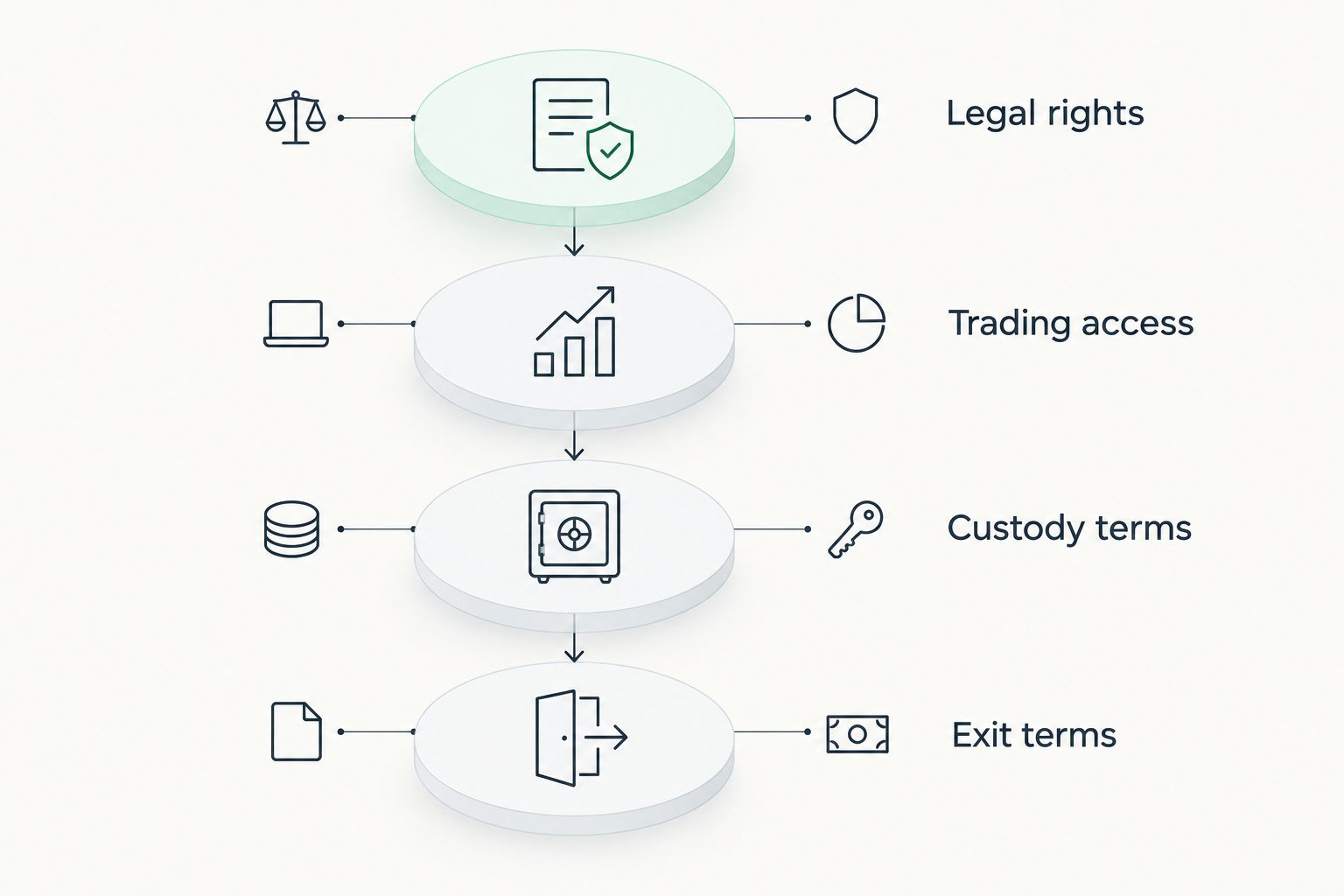
These checks establish what the instrument is. A price chart answers a narrower question: how the displayed market has moved.
Digital Credit wins for access to dividend-paying instruments
Digital Credit is the named dividend-paying instrument offering in this comparison. It matters to an eligible bitcoin holder evaluating an income-oriented investment, not simply looking for another way to display a chart.
The attraction is the instrument's stated dividend-paying purpose. The limitation is that a dividend description does not make the investment equivalent to cash, a deposit, or a guaranteed payment.
Examine the issuer's obligations, payment conditions, seniority, and exit provisions. Determine whether distributions depend on contractual conditions and what rights you have if an expected payment does not occur.
TradingView is useful for market research, but research access does not grant entitlement to an instrument's distributions. Choose the investment offering for access; choose analysis software to support your research. Keep the decision to receive investment income separate from the decision to subscribe to a research tool.
Neither wins execution without an account-level check
Bitcoin and crypto trading belong to the financial-platform side of this comparison. TradingView also supports trading through connected brokers, so describing it as incapable of execution would be inaccurate.
The distinction is where the financial relationship sits. With a connected-broker workflow, the broker's account, supported instruments, and execution terms remain essential. A charting interface does not replace those obligations.
There is no honest universal winner here. Check the instrument you intend to trade, the account through which you will trade it, supported order behavior, and the applicable custody terms.
Both workflows need an execution check. Test your decision process against the actual account setup rather than assuming that a visible market, a working alert, and an executable order are the same thing.
Neither replaces eligibility and legal checks
Roxom excludes U.S. persons. That restriction is decisive: an otherwise suitable feature set does not make an excluded investor eligible.
TradingView access is not a workaround for restrictions imposed by a broker, issuer, or financial platform. A chart or broker connection does not change the eligibility rules attached to an account or instrument.
For your 2026 shortlist, separate software access from permission to use a financial service. Check the current account requirements and applicable instrument restrictions before transferring assets. Do not infer eligibility solely from where you are physically located or which interface you can open.
Pricing: subscriptions and financial terms need different checks
TradingView uses free access and paid subscriptions. The decision is whether the subscription's features match your actual charting, alerting, and research requirements. Keep any connected provider's charges separate from the software subscription.
For the bitcoin-native financial offering, examine the current trading schedule, instrument documentation, and credit-line agreement. Compare the terms relevant to your intended action rather than assuming that one platform-wide figure describes every activity.
Subscription cost and financial exposure are different comparisons. A recurring software subscription is a research expense; borrowing creates repayment obligations, and buying an instrument exposes capital to its terms and market risk.
For 2026 budgeting, record software subscriptions separately from transaction charges, financing obligations, and investment capital. This prevents a low software expense from obscuring a much larger financial commitment.
Final verdict: choose the job, then the platform
Choose Roxom if you are an eligible bitcoin holder seeking financial access
Your goal is bitcoin or crypto trading, BTC-collateralized borrowing, tokenized-stock exposure, or evaluating Digital Credit. You are not a U.S. person, and you will review the terms attached to each activity.
The winner is the bitcoin-native trading platform because your requirement is a financial service or instrument—not merely a chart.
Choose TradingView if you are a chart-led trader or strategy developer
Your goal is technical research, condition-based alerts, custom indicators, or historical strategy testing. You will arrange any necessary financial account separately and check its execution terms.
The winner is TradingView because the analysis environment directly matches that workflow. A financial product does not automatically replace a dedicated research tool.
| Dimension | Winner |
|---|---|
| Bitcoin-native financial access | Roxom |
| Technical chart analysis | TradingView |
| Technical alerts | TradingView |
| Script-based strategy testing | TradingView |
| BTC-collateralized credit access | Roxom |
| Tokenized-stock access | Roxom |
| Digital Credit access | Roxom |
| Execution suitability | Account-level check; no universal winner |
| Eligibility and legal suitability | Mandatory checks for both workflows |
| Pricing | Compare subscriptions separately from financial terms |
FAQ
Is Roxom better than TradingView in 2026?
Roxom is better suited to eligible non-U.S. bitcoin holders seeking its stated financial offerings; TradingView is better suited to technical chart analysis and strategy testing. They address different jobs rather than serving as direct substitutes.
Can I trade directly through TradingView?
TradingView supports trading through connected brokers. Check the broker connection, supported instruments, account eligibility, and execution terms before relying on that workflow.
Does TradingView offer BTC-collateralized credit lines?
TradingView's charting and strategy tools do not provide a BTC-collateralized credit line. Borrowing requires a separate financial agreement with a credit provider.
Can U.S. persons use the bitcoin-native platform in this comparison?
The stated offering excludes U.S. persons. Access to TradingView does not override that restriction or the eligibility rules of any connected financial provider.
Are tokenized stocks the same as owning ordinary shares?
A tokenized-stock label does not establish the same legal rights as ordinary-share ownership. Read the instrument documentation for ownership claims, voting rights, distribution treatment, and redemption conditions.
Does a dividend-paying Digital Credit instrument guarantee income?
The dividend-paying description does not establish a payment guarantee. Review the instrument's payment conditions, issuer obligations, and holder rights before making an investment decision.
How should I compare the cost of these platforms?
Compare TradingView's subscription requirements separately from trading terms, instrument terms, and borrowing obligations. A research subscription and a financial commitment are different expenses and risks.
One last thing
The reference chart is not the investment contract. Even when an instrument tracks a familiar market, its holder rights come from its own documentation—not from the name of the underlying asset or the appearance of its chart.
Save the applicable terms alongside your investment thesis. If you cannot explain what you own, what you owe, and how you exit, stop before funding the position.